1. Home
  2. Resources
  3. Featured Solutions
  4. One-Stop ADC Development Solution
  5. ADC In Vitro Analysis Solution
  6. ADC Biochemical Analysis Service

ADC Biochemical Analysis Solution

Navigating the complexity of Antibody-Drug Conjugates (ADCs) requires a multi-dimensional analytical approach to ensure pre-clinical success. Creative Biolabs provides an integrated ADC biochemical analysis solution designed to decrypt the structural heterogeneity, drug-to-antibody ratio (DAR) distribution, and biophysical stability of your candidates. By leveraging high-resolution mass spectrometry and advanced liquid chromatography, we transform complex molecular data into actionable insights for lead optimization. Our services are strictly focused on the pre-clinical stage, ensuring your discovery programs transition seamlessly from in vitro validation to in vivo efficacy studies with a clearly defined molecular fingerprint.

Request Pre-clinical Analysis

Decoding ADC Complexity through Biochemical Characterization

Unlike standard monoclonal antibodies, ADCs are tripartite systems composed of an antibody, a chemical linker, and a cytotoxic payload. This inherent complexity leads to significant heterogeneity that directly impacts the therapeutic index. Our biochemical analysis suite serves as the cornerstone of pre-clinical development, answering critical questions regarding identity, purity, and stability.

Core Pillars of Our Analytical Framework

We provide a comprehensive "molecular audit" for your ADC candidates, focusing on the three most critical parameters for pre-clinical evaluation:

  • Precision Identity Confirmation: Validating that the antibody, linker, and payload are correctly assembled and confirming the precise conjugation sites.
  • Homogeneity & DAR Mapping: Quantifying the drug-to-antibody ratio (DAR) and its distribution to predict pharmacokinetic (PK) behavior and systemic toxicity.
  • Stability Under Stress: Evaluating the resistance of the linker-payload complex to premature cleavage and assessing the aggregation propensity.

Integrated Analytical Service Units

Our service matrix is organized into four intensive analytical units, each designed to answer fundamental questions about your ADC's structural and functional attributes with minimal throughput barriers.

Advanced Structural Mapping & Identity Validation

The foundation of any ADC program is the absolute confirmation of its chemical identity. This unit focuses on verifying that the linker-payload architecture is correctly grafted onto the antibody scaffold without disrupting the critical primary structure.

Critical Challenges Solved
  • Mass Discrepancy: Verifying if the intact and reduced mass of the conjugate aligns with theoretical calculations.
  • Regional Interference: Identifying conjugation sites (Lys/Cys/Engineered) to ensure payloads are distal from the antigen-binding CDRs.
  • Structural Fidelity: Mapping disulfide pairing and identifying free thiols that could lead to structural instability.
Technical Platforms
We utilize high-resolution Orbitrap MS and Q-TOF MS for sub-ppm accuracy. NanoLC-MS/MS Peptide Mapping provides >95% sequence coverage, while specialized enzymes enable C/N Terminal Confirmation and site-occupancy quantification.

Drug Loading Precision & DAR Homogeneity Profiling

Homogeneity is the primary indicator of ADC manufacturing control and a key predictor of in vivo performance. This unit quantifies the distribution of drug loading across the antibody population.

Critical Challenges Solved
  • PK/PD Variability: Quantifying the "Average DAR" and the full distribution spectrum (DAR 0 to n) to establish SAR.
  • Hydrophobicity Risk: Monitoring high-DAR species that are often more hydrophobic and prone to rapid in vivo clearance.
  • Batch Consistency: Comparing drug-load profiles across different conjugation batches and process conditions.
Technical Platforms
Our suite includes HIC-HPLC for native-like DAR profiling of cysteine conjugates and RP-HPLC for light/heavy chain resolution. We also employ UV/Vis DAR Analysis and LC-MS Deconvolution for a multi-platform consensus on drug loading.

Purity Auditing & Charge Heterogeneity Mapping

Conjugation can introduce subtle impurities and shift the antibody's charge profile. This unit monitors the physical and chemical purity of the final conjugate candidate.

Critical Challenges Solved
  • Aggregation Tendency: Identifying high-molecular-weight species (HMWS) and aggregates using multiple orthogonal methods.
  • Charge Variant Drift: Mapping acidic and basic peaks using icIEF to identify post-translational modifications (PTMs) like deamidation or oxidation.
  • Fragmentation: Detecting clipping or chain dissociation that could occur during the conjugation process.
Technical Platforms
We rely on SEC-MALS for absolute aggregate quantification and icIEF for high-resolution charge profiling. CE-SDS (Reduced/Non-reduced) and DLS provide critical data on molecular size distribution and monomeric purity.

Biophysical Stability & Functional Bio-Integrity

The success of an ADC hinges on its ability to remain intact in systemic circulation and bind its target. This unit evaluates the conjugate's resilience and biological function.

Critical Challenges Solved
  • Payload Leakage: Quantifying free drug release and DAR shifts in in vitro human/mouse serum or plasma environments.
  • Conformational Loss: Assessing changes in secondary and tertiary structure using thermal stress models.
  • Affinity Preservation: Confirming that target binding kinetics (Ka, KD) are preserved post-modification.
Technical Platforms
DSC and Nano-DSF are used for thermal stability profiling. SPR/BLI platforms provide real-time antigen binding kinetics, while Hybrid LBA-LC/MS protocols enable precision stability tracking in complex biological matrices.

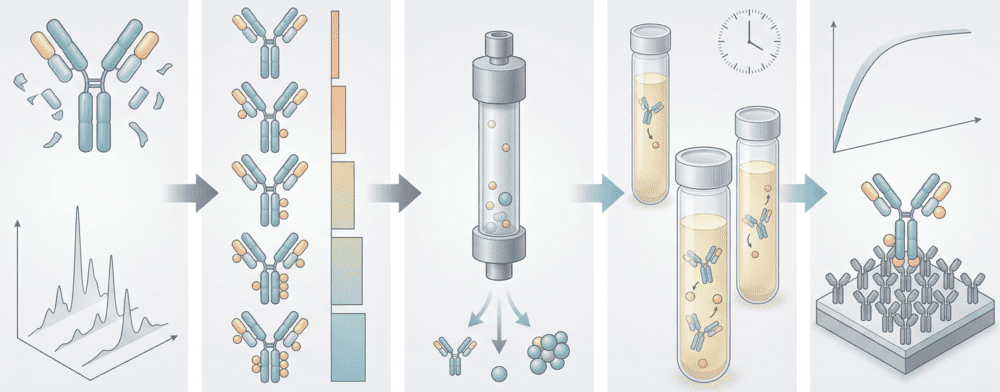
Standardized Workflow for ADC Characterization

Our standardized pre-clinical process ensures data integrity and maximum conjugate homogeneity from structural mapping to validation:

Integrated workflow for ADC biochemical analysis

Step 1: Structural Integrity Audit

Verification of intact mass and reduced light/heavy chains to confirm successful conjugation and identify primary structure PTMs.

Step 2: DAR Spectrum Mapping

High-resolution quantification of drug loading distribution via HIC or LC-MS, establishing the homogeneity baseline for pre-clinical evaluation.

Step 3: Purity & Aggregation Check

Orthogonal assessment of soluble aggregates and fragments using SEC-MALS and CE-SDS to ensure candidate biophysical quality.

Step 4: Matrix Stability Profiling

Evaluating linker stability and payload release kinetics in human or animal serum matrices over 7–14 days in vitro.

Step 5: Functional Binding Validation

Real-time binding kinetics analysis using SPR or BLI to confirm target affinity preservation after payload conjugation.

Research Insights: Validating ADC Discovery via Analytics

According to Kim et al. (2022), precise biochemical characterization is the cornerstone of translating discovery leads into therapeutic candidates. Their study on 4C9-DM1, a c-Kit targeting ADC, illustrates this transition:

Case Study Highlights (c-Kit ADC):

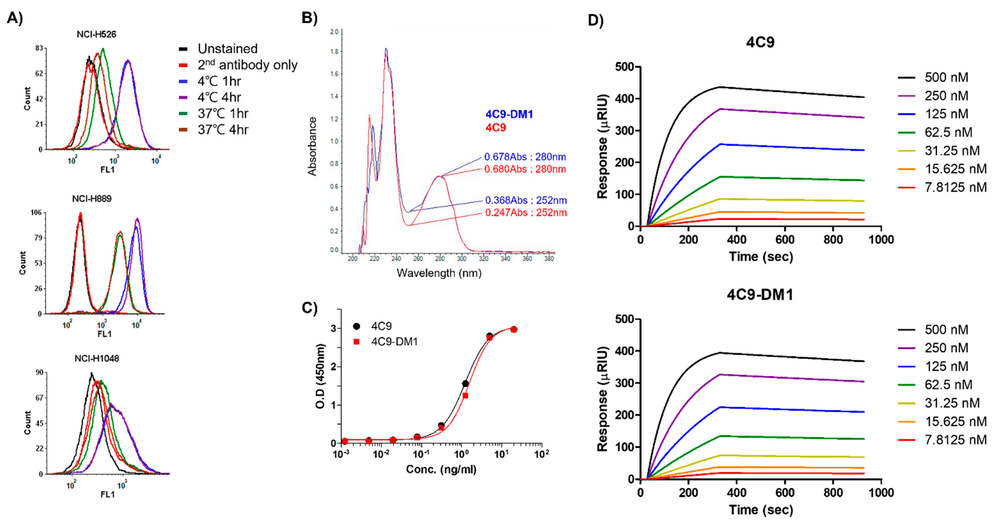
  • Affinity Verification: SPR analysis was used to confirm that the SMCC-DM1 payload conjugation did not interfere with target recognition, maintaining a KD of 5.5 ×10^-9 M.
  • Homogeneity Control: A defined DAR of 2.16 was established, correlating structural homogeneity with potent in vitro cytotoxicity (IC50 in pM range) and dose-dependent in vivo efficacy.
  • Internalization Logic: Kinetic biochemical assays proved internalization efficiencies of up to 91%, verifying the ADC's mechanism of action before animal model testing.

Detailed biochemical insights allow researchers to predict biological outcomes and optimize drug-antibody ratios for maximum therapeutic effect.

Characterization of the 4C9-DM1 ADC.

Fig.1 Characterization of 4C9‑DM1 antibody–drug conjugate.1,2

FAQs: ADC Biochemical Analysis

Q: How do you differentiate between surface-bound drug and covalently linked drug?

A: We utilize orthogonal chromatography (RP-HPLC and HIC) paired with high-resolution MS. Denaturing conditions allow us to identify non-covalently associated payloads, while peptide mapping confirms site-specific covalent attachment.

Q: What is the benefit of SEC-MALS over traditional SEC for ADC analysis?

A: SEC-MALS provides the absolute molecular weight of each peak independent of elution time or standards. This is critical for ADCs because the payload shift impacts the hydrodynamic radius, making traditional SEC standards less accurate.

Q: Can you perform matrix stability assays for delicate linker systems?

A: Yes. We offer specialized stability profiling in serum and whole blood. Using hybrid LBA-LC/MS, we track both the "total antibody" and the "conjugated payload" over time to pinpoint the exact site of linker instability.

Q: How do you support the selection of the optimal DAR for pre-clinical leads?

A: We generate specific DAR-enriched fractions using preparative HIC and evaluate their individual biophysical stability and in vitro potency. This data allows for the rational design of the optimal therapeutic DAR.

Q: Is peptide mapping mandatory for identifying PTMs in ADC discovery?

A: While intact mass provides a high-level view, peptide mapping is essential for pinpointing the exact location of chemical modifications like deamidation or oxidation, which can be critical for predicting long-term stability.

References:
1. Kim, Kwang-Hyeok, et al. "Antibody-Drug Conjugate Targeting c-Kit for the Treatment of Small Cell Lung Cancer." International Journal of Molecular Sciences 23.4 (2022): 2264. https://doi.org/10.3390/ijms23042264
2. Distributed under Open Access License CC BY 4.0, without modification.

For Research Use Only. NOT FOR CLINICAL USE.


Online Inquiry

Name:
Phone:
*E-mail Address:
*Products or Services Interested:
Company/Institution
Project Description:

Welcome! For price inquiries, please feel free to contact us through the form on the left side. We will get back to you as soon as possible.