- Home
- Resources
- Featured Solutions
- One-Stop ADC Development Solution
- ADC In Vitro Analysis Solution
- ADC Biochemical Analysis Service
- ADC Structure Analysis Service
ADC Structure Analysis Solution
In the rapidly evolving landscape of biotherapeutics, Antibody-Drug Conjugates (ADCs) stand as a pinnacle of engineering, yet their inherent complexity demands rigorous structural scrutiny. Creative Biolabs offers a cutting-edge ADC Structure Analysis Solution specifically designed for pre-clinical discovery phases. Our approach transcends simple DAR measurements by deploying a multi-tier, orthogonal analysis framework. By integrating advanced mass spectrometry (LC-MS/MS), high-resolution chromatography (HIC/SEC), and capillary electrophoresis, we provide a definitive molecular fingerprint of your ADC candidates. This ensures that every attribute—from payload distribution and site occupancy to linker stability and impurity profiles—is mapped with atomic precision, facilitating the successful transition of leads through the discovery pipeline.
Overview: Deep Structural Insights into Complex Bioconjugates
The core objective of our structure analysis service is not merely to "test a sample," but to establish a comprehensive structural evidence chain. For pre-clinical ADCs, structural integrity directly influences both in vitro potency and in vivo pharmacokinetic (PK) behavior. Our solution addresses critical developmental questions: Is the conjugation successful? Does the drug load match the design? Where are the attachment sites located? Is the linker shielded or exposed? By answering these questions, we help researchers mitigate risks associated with aggregation, premature payload release, and unexpected structural variants.
A Multi-Dimensional Analytical Matrix
Our analysis is structured across three primary levels of protein architecture to ensure no detail is overlooked:
- • Intact & Subunit Analysis: Confirmation of total molecular mass, macro-heterogeneity, and major drug-load species (D0, D2, D4, etc.).
- • Peptide Level Mapping: Precise identification of conjugation sites (Lysine, Cysteine, or site-specific handles) and quantification of site occupancy ratios.
- • Impurity & Residual Profiling: Sensitive detection of free payloads, linker-payload residuals, and process-related degradants.
Navigating the Analytical Challenges of Pre-clinical ADCs
Developing a stable and potent ADC requires overcoming significant molecular hurdles that traditional antibody analysis cannot solve:
- ▶ High Hydrophobicity & Aggregation: High DAR species often exhibit increased hydrophobicity, leading to aggregation in vitro and rapid clearance in vivo. Our SEC-MALS and DLS platforms detect sub-visible particles and absolute molecular weights.
- ▶ Linker Fragility: Linkers may undergo degradation or premature cleavage under storage or physiological stress. We utilize forced degradation studies combined with HRMS to map these instability hotspots.
- ▶ Complex Charge Heterogeneity: Conjugation significantly alters the charge profile of the antibody. Our icIEF-MS platform allows for the direct identification of specific proteoforms associated with different drug loads.
Tiered ADC Structure Analysis Portfolio
Our tiered analytical portfolio provides a comprehensive evidence chain from initial screening to detailed structural characterization, ensuring every quality attribute is validated for pre-clinical leads.
A. Identity & Basic Integrity Validation Package
Pilot Screening StageThis package is optimized for rapid assessment of pilot-scale ADC batches. It focuses on confirming the successful assembly of the conjugate and determining if the drug-to-antibody ratio distribution meets the preliminary design goals.
- UV/Protein Concentration Profiling: Accurate titer quantification.
- Intact Mass Analysis (HRMS): Confirmation of molecular weight matching.
- HIC-DAR Distribution: Quantifying drug-load species (D0, D2, D4, etc.).
- Initial Purity Screening: SEC-HPLC for aggregate/monomer ratios.
- Integrity Verification: SDS-PAGE or CE-SDS analysis.
- Definitive mass spectra deconvolution report.
- Average DAR and species percentage histogram.
- Homogeneity and stability risk assessment summary.
- High-Res MS Mapping: Precise MW confirmation for intact ADC.
- Subunit Mass Matching: IdeS-mediated subunit mapping (Fc, Fab).
- Rapid Turnaround: Screening-ready data in < 5 business days.
- Platform Stability: Robust HIC methods for standard payloads.
B. Standard Comprehensive Characterization Package
Lead Confirmation StageDesigned for candidate selection and process optimization, this package maps the complete molecular architecture. It utilizes high-resolution peptide mapping to pinpoint exact attachment sites and quantify the distribution of the payload across the antibody scaffold.
- Native SEC-MS / Native LC-MS: Preserving non-covalent structures.
- Peptide Mapping (LC-MS/MS): Full sequence coverage verification.
- Site Identification: Exact localization of linker-payload attachment.
- Quantitative Site Occupancy: Mapping load frequency per residue.
- Charge Variant Mapping: icIEF-UV/MS for acidic/basic species.
- PTM Analysis: Monitoring oxidation, deamidation, and glycans.
- Complete annotated structural map of the bioconjugate.
- Site-specific modification abundance list.
- Comparability dossiers for batch-to-batch consistency studies.
- Atomic-Level Precision: Orbitrap/Q-TOF-level site mapping.
- Deep Sequence Coverage: Achieving >98% mapping resolution.
- PTM Quantitation: Tracking conjugation-induced modifications.
- Charge Profile Deconvolution: Linking pI shifts to drug load.
C. Advanced Stability & Troubleshooting Package
Stress & Risk InvestigationThis package deep-dives into the degradation pathways and impurity profiles of the ADC under various stress conditions. It provides the mechanistic insights needed to troubleshoot issues like aggregation, de-conjugation, or low in vivo stability.
- Forced Degradation Analysis: Thermal, pH, and light stress profiles.
- Linker Cleavage Pathways: Mechanism of drug release identification.
- Free Payload Detection: 2D-LC/MS for trace residual toxins.
- Aggregation Resolution: SEC-MALS for absolute MW calculation.
- Sub-visible Particle Tracking: DLS for nanoparticle stability.
- Detailed degradation pathway and impurity risk summary.
- Toxic residual quantification report (ng/mL sensitivity).
- Formulation compatibility and CQA recommendation guide.
- Trace Impurity Profiling: 2D-LC sensitivity for free toxins.
- Stress-induced Mapping: Pinpointing linker-payload cleavage sites.
- Aggregation Kinetics: Real-time DLS monitoring of HMW species.
- Root Cause Analysis: Actionable data for ADC design refinement.
Integrated Workflow for Structural Mapping
Our standardized SOPs ensure consistency and depth for every ADC structure analysis project:
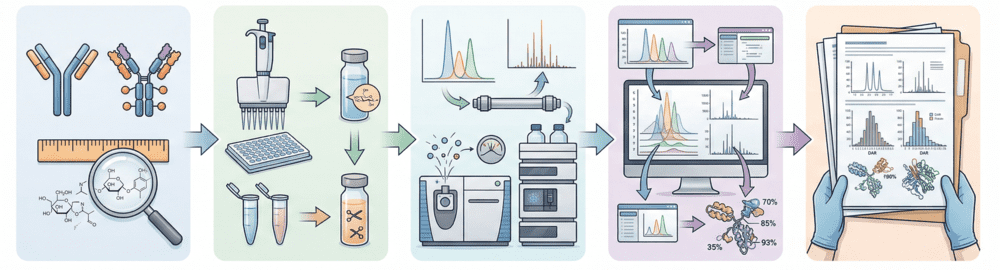
Phase 1: Project Scoping & Strategy Design
We evaluate your ADC type to choose the most sensitive orthogonal methods. We consider the theoretical DAR and payload hydrophobicity to optimize separation parameters.
Phase 2: Multi-level Sample Pre-treatment
Samples undergo automated buffer exchange, deglycosylation, and enzymatic digestion for subunit and peptide-level mapping.
Phase 3: High-Resolution Data Acquisition
Executing Native LC-MS, HIC-DAR profiling, and SEC-MALS. For site-specific ADCs, we focus on Orbitrap-level peptide mapping.
Phase 4: Bioinformatic Structural Annotation
Using advanced software suites to perform deconvolution, PTM quantification, and site occupancy calculations.
Phase 5: Definitive Analysis Reporting
Delivery of a comprehensive dossier including raw chromatograms, annotated spectra, and a summary of structural risk factors for in vivo studies.
Unique Analytical Platforms for ADC Analysis
Our facility is equipped with state-of-the-art instrumentation specifically calibrated for the unique challenges of bioconjugates:
1. Orthogonal DAR Profiling Platform (HIC + Native LC-MS)
Relying on a single method for DAR can be misleading. Our platform provides a dual-verification system to ensure the most accurate drug-load statistics.
- • HIC-HPLC: Ideal for cysteine-linked ADCs to resolve species by hydrophobicity.
- • Native LC-MS/SEC-MS: Directly measures the mass of intact species in a non-denaturing environment.
2. Site-Occupancy & Peptide Mapping Unit
Essential for site-specific ADCs to prove that the payload is attached where it was designed. This platform maps the coordinates of conjugation.
- • Sequence Coverage: High-resolution MS/MS reaching >98% antibody coverage.
- • Occupancy Ratios: Determining the percentage of modification at each specific site.
3. 2D-LC/MS Impurity Identification System
Detecting trace amounts of toxic free payloads and unreacted linker-payloads is critical for safety assessment in in vivo models.
- • High Sensitivity: Detection limits tailored for highly potent payloads.
- • De-conjugation Analysis: Quantifying the stability of the drug-antibody bond over time.
Research Insights: Linker Shielding and ADC Stability
Recent structural characterization studies, such as those conducted by Jaime-Garza et al. (2025), have shed light on the critical role of "linker shielding" in site-specific ADCs. Using X-ray crystallography and molecular dynamics (MD), researchers have visualized how antibody Fab and Fc pockets can interact with and protect the linker-payload moiety.
Key Findings in Structural Shielding Research:
- • Antibody-Linker Interactions: High-resolution structures reveal that certain sites allow the linker to bind within hydrophobic regions, burying significant surface area (up to 326 Ų).
- • Reduced Hydrophobicity: Stronger antibody-linker interactions correlate with lower overall ADC hydrophobicity in HIC profiles.
- • Enhanced Stability: Pockets in the Fc domain can provide solvent protection, potentially reducing premature cleavage.
These structural insights underscore the potential of structure-based design to tailor bespoke linker-payloads for specific antibody sites, optimizing next-generation ADCs.
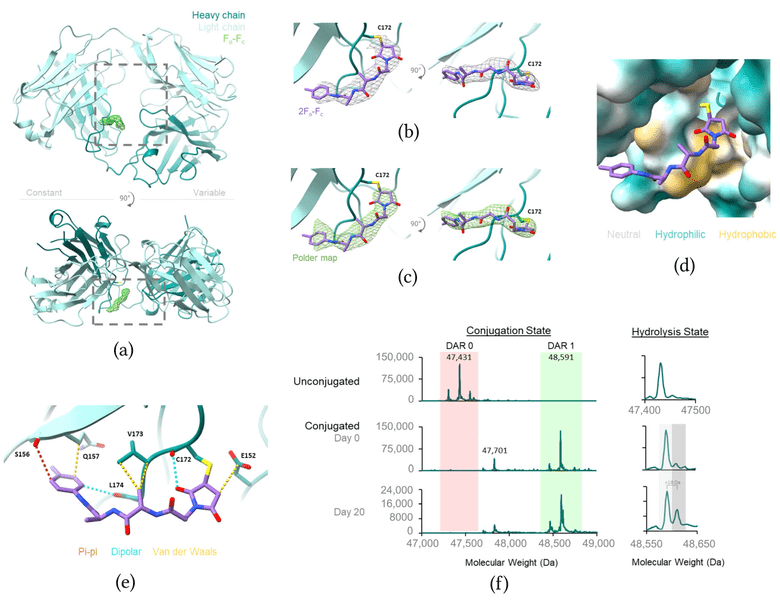
Fig.1 Structural analysis of ADC linker interactions at the A172C Fab conjugation site.1,2
FAQs about ADC Structure Analysis
Q: Why is orthogonal DAR analysis necessary for pre-clinical ADCs?
A: Average DAR values can be misleading. Orthogonal analysis ensures that you understand the true distribution of drug loads. This is critical for predicting in vivo metabolism and therapeutic index, as high-DAR species often have different safety profiles.
Q: Can you identify conjugation sites for random Lysine-linked ADCs?
A: Yes. For stochastic Lysine conjugation, we use high-resolution peptide mapping (LC-MS/MS) to identify the hotspots of modification. We provide a map of modified residues and their relative abundance, helping you understand process consistency.
Q: How do structural analysis services support lead optimization?
A: By identifying risky structural features—such as exposed linkers prone to cleavage or sites that trigger aggregation—we provide the data needed to redesign the molecule and adjust the linker hydrophilicity.
Q: What is the sensitivity for free payload detection?
A: We utilize sensitive 2D-LC/MS methods designed to detect free payloads at the ng/mL level. This is vital for in vitro assays to ensure that cell killing is due to the conjugate and not residual free toxins.
Q: Do you offer comparability analysis between discovery batches?
A: Absolutely. As you scale up from pilot to animal-study batches, structural consistency is paramount. We provide side-by-side comparability analysis (DAR distribution, peptide maps, SEC profiles) to validate your pre-clinical data.
Related Products
Related Resources
References:
1. Jaime-Garza, Maru, et al. "Structural Characterization of Linker Shielding in ADC Site-Specific Conjugates." Pharmaceutics 17.12 (2025): 1568.https://doi.org/10.3390/pharmaceutics17121568
2. Distributed under Open Access License CC BY 4.0, without modification.
For Research Use Only. NOT FOR CLINICAL USE.
Online Inquiry
Welcome! For price inquiries, please feel free to contact us through the form on the left side. We will get back to you as soon as possible.
