- Home
- Resources
- Featured Solutions
- One-Stop ADC Development Solution
- ADC In Vitro Analysis Solution
- ADC In Vivo Analysis Solution
- Preclinical ADC Safety Assessment & Toxicology Services
- Mesothelin ADC Safety Evaluation: TCR & Preclinical Toxicology
Mesothelin ADC Safety Evaluation: TCR & Preclinical Toxicology
Mesothelin (MSLN) is a clinically validated tumor-associated antigen overexpressed in mesothelioma, ovarian, pancreatic, and lung cancers, making it a compelling target for antibody-drug conjugate (ADC) development. Creative Biolabs delivers integrated preclinical safety evaluation of mesothelin-targeting ADCs, encompassing dosage tolerance profiling, in vivo stability and clearance analysis, and comprehensive tissue cross-reactivity studies. Our platform combines mesothelin-expressing xenograft tumor models with advanced bioanalytical workflows to provide a rigorous, data-driven safety profile that supports candidate selection and risk mitigation during the pre-clinical discovery phase.
Inquire for Pre-clinical SupportOverview: Mesothelin as an ADC Target & Safety Assessment Framework
Mesothelin is a 40-kDa glycosylphosphatidylinositol (GPI)-anchored glycoprotein present at low levels on normal mesothelial cells lining the pleura, pericardium, and peritoneum. In malignancy, MSLN is markedly overexpressed across a spectrum of aggressive solid tumors, while its normal-tissue distribution remains restricted, creating a favorable therapeutic window for targeted delivery. However, residual expression on healthy mesothelial surfaces introduces the risk of on-target, off-tumor toxicity that must be rigorously characterized before advancing any MSLN-directed ADC candidate.
Key Elements of Preclinical ADC Safety Evaluation
A comprehensive safety assessment of mesothelin-targeted ADCs demands a multi-dimensional analytical strategy that integrates pharmacology and toxicology endpoints. Our evaluation framework includes:
- • Dosage Tolerance Profiling: Single-dose and repeat-dose studies in rodent and non-rodent species to establish the maximum tolerated dose and characterize dose-limiting toxicities.
- • In Vivo Stability & Biotransformation: Serial pharmacokinetic sampling with dual-analyte quantitation (conjugated antibody, total antibody, and free payload) via LC-MS/MS and immunoassay to track ADC integrity over time.
- • Tissue Cross-Reactivity (TCR): Immunohistochemical screening across a standardized panel of human and animal tissues to map on-target and off-target binding patterns that could translate to organ-level toxicity.
Comparative Analysis: MSLN-Targeted vs. Broad-Spectrum ADC Safety Profiling
| Feature | General ADC Safety Panel | Extended Safety Panel | MSLN-Targeted ADC Program (Our Service) |
|---|---|---|---|
| Tumor Model Scope | Single xenograft line | 2-3 xenograft models | Multi-model panel (ovarian, pancreatic, mesothelioma, lung) |
| Animal Species | Mouse only | Mouse + rat | Mouse + rat + cross-reactive species option |
| Analytical Coverage | Total antibody only | Conjugated + total antibody | Conjugated Ab, total Ab, free payload, DAR tracking |
| TCR Tissue Panel | Limited (5-10 tissues) | Standard (25-30 tissues) | Comprehensive (>35 tissues, human + animal matched) |
| Metabolite Identification | Not included | Optional | Included: LC-MS metabolite profiling in plasma & tissue homogenates |
Understanding the Safety Challenges of MSLN-Targeted ADCs
Despite the favorable expression profile of mesothelin, ADCs directed against this target present unique safety hurdles that extend beyond the generic challenges of ADC development. Addressing these challenges early in the preclinical phase is essential for candidate de-risking:
- ▶ On-Target, Off-Tumor Binding: Basal MSLN expression on pleural, pericardial, and peritoneal mesothelium means that even highly specific ADCs may engage target antigen on healthy serosal surfaces, potentially causing serositis or effusion in in vivo models.
- ▶ Shed Antigen Interference: MSLN is actively shed from tumor cell surfaces via proteolytic cleavage, generating soluble MSLN fragments that can act as an antibody sink, altering ADC biodistribution and potentially masking toxicity signals in early preclinical readouts.
- ▶ Payload-Driven Hematotoxicity: Many ADC payloads carry an inherent myelosuppressive liability. Without robust exposure-response modeling in relevant species, the contribution of payload class to the overall safety margin can be underestimated during discovery.
Our Integrated Safety Testing Solutions for MSLN ADCs
Creative Biolabs offers a tiered preclinical safety assessment framework tailored to the unique biological context of mesothelin-targeted ADCs. Each module is designed to produce actionable safety data for informed candidate progression:
| Assessment Module | Key Safety Questions Answered | Analytical Methods & Readouts |
|---|---|---|
|
Core Module Dosage Tolerance & Dose-Ranging Single and repeat-dose escalation studies in immunocompromised rodent models bearing MSLN-positive xenografts, with unconjugated antibody and free payload control arms. |
• What is the maximum tolerated dose (MTD) in tumor-bearing hosts? • Does repeat dosing reveal cumulative or delayed toxicities? • How does the safety margin compare between conjugated and unconjugated components? |
• Clinical Observations: Daily body weight, food intake, behavioral scoring. • Hematology & Clinical Chemistry: Full blood count, liver enzymes, renal function markers. • Postmortem Analysis: Organ weight, gross necropsy, histopathology of target organs. |
|
Advanced Module In Vivo Stability & Biotransformation Serial pharmacokinetic sampling with dual-analyte quantification to deconvolve the circulating ADC species and detect premature payload release. |
• Is the linker stable under physiological conditions in vivo? • What fraction of the payload is released systemically vs. retained on the antibody? • Do metabolite profiles differ between tumor-bearing and non-tumor-bearing animals? |
• ELISA/LBA: Quantitation of total antibody and conjugated antibody. • LC-MS/MS Payload Analysis: Free drug and linker-payload catabolite profiling in plasma and tissue homogenates. • DAR Monitoring: Intact mass spectrometry to track drug-to-antibody ratio over time. |
|
Safety Module Tissue Cross-Reactivity (TCR) Screening Immunohistochemical evaluation of ADC binding across a comprehensive panel of frozen or formalin-fixed human and animal tissues to identify potential off-target binding sites. |
• Does the ADC cross-react with non-mesothelin antigens in healthy tissues? • Are binding patterns concordant between human and toxicology species tissues? • Is any unexpected reactivity observed in vital organs (liver, kidney, heart, CNS)? |
• IHC Staining Panel: >35 human tissues + matched rodent/non-rodent tissues. • Scoring & Grading: Semi-quantitative intensity and distribution scoring by board-certified pathologists. • Competitive Blocking Controls: Soluble MSLN pre-incubation to confirm antigen specificity. |
|
Specialized Module MSLN-Specific Biodistribution & Excretion Balance Radiolabeled or fluorescently tagged ADC administration to map organ-level accumulation and determine routes and rates of excretion in xenograft-bearing animals. |
• Which organs accumulate the ADC beyond the tumor compartment? • Is hepatic or renal clearance the primary elimination route? • Does tumor burden alter systemic exposure and organ distribution patterns? |
• Quantitative Whole-Body Autoradiography (QWBA): Tissue distribution heatmaps. • Mass Balance Studies: Cumulative recovery of radiolabel in urine, feces, and cage wash. • Selected Tissue Digestion & LC-MS: Payload quantitation in key organs at terminal time points. |
Personalized Workflow for Mesothelin ADC Safety Programs
Our standardized preclinical safety assessment process is designed to deliver reproducible, interpretable data from study design through final reporting:
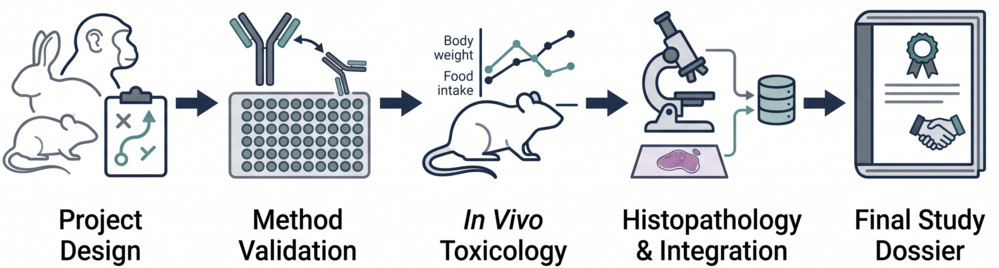
Phase 1: Study Design & Model Selection
We collaborate with your team to define the optimal study design, selecting from our panel of MSLN-expressing tumor models (ovarian, pancreatic, mesothelioma, lung) and matching the appropriate animal species based on target cross-reactivity data for in vivo safety evaluation.
Phase 2: MSLN-Positive Tumor Model Establishment
Tumor cells are implanted via subcutaneous or orthotopic routes in immunocompromised mice. MSLN expression is confirmed by quantitative PCR, western blot, and immunohistochemistry prior to treatment initiation, ensuring model fidelity for safety readouts.
Phase 3: ADC Dosing & In-Life Monitoring
The mesothelin-targeted ADC is administered at pre-defined dose levels (single or repeat dosing). Animals are monitored daily for body weight, clinical signs, food consumption, and behavioral changes. Serial blood samples are collected for pharmacokinetic and hematological profiling.
Phase 4: Terminal Bioanalysis & Histopathology
At study termination, full necropsy is performed with organ weight recording. Tissues are processed for histopathological evaluation. Plasma and tissue homogenate samples are analyzed by LC-MS/MS for payload quantitation, while intact ADC levels are measured by immunoassay and mass spectrometry for DAR tracking.
Phase 5: Integrated Safety Report & Data Delivery
All data streams are compiled into a comprehensive safety assessment report that includes dose-toxicity curves, pharmacokinetic-exposure relationships, TCR tissue scoring matrices, and a structured risk-benefit summary. Raw data files and analytical certificates are provided alongside the report for your internal review.
Dedicated Platforms for ADC Preclinical Safety Assessment
Our integrated analytical and in vivo platforms are configured to deliver high-quality safety data suitable for candidate ranking and lead optimization:
1. Mesothelin-Expressing Tumor Model Repository
A curated collection of authenticated human tumor cell lines with verified MSLN expression, including pancreatic (PaCa-2), colorectal (HT-29), ovarian (OVCAR-3), and lung squamous (NCI-H226) carcinoma models. Each line is quality-controlled for MSLN transcript and protein levels before study initiation, and patient-derived xenograft options are available for translational studies.
- • Orthotopic & Metastatic Models: Surgically implanted tumors that recapitulate the native tissue microenvironment for in vivo toxicity evaluation.
- • Subcutaneous Xenograft Models: Standardized flank-implanted tumors enabling direct caliper measurement and group-level toxicity comparisons.
- • Bioluminescent Imaging: Luciferase-expressing tumor lines for non-invasive, longitudinal monitoring of tumor burden alongside safety endpoints.
2. Bioanalytical & Pharmacokinetic Suite
A fully integrated laboratory equipped for multiplexed ADC quantification. Our platform combines ligand-binding assays for total and conjugated antibody measurement with a validated LC-MS/MS workflow capable of simultaneously detecting and quantifying multiple ADC payload classes in a single chromatographic run from minimal sample volumes.
- • Dual-Analyte PK Profiling: Parallel measurement of total antibody, conjugated antibody, and free payload concentrations over time.
- • DAR Integrity Tracking: Intact mass spectrometry to confirm that the drug-to-antibody ratio remains stable throughout the in vivo exposure period.
- • Metabolite Identification: High-resolution mass spectrometry for structural elucidation of circulating ADC catabolites.
3. Tissue Cross-Reactivity & Histopathology Core
A dedicated immunohistochemistry facility supporting tissue cross-reactivity studies on standardized human and animal tissue microarrays. Our pathologists apply validated staining protocols with rigorous positive and negative controls, including soluble antigen competition, to ensure binding specificity is accurately attributed.
- • Comprehensive Tissue Panels: Frozen and FFPE tissue arrays covering >35 human organs, plus matched rodent and non-rodent species panels.
- • Semi-Quantitative Scoring: Intensity (0-4+) and distribution grading by independent pathologist review for in vitro cross-reactivity assessment.
- • Species Concordance Analysis: Cross-species binding comparison to identify the most relevant toxicology species for follow-up studies.
4. Clinical Pathology & Hematology Laboratory
An on-site laboratory providing complete blood count with differential, serum chemistry panels (liver function, renal function, electrolytes), and coagulation profiles. Longitudinal sampling enables time-course toxicity characterization and identification of dose-limiting hematological or organ-level effects during preclinical safety studies.
- • Hematology Profiles: RBC, WBC, platelet counts, and differential leukocyte analysis at multiple time points.
- • Serum Chemistry: ALT, AST, ALP, bilirubin, BUN, creatinine, and electrolyte panels for organ function monitoring.
- • Coagulation Panel: PT, aPTT, and fibrinogen assessment when payload class warrants hemostatic evaluation.
Why Choose Our MSLN ADC Safety Assessment Services?
Target-Specific Expertise with Mesothelin Biology
Our team has deep experience with MSLN as an ADC target, including understanding its normal-tissue distribution, shedding dynamics, and tumor-specific overexpression patterns. This domain knowledge ensures that safety study design accounts for MSLN-specific liabilities from the outset rather than applying a generic ADC safety template.
Multi-Analyte Pharmacokinetic Resolution
Instead of reporting a single total-antibody concentration, we deconvolve the circulating ADC into its constituent species, providing a quantitative picture of linker stability, payload release kinetics, and antibody clearance that directly informs the interpretation of toxicity data in in vivo models.
Comprehensive Tissue Safety Profiling
Our TCR screening goes beyond regulatory checklists by integrating histopathological evaluation of dosed animals with the immunohistochemical binding survey, creating a direct line of evidence between binding site prediction and observed organ-level toxicity for your preclinical candidate.
Flexible, Modular Study Design
We adapt our safety modules to the development stage of your program. Whether you need a focused MTD study for early lead ranking or a comprehensive multi-endpoint toxicology assessment, our workflow scales accordingly while maintaining data quality and reproducibility across all phases of preclinical evaluation.
Research Insights: Advances in Mesothelin ADC Safety & Bioanalysis
According to Silvestri et al. , a deeper understanding of mesothelin biology is essential for improving the therapeutic index of MSLN-targeted agents. Their review highlights that MSLN shedding and its immunosuppressive functions within the tumor microenvironment present unique challenges for ADC safety evaluation that require tailored preclinical models.
Key Findings from Recent ADC Safety Research:
- • ADC Toxicity Mechanisms: Nguyen et al. identified that off-target payload delivery — via Fc receptor-mediated uptake, premature linker cleavage, and passive diffusion of membrane-permeable payloads — accounts for the majority of ADC-related toxicities observed in preclinical in vivo models, underscoring the need for multi-analyte PK profiling.
- • Payload Bioanalysis: Mak et al. demonstrated a validated LC-MS/MS workflow capable of simultaneously quantifying six distinct ADC payloads from 5 µL of plasma, enabling high-resolution pharmacokinetic-toxicodynamic correlation in small-animal safety studies.
- • Next-Generation ADC Design: Long et al. reviewed emerging strategies to improve ADC tolerability, including site-specific conjugation, stable linker chemistries, and hydrophilic payload designs that reduce nonspecific cellular uptake — all of which directly inform the design of safer MSLN-targeted conjugates.
These findings collectively reinforce that a rigorous, multi-faceted preclinical safety assessment is indispensable for advancing mesothelin-targeted ADCs toward candidate nomination.
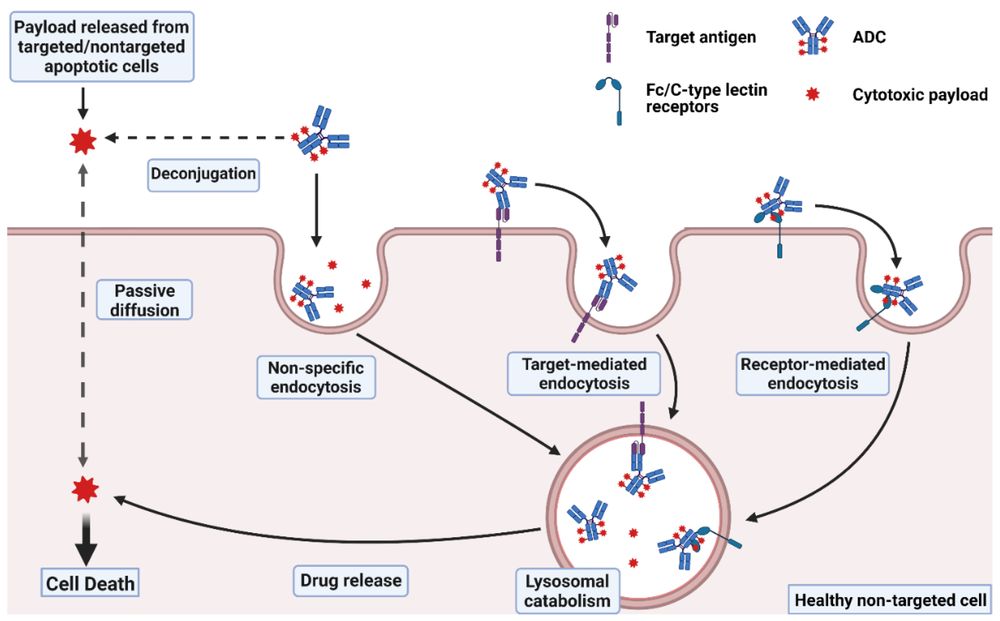
Fig.1 Mechanisms underlying ADC toxicity.2,5
FAQs about Mesothelin ADC Safety Assessment
Q: What animal species do you use for mesothelin ADC safety studies?
A: Our standard safety assessment uses immunocompromised mice bearing MSLN-positive xenografts for dosage tolerance and pharmacokinetic analysis. For tissue cross-reactivity studies, we screen across both human and rodent tissue panels, and can include a non-rodent species (e.g., non-human primate tissue) when target homology supports cross-reactive binding, ensuring the most relevant toxicology readout for preclinical evaluation.
Q: How do you distinguish on-target toxicity from off-target effects in safety studies?
A: We include unconjugated antibody and free payload control arms in every study. By comparing toxicity profiles across these groups, we can attribute observed effects to target engagement (via the antibody), payload pharmacology (via the free drug), or the intact ADC. Tissue cross-reactivity data from IHC staining on normal human and animal tissues provides an additional orthogonal line of evidence for predicting on-target, off-tumor binding sites.
Q: What tumor models are available for mesothelin ADC safety evaluation?
A: We maintain a panel of validated MSLN-expressing cell lines including pancreatic (PaCa-2), colorectal (HT-29), ovarian (OVCAR-3), and lung squamous (NCI-H226) carcinoma models. Both subcutaneous and orthotopic implantation options are available. For programs requiring greater translational relevance, patient-derived xenograft (PDX) models with confirmed MSLN expression can be incorporated into the study design during preclinical evaluation.
Q: What analytical methods do you use to measure ADC stability in vivo?
A: We employ a dual-platform approach: ligand-binding assays (ELISA) quantify total antibody and conjugated antibody concentrations, while a validated LC-MS/MS method simultaneously measures free payload and linker-payload catabolites in plasma and tissue homogenates. Intact mass spectrometry is also used to track drug-to-antibody ratio (DAR) changes over the in vivo exposure period, providing a complete picture of ADC biotransformation during preclinical safety studies.
Q: Can your safety assessment support regulatory submissions for mesothelin ADC programs?
A: Our safety studies are conducted following IACUC-approved protocols and generate data in formats suitable for inclusion in regulatory documentation packages. We provide comprehensive study reports with raw data, analytical certificates, and detailed methodology sections. While we do not submit regulatory filings ourselves, the data we produce is structured to support the pharmacology and toxicology sections of preclinical development dossiers prepared by your regulatory affairs team.
Related Products
Related Resources

References:
1. Silvestri, Roberto, Emanuela Colucci, and Margherita Piccardi, et al. "Decoding the role of mesothelin in tumor dynamics and targeted treatment innovations." Mol. Biomed. 6 (2025): 131. https://doi.org/10.1186/s43556-025-00379-z
2. Nguyen, Toan D., Brandon M. Bordeau, and Joseph P. Balthasar. "Mechanisms of ADC Toxicity and Strategies to Increase ADC Tolerability." Cancers 15.3 (2023): 713. https://doi.org/10.3390/cancers15030713
3. Mak, Shi Ya, Shuwen Chen, and Wey Jia Fong, et al. "A simple and highly sensitive LC-MS workflow for characterization and quantification of ADC cleavable payloads." Sci. Rep. 14 (2024): 11018. https://doi.org/10.1038/s41598-024-61522-4
4. Long, Rou, Hanrong Zuo, and Guiyang Tang, et al. "Antibody-drug conjugates in cancer therapy: applications and future advances." Front. Immunol. 16 (2025): 1516419. https://doi.org/10.3389/fimmu.2025.1516419
5. Distributed under Open Access License CC BY 4.0, without modification.
For Research Use Only. NOT FOR CLINICAL USE.
Online Inquiry
Welcome! For price inquiries, please feel free to contact us through the form on the left side. We will get back to you as soon as possible.
