

Anti-Viral Glycan Shield Antibody Development Service
Anti-Viral Glycan Shield Antibody Development Service
Viral glycan shields are more than surface decoration. They can mask conserved protein epitopes, influence receptor engagement, and create glycan-dependent antibody targets. Creative Biolabs builds research-use antibody programs that treat viral glycosylation as a central design variable rather than a background complication.
Consult Our Experts
Recommended Platform
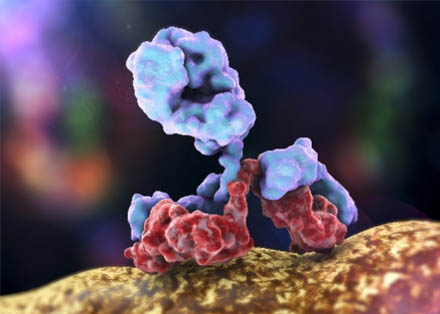
Viral Receptor Specificity Microarray
Profiling glycan-recognition patterns to support viral entry, antibody-binding, and receptor-mimicry studies.
Learn MoreTurning Viral Glycan Shields into Actionable Antibody Targets
Many enveloped viruses display surface glycoproteins modified by host-derived glycans. These glycans can mask protein epitopes from immune surveillance, support folding and stability, influence receptor engagement or tissue tropism, and shape antibody responses. HIV-1 Env, influenza hemagglutinin, coronavirus spike proteins, filovirus glycoproteins, flavivirus envelope proteins, hepatitis C virus E1/E2, herpesvirus glycoproteins, and RSV fusion protein all present different glycosylation-related challenges.1,2
For antibody development, the central question is not simply whether an antibody binds the viral antigen. Researchers often need to know whether a candidate recognizes a primarily protein-based epitope, a glycan-dominant epitope, a glycopeptide epitope, or a conformational glycoepitope created by clustered glycans on a folded antigen. Creative Biolabs integrates antigen design, glycoform-aware screening, microarray profiling, and application validation to help clients separate these possibilities early in the project.
Our anti-viral glycan shield antibody development service is designed for research applications, including reagent discovery, vaccine immunogen evaluation, neutralization-related studies, epitope mapping, glycoprotein quality assessment, and comparative studies across viral strains, variants, or expression systems.
Glycan Shield Data Snapshot
22N-linked glycan sequons per SARS-CoV-2 spike protomer.
66Potential N-glycan sites across a trimeric SARS-CoV-2 spike.
32%Oligomannose-type glycans reported in the SARS-CoV-2 spike glycan pool.
Data summarized from Watanabe et al., site-specific mass spectrometric analysis of a recombinant, native-like SARS-CoV-2 spike immunogen. Percentages are rounded as reported in the source.1
Why Viral Glycan Shield Antibodies Are Difficult to Develop
Self-like Shielding
Viral glycans are produced by host biosynthetic machinery. They may resemble host glycans, while dense or unusual glycan clustering can also create glycoepitopes that require carefully designed screening.
Glycoform Heterogeneity
The same viral protein sequence can present different oligomannose, hybrid, complex, fucosylated, or sialylated glycan profiles depending on expression host, construct design, protein conformation, and local glycan density.
Conformational Context
Important epitopes may exist only on trimeric, prefusion, cell-displayed, or particle-displayed antigen formats. A linear peptide screen may miss biologically relevant glycan-dependent binders.
Schedule a Technical Feasibility Discussion →
Dedicated Tracks
Explore Anti-Viral Glycan Shield Antibody Development Tracks
Each viral family presents a different glycoprotein architecture and glycosylation pattern. Creative Biolabs organizes the following dedicated service tracks under one parent development framework, allowing researchers to select a focused program while keeping antigen design, counter-screening, and validation logic consistent.
8 specialized services one coordinated program
Anti-HIV Glycan Shield Antibody Development View service Anti-Influenza Virus Glycan Shield Antibody Development View service Anti-Coronavirus Glycan Shield Antibody Development View service Anti-HCV Glycan Shield Antibody Development View service Anti-Ebola/Marburg Virus Glycan Shield Antibody Development View service Anti-Flavivirus Glycan Shield Antibody Development View service Anti-Herpesvirus Glycan Antibody Development View service Anti-RSV Glycan Antibody Development View service
Anti-HIV Glycan Shield Antibody DevelopmentAnti-Influenza Virus Glycan Shield Antibody DevelopmentAnti-Coronavirus Glycan Shield Antibody DevelopmentAnti-HCV Glycan Shield Antibody DevelopmentAnti-Ebola/Marburg Virus Glycan Shield Antibody DevelopmentAnti-Flavivirus Glycan Shield Antibody DevelopmentAnti-Herpesvirus Glycan Antibody DevelopmentAnti-RSV Glycan Antibody Development
A Glycan-Aware Discovery Workflow
1
Target and Glycosite Review
We review the sequence, known structures, glycosylation sequons, available glycan-occupancy or glycoproteomics reports, receptor-binding regions, and feasible antigen formats to define a scientifically defensible antibody strategy.
2
Antigen and Counter-Antigen Design
Depending on the goal, immunogens or screening antigens may include recombinant glycoproteins, stabilized trimers, glycopeptides, glycan conjugates, VLP-like or pseudoparticle-like formats, cell-displayed antigens, or glycosylation-site mutants.
3
Discovery Route Selection
Hybridoma, single B-cell screening, phage display, immune libraries, naive or synthetic libraries, and single-domain antibody formats can be selected according to epitope class, available immunogen, species requirements, and desired downstream format.
4
Glycan-Dependent Screening
Primary hits can be screened against matched glycoforms and counter-screens such as carrier-only antigen, deglycosylated or glycosite-mutant antigen, unrelated glycoproteins, host-cell background, and glycan panels.
5
Functional and Analytical Validation
Selected candidates can be tested for affinity, glycoform dependence, epitope binning, receptor-blocking or competition, pseudovirus-related assay compatibility, flow cytometry, immunostaining, or antigen quality-assessment use.
6
Engineering and Delivery
Creative Biolabs can provide purified antibody, recombinant antibody sequence, isotype switching, labeling, format conversion, and humanization- or developability-oriented engineering for research use when appropriate.
Discuss a Glycan-Aware Antibody Strategy → Share your viral antigen format, glycosylation site information, or preferred downstream assay.
What Clients Can Receive from an Anti-Viral Glycan Shield Program
Because viral glycan shield projects often support vaccine research, analytical reagent development, or early-stage antibody discovery research, Creative Biolabs designs each deliverable package around the evidence needed for the next decision. A basic project may deliver purified monoclonal antibodies with ELISA data against the immunogen and negative controls. A more advanced program can include clone ranking, glycoform-dependent binding curves, antigen-mutant profiles, glycan microarray data, epitope binning, receptor-competition data, and sequence information for recombinant production.
For programs focused on viral entry or neutralization-related research, we can help clients decide whether to prioritize native-like trimer binding, cell-surface binding, receptor-site competition, or pseudovirus-related assay compatibility. For programs focused on antigen quality assessment, we may emphasize reproducible recognition of a defined glycoform-associated epitope across lots, limited binding to irrelevant host-cell proteins, and compatibility with sandwich ELISA or flow cytometry. These distinctions are important because the most useful antibody in one assay may not be the most useful reagent in another.
| Deliverable Type | Typical Information Included |
|---|---|
| Candidate antibody panel | Purified antibodies, clone IDs, isotype, concentration, and primary binding data. |
| Specificity package | Binding against glycoprotein, deglycosylated antigen, glycosite mutants when available, and unrelated glycoprotein controls. |
| Array profile | Glycan or glycoprotein microarray report to assess glycan preference and cross-reactivity. |
| Functional-priority report | Ranking for receptor-blocking, competition, pseudovirus-related assay compatibility, or analytical reagent use. |
Final deliverables are customized according to biosafety requirements, target virus, available controls, and whether the client needs research reagents, early discovery leads, or assay development support.
Request a Deliverable Plan →
Application-Focused Validation
Research Applications
A successful viral glycan shield antibody is useful only when it answers the intended biological question. We align screening, counter-screening, and validation with the client's final assay so each candidate is evaluated in the context where it will actually be used.
01
Immunogen QC
Assess whether recombinant viral antigens preserve selected glycoform-associated or glycan-dependent epitopes; comprehensive glycan distribution analysis may require orthogonal glycoproteomics or mass spectrometry.
02
Epitope Mapping
Separate primarily protein-based, glycan-dominant, glycopeptide, and conformational glycoepitope recognition patterns.
03
Variant Comparison
Compare antibody binding across strains, glycosylation-site mutants, antigenic variants, or expression hosts.
04
Functional Research
Prioritize candidates for receptor-blocking, competition, neutralization-related, or Fc-effector research experiments.
Published Data: Glycan-Resolved Evidence for Viral Shield Analysis
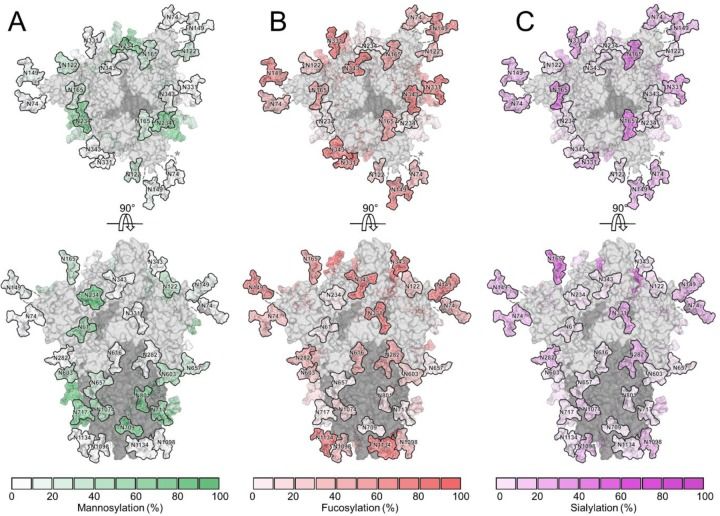
Fig. 1 Glycosylated model of SARS-CoV-2 spike highlighting relative mannosylation, fucosylation, and sialylation across experimentally observed glycans.1
Watanabe and colleagues mapped the site-specific glycosylation of a recombinant SARS-CoV-2 spike immunogen and reported 22 N-linked glycan sequons per protomer. Across a trimer, this corresponds to 66 potential N-glycosylation sites. Their data show that glycan composition varies by site and is influenced by local protein architecture and expression context, which is directly relevant when selecting immunogens, glycosite mutants, and counter-screening antigens for viral glycan shield antibody development.
22 sequons/protomer66 trimer sitessite-specific MSFor a Creative Biolabs project, this kind of evidence supports a glycoform-aware screening strategy. We can compare candidates against native-like trimers, glycosylation-site mutants, deglycosylated antigens, recombinant antigens from different host cells, and glycan microarray panels when suitable materials are available. The goal is to clarify whether a clone recognizes a primarily protein-based epitope, a glycan-dominant epitope, a glycopeptide epitope, or a conformational glycan cluster.
Frequently Asked Questions
Can Creative Biolabs develop antibodies against glycan-dependent viral epitopes?
Yes. Creative Biolabs can design research-use campaigns around glycan-dominant, glycopeptide, glycoprotein, conformational, or glycan-cluster epitopes. We help select antigen formats and counter-screens that match the viral target and the final assay.
Can you compare candidates across different viral glycoforms?
Yes. We can screen candidates against antigens produced in different host cells, enzymatically remodeled glycoforms, site-directed glycosylation mutants, and native-like trimer formats when suitable materials and controls are available.
How do you avoid selecting antibodies that bind only the protein backbone?
We build counter-screening into the workflow. Depending on the project, candidates may be compared against deglycosylated antigen, glycosite mutants, unrelated glycoproteins, carrier-only controls, and glycan microarrays.
Do you support pseudovirus or neutralization-related assays?
Creative Biolabs can support receptor-blocking, competition, cell-binding, and pseudovirus-related assay design for research use. The final testing package is selected according to biosafety requirements, target virus, and customer goals.
Can this service support vaccine immunogen evaluation?
Yes. Glycan-shield antibodies can be used to assess whether a recombinant viral antigen preserves selected glycan-dependent epitopes, trimeric presentation, or lot-to-lot consistency. Full glycan-site analysis should be supported by orthogonal analytical methods when needed.
What deliverables can we receive?
Deliverables may include purified antibody, clone information, isotype, binding curves, glycoform-dependence data, array profiles, epitope binning, sequence information, and optional recombinant expression or engineering for research use.
Can you work with virus families beyond HIV and coronaviruses?
Yes. Our service can be adapted for influenza, HCV, filoviruses, flaviviruses, herpesviruses, RSV, and other glycosylated viral targets when suitable antigen information, biosafety conditions, and assay controls are available.
How should we start a project?
You can provide the viral antigen sequence, expression format, preferred assay, known glycosylation sites, and any comparator antigens. Our team will help translate that information into an antigen and screening plan.
Send Your Project Questions →
References:
- Watanabe, Yasunori, et al. "Site-specific analysis of the SARS-CoV-2 glycan shield." bioRxiv (2020): 2020.03.26.010322. Preprint distributed under Open Access license CC BY 4.0, without modification. https://doi.org/10.1101/2020.03.26.010322
- Miller, Nathaniel L., et al. "Glycans in Virus-Host Interactions: A Structural Perspective." Frontiers in Molecular Biosciences 8 (2021): 666756. Distributed under Open Access license CC BY 4.0. https://doi.org/10.3389/fmolb.2021.666756
Featured Products





For Research Use Only. Not For Clinical Use.
Related Services:
- Anti-HIV Glycan Shield Antibody Development
- Anti-Influenza Virus Glycan Shield Antibody Development
- Anti-Coronavirus Glycan Shield Antibody Development
- Anti-HCV Glycan Shield Antibody Development
- Anti-Ebola/Marburg Virus Glycan Shield Antibody Development
- Anti-Flavivirus Glycan Shield Antibody Development
- Anti-Herpesvirus Glycan Antibody Development
- Anti-RSV Glycan Antibody Development
Loading case studies...
Online Inquiry