
Epitope definition:
A candidate may recognize the peptide backbone, the glycan, a composite glycopeptide surface, or a conformation supported by adjacent glycans.


Creative Biolabs helps researchers turn a defined spike glycosylation question into a workable anti-coronavirus glycan shield antibody development service. Through our broader anti-viral glycan shield antibody development platform, we align antigen format, glycosite controls, screening logic, and downstream readouts with the biological question—whether the goal is to distinguish a glycan-dependent epitope, compare variant-associated glycoforms, or obtain a reagent for structural and mechanistic studies.
A candidate may recognize the peptide backbone, the glycan, a composite glycopeptide surface, or a conformation supported by adjacent glycans.
Oligomannose, hybrid, and complex structures can vary with expression host, construct stabilization, local steric crowding, and protein conformation.
A binder selected against a short glycopeptide may not access the corresponding region on a trimer, while a trimer-selected clone may lose binding to isolated material.
Deglycosylated antigen, glycosite mutants, matched expression controls, and unrelated glycoproteins help separate true glycan dependence from carrier or scaffold recognition.
We configure the program around the requested epitope class and final assay rather than applying one antigen or screening package to every spike target. The table summarizes common service components and the research questions they address.
| Service Component | How It Supports the Project | Project-Dependent Choices |
|---|---|---|
| Target scoping and glycosite review | Defines whether the target is glycan-dominant, glycopeptide, conformational, or a glycan-modulated protein epitope. | Virus or variant, spike region, sequon, structural model, known occupancy data, and required specificity. |
| Antigen and counter-antigen design | Creates positive and negative materials that can reveal glycan dependence and native-context binding. | Glycopeptide, recombinant domain, stabilized trimer, cell display, glycosite mutant, enzymatic treatment, or matched host expression. |
| Antibody discovery | Provides a route to generate and recover candidate binders suitable for the selected epitope and format. | Immunization-based discovery, library screening, single-domain approaches, species source, and desired antibody format. |
| Specificity characterization | Compares binding across glycosylated, altered, and unrelated materials to define the recognition pattern. | ELISA, flow cytometry, array profiling, competition, kinetic analysis, or structural follow-up. |
Candidates are advanced through differential screening that establishes reproducible binding, glycan dependence, and antigen-format sensitivity before application-specific characterization. Discovery routes and antibody formats are selected according to the epitope class and the available antigen.
Structural context helps determine which antigen comparisons are informative. Sites such as N165, N234, or N343 are often discussed in relation to spike dynamics, but an antibody program does not assume that one site behaves identically across constructs or variants. We use available structures and literature to identify nearby protein surfaces, glycan crowding, solvent exposure, and possible changes introduced by mutations or stabilization designs.
| Research Goal | Useful Target Comparison | Interpretation Focus |
|---|---|---|
| Confirm glycan-dependent recognition | Glycosylated antigen versus glycosite mutant or appropriately deglycosylated material | Whether binding changes with the presence of the target glycan, while controlling for structural disruption. |
| Compare variant-associated shielding | Matched spike constructs from selected variants, preferably produced and handled comparably | Whether sequence and glycosylation changes alter candidate binding under a controlled comparison. |
| Resolve local glycoform preference | Defined or enriched glycoforms, glycopeptide series, or glycan-array elements | Preference for oligomannose, hybrid, complex, or selected terminal features within the tested context. |
We review the virus or variant, spike region, glycosylation site, antigen availability, intended application, and the distinction the antibody needs to make.
Positive materials and counter-antigens are selected to separate glycan, peptide, carrier, host-cell, and conformational contributions.
Candidates are generated or selected with screening conditions matched to the available antigen format and expected epitope class.
Shortlisted clones are compared across matched glycosylated and altered antigens, with additional array or mutant panels where they add interpretive value.
Affinity, competition, cell binding, imaging compatibility, variant comparison, or other requested readouts are applied to the relevant subset.
Coronavirus species, strain, or variant and the exact spike sequence or construct reference.
Target region, glycosylation site, suspected glycoform, or structural feature of interest.
Available antigen, expression host, purification status, and any existing glycoproteomic or occupancy data.
Required selectivity, including sites, variants, glycoforms, carriers, host-cell backgrounds, or unrelated glycoproteins to exclude.
Intended application, assay platform, preferred antibody format, and whether sequence delivery or recombinant conversion is needed.
Typical Content: Clone identifiers, antibody material or agreed format, concentration, and primary binding results. Interpretive Boundary: The panel reflects the antigens and screens included in the scoped project.
Typical Content: Results against target, selected negative controls, glycosite variants, or glycoform comparisons. Interpretive Boundary: A loss of binding is interpreted with attention to possible structural effects of the control manipulation.
Typical Content: Assay methods, test materials, response data, ranking criteria, and observations for each candidate. Interpretive Boundary: Conclusions remain tied to the tested formats and conditions.
Differentiate glycan-dominant, glycopeptide, protein-dominant, and conformational recognition patterns.
Examine how selected sequence or glycosylation changes influence antibody binding across matched spike materials.
Use site- or conformation-sensitive antibodies to compare antigen lots or expression formats, with orthogonal analytics where broader glycan profiling is required.
Select Fab, scFv, or other formats for complex formation, competition studies, or epitope-localization experiments.
Prioritize candidates for receptor-competition or approved surrogate/pseudotyped assays without treating binding alone as evidence of functional activity.
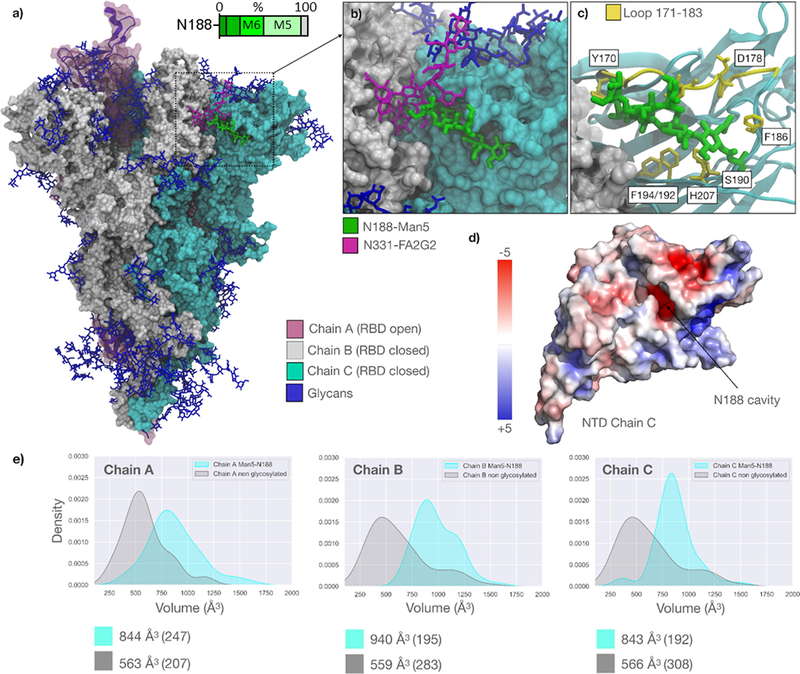
Newby and colleagues compared site-specific glycosylation across recombinant SARS-CoV-2 variant spike mimetics and used molecular dynamics to examine the acquired N188 site in the P.1/Gamma spike. Their model placed Man5 at N188 within an N-terminal-domain cavity near an adjacent receptor-binding domain, illustrating how a newly introduced glycan can interact with local protein architecture rather than acting only as a passive surface shield. The study supports variant-aware antigen design and the use of matched structural controls; it does not establish the performance of any Creative Biolabs project.
To scope the program, share the coronavirus or variant, spike sequence or construct, target glycosylation site or region, preferred antigen format, expression host, available controls, intended assay, required cross-reactivity or exclusions, and desired antibody format. We will use these parameters to propose a research-use strategy with project-specific stages and data outputs. Creative Biolabs will use the submitted parameters to define a tailored research plan. This service is for research use only and is not intended for clinical use.