


Anti-HIV Glycan Shield Antibody Development Service
The HIV-1 envelope glycoprotein (Env) trimer is the sole target for neutralizing antibodies on the viral surface. However, it is heavily coated with host-derived glycans, forming a formidable defense known as the "glycan shield." This shield limits the access of the immune system to the underlying protein epitopes, posing a significant challenge for Anti-Viral Glycan Shield Antibody Development. Creative Biolabs leverages decades of expertise in glyco-immunology to provide specialized antibody development services targeting the HIV-1 glycan shield. Our platform focuses on the precise design of immunogens that mimic high-mannose clusters (e.g., Man5–9GlcNAc2) found on the V1V2 and V3 loops, supporting basic research into glycan-dependent epitope recognition and the mechanisms of broad neutralization.
The HIV-1 Glycan Shield: A Barrier and A Target
The viral hiv envelope is covered by N-linked glycans that account for approximately half of its mass. Unlike typical host proteins where glycans are processed into complex forms, the density of glycans on the HIV-1 trimer restricts the access of glycosyltransferases. This steric hindrance preserves a population of under-processed, high-mannose glycans (Man5–9GlcNAc2), particularly around the V1V2 and V3 variable loops. While this shield primarily serves to evade immune recognition by mimicking "self," it ironically creates a conserved, tumor-like target that can be exploited for hiv therapy. Broadly neutralizing antibodies (bNAbs) such as PGT121, PGT128, and 2G12 have demonstrated that the immune system can indeed breach this shield by recognizing specific glycan-protein epitopes or dense glycan patches.
Challenges in Targeting the Glycan Shield
Self-Tolerance
The HIV-1 glycan shield is composed of host-derived carbohydrates. The immune system is naturally tolerized to these "self" structures, making it difficult to elicit a potent antibody response without sophisticated immunogen design.
Steric Hindrance
The extreme density of the hiv glycan shield prevents conventional antibodies from accessing the protein surface. Binders must possess long CDR loops or unique structural features to penetrate the canopy of sugars.
Glycan Heterogeneity
Viral glycans are not static; they fluctuate between high-mannose and complex forms depending on the cell type and viral strain. Developing an antibody that recognizes conserved features amidst this diversity is a major hurdle in hiv vaccine design.
Epitope Masking
Conformational masking allows the virus to hide vulnerable neutralizing epitopes. Antibodies must target the specific "holes" in the shield or the glycans themselves, requiring precise structural characterization.
Our Solutions: Anti-HIV Glycan Shield Antibody Development
Creative Biolabs addresses these challenges through a comprehensive suite of services designed to isolate high-affinity binders against glycan-dependent epitopes. We utilize proprietary technologies to construct immunogens that faithfully replicate the native trimer glycosylation profile.
Precision Immunogen Design
We design and express native-like Env trimers (e.g., SOSIP trimers) that display the correct density of high-mannose glycans. By engineering specific glycan sites (N332, N160), we create antigens that favor the binding of V3-glycan and V1V2-glycan directed hiv bNAb precursors while minimizing non-neutralizing epitopes.
High-Throughput Library Screening
Our phage and yeast display libraries are screened against defined glycan arrays and recombinant Env proteins. We employ a dual-screening strategy—selecting for binding to the target glycopeptide while counter-selecting against "self" antigens—to overcome immune tolerance and isolate rare clones with broadly neutralizing characteristics for research applications.
Glycan Profiling & Epitope Mapping
We characterize the binding specificity of candidate antibodies using high-density glycan microarrays and site-directed mutagenesis of Env. This confirms whether the antibody targets the Man5-9GlcNAc2 cluster or requires specific peptide contacts within the V1V2 or V3 loops—generating critical insights for HIV immunogen design and antibody mechanism studies.
Functional Validation Assays
Beyond binding, we assess antibody neutralization activity using pseudovirus panels representing diverse HIV-1 clades. Functional assays evaluate the ability of antibodies to engage the glycan shield and trigger Fc-mediated effector responses in vitro, providing valuable tools for fundamental virology and vaccine-related research.
Focus on High-Mannose Patches (Man5-9GlcNAc2)
A key target of our service is the dense cluster of high-mannose oligomannose glycans. On the native spike, these glycans are packed so tightly that enzymatic processing is inhibited.
- V3-Glycan Supersite: Antibodies targeting the N332 glycan at the base of the V3 loop are among the most potent bNAbs. We optimize immunogens to expose this supersite.
- V1V2-Glycan Apex: We target the quaternary epitopes at the trimer apex, dependent on N160 and N156, which are critical for viral entry and hiv vaccine targeting.
- 2G12-like Epitopes: We develop antibodies that recognize the unique domain-swapped configuration of high-mannose glycans on the outer domain of gp120.
Core Advantages
Native-Like Presentation
Our SOSIP trimer technology ensures glycans are presented in their relevant quaternary conformation.
Broad Spectrum Screening
Screening against diverse clades to ensure the isolation of broadly neutralizing candidates.
Detailed Glycan Analytics
Comprehensive mapping of epitope specificity using MS and glycan array technologies.
Expert Consultation
PhD-level support for project design, ensuring alignment with current HIV vaccine strategies.
Inquire about Anti-HIV Glycan Antibodies
Published Data
The dense glycan shield of the HIV-1 envelope glycoprotein (Env) trimer acts as a primary defense against the host immune system. However, breaches in this shield, termed "glycan holes," expose the underlying protein surface and can serve as targets for neutralizing antibodies. In a comprehensive study, researchers investigated the impact of these glycan holes on the induction of autologous neutralizing antibodies (NAbs). By characterizing a diverse panel of SOSIP trimers from subtypes A, B, and C—ranging from those with complete glycan shields to those with multiple missing glycosylation sites—the study sought to identify the drivers of strain-specific immunity. The researchers introduced artificial glycan holes into the AMC011 and AMC016 trimers, observing that these modifications significantly boosted autologous NAb titers. Most importantly, a statistical analysis using a generalized linear model revealed a prominent positive correlation between the calculated cumulative glycan hole area and the magnitude of the autologous NAb response. The data indicate that the size of the exposed protein surface area, rather than merely the number of missing glycans, is a key predictor of immunogenicity, providing vital insights for the rational design of HIV-1 vaccine immunogens.
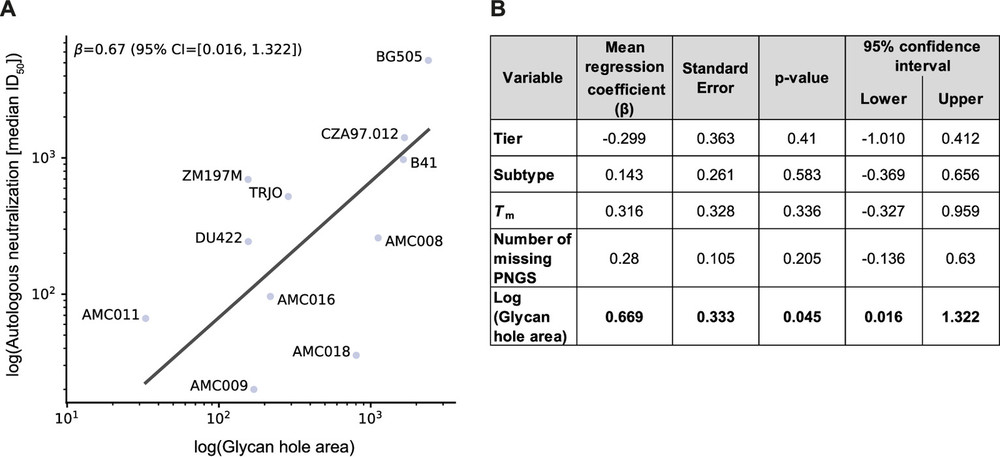 Fig.1 Fitted correlation based on the mean regression coefficient of log glycan hole area and log autologous neutralization. The analysis suggests that the cumulative surface area of glycan holes is a major determinant of the magnitude of the autologous antibody response.1
FAQs
Why is the HIV-1 glycan shield considered a target if it mimics host glycans?
While the glycans themselves are host-derived, their density on the HIV-1 spike is unnaturally high. This crowding prevents normal processing, resulting in clusters of high-mannose glycans (Man5-9GlcNAc2) that are rarely seen on healthy host cells. bNAbs target this specific high-density pattern or the "holes" in the shield, distinguishing the virus from "self."
Can you generate antibodies against specific loops like V1V2 or V3?
Yes. We design immunogens that stabilize specific conformations of the V1V2 or V3 loops. By combining these scaffolds with glycan engineering (e.g., enriching N332 or N160), we can direct the antibody response toward specific supersites on the Env trimer relevant to hiv bNAb discovery.
How do you overcome the low immunogenicity of glycans?
We utilize carrier protein conjugation, multivalent display (nanoparticles or VLPs), and potent adjuvant systems to enhance the immune response. Furthermore, our phage display libraries allow us to select for binders with high affinity that might be deleted or suppressed in a natural in vivo immune response due to tolerance mechanisms.
Do you offer neutralization assays for the developed antibodies?
Yes, we offer TZM-bl pseudovirus neutralization assays using a panel of Tier 1 and Tier 2 HIV-1 strains. This allows us to assess the breadth and potency of the antibodies and confirm their ability to penetrate the glycan shield functionally.
What is the timeline for a custom anti-HIV glycan antibody project?
Timelines vary based on the complexity of the target and the chosen platform (hybridoma vs. phage display). Typically, a project ranging from immunogen preparation to the delivery of purified, validated antibody clones takes approximately 16–24 weeks. We provide a detailed Gantt chart upon project initiation.
What Our Customers Say
"The complexity of the HIV Env trimer usually makes antibody generation a nightmare. Creative Biolabs designed a V3-scaffold immunogen that worked exceptionally well. The antibodies we received showed broad reactivity against our clade C panel."
"We needed binders specific to the high-mannose patch without cross-reacting to complex glycans. Their counter-selection strategy in phage display was precise. The clones were clean and ready for crystallography."
"Developing bNAbs is a long road, but Creative Biolabs accelerated our discovery phase. Their team understands the nuances of SOSIP trimers and glycan density. A reliable partner for HIV research."
"Excellent support on the analytical side. The glycan array data provided with the antibodies gave us confidence in the epitope specificity before we even started the neutralization assays."
Reference:
- Schorcht, A., et al. "The Glycan Hole Area of HIV-1 Envelope Trimers Contributes Prominently to the Induction of Autologous Neutralization." Journal of Virology 95.24 (2021): e01552-21. Distributed under Open Access license CC BY 4.0. https://doi.org/10.1128/JVI.01552-21