


Anti-Ebola/Marburg Virus Glycan Shield Antibody Development Service
The Filoviridae family, comprising genera such as Ebolavirus and Marburgvirus, represents a significant global health threat, characterized by sporadic but devastating outbreaks of hemorrhagic fever with case fatality rates ranging from 25% to 90%. The viral envelope glycoprotein (GP) is the sole protein expressed on the virion surface and is responsible for host cell attachment, receptor binding, membrane fusion, and viral entry. Consequently, it is the primary target for neutralizing antibodies. However, filoviruses have evolved a formidable defense mechanism: the surface GP is heavily ensheathed in a dense Anti-Viral Glycan Shield Antibody Development service composed of host-derived N-linked and O-linked glycans. This "glycan shield" effectively masks conserved, vulnerable epitopes from immune recognition, rendering the virus poorly immunogenic during natural infection. Developing antibodies capable of navigating or targeting this complex glycan architecture is critical for next-generation antiviral drug discovery and diagnostic development. At Creative Biolabs, we leverage our deep expertise in glycobiology and antibody engineering to offer a specialized custom antibody service tailored to the unique challenges of the ebola gp and Marburg GP glycan shields.
Structural Composition of the Filovirus Glycan Shield
The filovirus GP is a trimer of heterodimers, each consisting of a surface subunit (GP1) and a transmembrane subunit (GP2). The glycan shield is not merely a passive coating but a sophisticated structural feature that plays multiple roles in the viral life cycle.
The Mucin-Like Domain (MLD)
A defining feature of the filovirus GP1 subunit is the presence of a large, intrinsically disordered region known as the mucin-like domain (MLD). Located at the apex of the GP trimer, the MLD is densely decorated with O-linked glycans. This domain accounts for a significant portion of the total molecular mass of the GP (approximately 50% carbohydrate by weight). The MLD acts as a primary shield, sterically hindering antibody access to the receptor-binding domain (RBD) and the glycan cap. Although the MLD sequence is highly variable among different Ebola and Marburg strains, its function as a steric barrier and a decoy for the immune system is conserved.
N-Linked Glycosylation
In addition to the O-linked glycans of the MLD, the GP1 core and the GP2 subunit are modified with numerous N-linked glycans. These glycans are critical for the proper folding, stability, and transport of the GP trimer. Unlike the MLD, the N-linked glycans on the core are often conserved in their positioning, forming a protective "calyx" around the receptor-binding site. Because these glycans are synthesized by the host cell machinery, they are chemically identical to "self" antigens, further facilitating immune evasion by exploiting host tolerance mechanisms.
Heterogeneity and Host Mimicry
The composition of the glycan shield can vary depending on the host cell type in which the virus replicates. This heterogeneity adds another layer of complexity to antibody development. Furthermore, the extensive glycosylation allows the virus to mimic host cell surfaces, reducing the likelihood of detection by the innate immune system and complicating the generation of high-affinity antibodies through standard immunization protocols.
Challenges in Developing Antibodies Against the Glycan Shield
Steric Hindrance and Epitope Masking
The bulky nature of the viral glycan shield physically obstructs the access of B-cell receptors to conserved protein epitopes. Standard immunization protocols often result in antibodies that bind only to the accessible, highly variable, and non-neutralizing loops of the glycan cap, rather than the critical fusion machinery underneath.
Host "Self" Tolerance
Since the viral glycans are derived from the host, the immune system often recognizes them as "self," leading to immunological tolerance. Overcoming this tolerance to generate antibodies that specifically recognize tumor-associated or virus-associated glycoforms without causing autoimmunity requires specialized immunogen design.
Antigen Heterogeneity
The glycosylation profile of recombinant ebola gp can vary significantly depending on the expression system used (e.g., HEK293 vs. insect cells). This heterogeneity can lead to the selection of antibodies that bind to artifacts of expression rather than the native viral structure found on infectious virions.
Workflow: From Antigen Design to Functional Validation
Our comprehensive workflow is optimized to discover rare antibodies that can penetrate the glycan shield or recognize specific glycopeptide epitopes.
Our Solutions: Tailored Services for Filovirus Research
Creative Biolabs offers a modular custom antibody service that can be adapted to the specific needs of your antiviral program. We are confident that our tailored solutions will ensure the optimal specificity and affinity for your research needs.
Glyco-Engineered Immunogen Production
To generate antibodies that recognize the native viral surface, the immunogen must mimic the authentic glycosylation state. We utilize mammalian expression systems and glyco-engineering techniques to produce ebola gp and Marburg GP trimers with precise glycan occupancy. We can also produce "glycan-deleted" variants to focus the immune response on conserved protein epitopes usually hidden by the shield.
Custom Antibody Discovery
Our custom antibody discovery platform includes both immunization-based methods (hybridoma, B-cell sorting) and synthetic library screening (phage/yeast display). We employ specialized immunization schedules with adjuvants designed to break tolerance to carbohydrate antigens. For library screening, we use competitive elution strategies to isolate binders that target the base of the glycan shield.
Epitope Mapping and Structural Analysis
Understanding where an antibody binds is crucial for mechanism-of-action studies. We offer high-resolution epitope mapping services, including hydrogen-deuterium exchange mass spectrometry (HDX-MS) and X-ray crystallography support. This allows us to confirm if your antibody binds to the glycan cap, the receptor-binding site, or the fusion loop.
Antiviral Functional Assays
A binder is not necessarily a neutralizer. We provide functional characterization services to assess the potential of your antibodies as antiviral drug candidates. This includes pseudotyped virus neutralization assays (ppVSV-EBOV), virus-like particle (VLP) entry assays, and cell-cell fusion inhibition assays, conducted in BSL-2 environments.
Core Advantages of Our Platform
Target Specificity
Proprietary screening algorithms to differentiate between viral-specific glycoforms and host glycans, reducing off-target effects.
Broad Neutralization
Capability to discover broadly neutralizing antibodies (bnAbs) that target conserved regions across multiple filovirus species.
Data-Driven Insights
Comprehensive data packages including sequence information, binding kinetics, and functional validation reports.
Flexible Commercial Terms
Royalty-free options available, ensuring you retain full intellectual property rights for your downstream development.
Start Your Project
The development of effective countermeasures against Ebola and Marburg viruses requires tools that can overcome the deceptive nature of the viral glycan shield. Creative Biolabs is committed to supporting your research with reliable, high-quality antibodies. Contact our scientific team today to discuss your project requirements and receive a customized proposal.
Inquire Now
Published Data
High-Resolution Mapping of the Ebolavirus Glycan Shield
A comprehensive glycoproteomics study published in Communications Biology (2022) provided a high-resolution map of the ebolavirus GP glycan shield. Using recombinant GP from both human and insect cells, the research revealed an extensive and heterogeneous landscape of N-, O-, and C-linked modifications. A critical discovery was the distinct processing states of conserved N-linked glycans. While the majority of sites displayed complex, processed structures, the conserved sites at N257 and N563 were consistently enriched in under-processed oligomannose and hybrid glycans.
This specific lack of maturation suggests these sites are structurally restricted and likely serve as primary ligands for host lectins like DC-SIGN, thereby facilitating viral attachment and entry. Furthermore, the study mapped up to 16 unique O-glycosylation sites within the disordered Mucin-like Domain (MLD), identifying a mix of simple Tn antigens and extended sialylated core structures that contribute to the shield’s density. Additionally, the presence of C-mannosylation at W288 in the glycan cap was confirmed in full-length trimeric GP. These site-specific insights are pivotal for understanding how the glycan shield balances immune evasion with functional requirements, guiding the design of glyco-engineered immunogens that can elicit antibodies targeting these exposed, vulnerable epitopes.
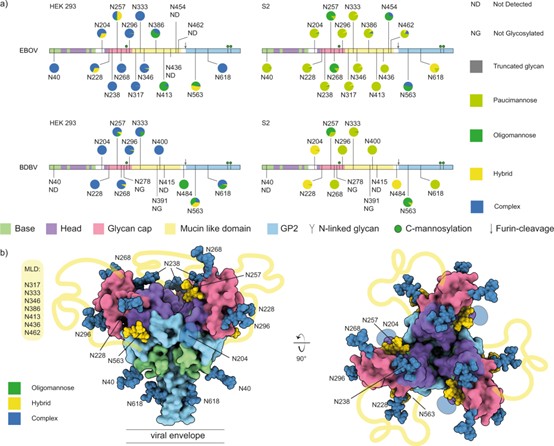 Fig.1 N-linked glycosylation and pseudomodel of the Ebolavirus GP trimer displaying the heterogeneous N-glycan shield.1
FAQs
Why is the mucin-like domain (MLD) of Ebola GP so difficult to target with antibodies?
The MLD is heavily glycosylated with both N-linked and O-linked glycans. This creates a dense physical barrier, or "shield," that sterically hinders antibodies from reaching the protein backbone. Furthermore, the MLD is intrinsically disordered and highly variable between strains, making it difficult to find conserved epitopes.
Does Creative Biolabs use live Ebola or Marburg virus for antibody validation?
No. For safety and regulatory reasons, we use pseudotyped viruses (e.g., VSV-EBOV or HIV-pseudotyped with filovirus GP) or Virus-Like Particles (VLPs). These systems faithfully mimic the surface presentation of the GP trimer and allow for accurate neutralization assays in a BSL-2 setting.
Can you develop antibodies that cross-react with both Ebola and Marburg viruses?
Developing pan-filovirus antibodies is challenging due to sequence divergence (approx. 70% difference). However, by targeting highly conserved regions such as the internal fusion loop or the receptor-binding site base, which are often shielded, we can screen for broad reactivity. We employ specific cross-screening protocols to identify such rare clones.
What type of immunogen do you recommend for generating neutralizing antibodies?
We generally recommend using trimeric, soluble GP ectodomains produced in mammalian cells (like HEK293 or CHO) to ensure native-like glycosylation. For targeting specific cryptic epitopes, we may recommend "glycan-deleted" mutants or designed peptide conjugates to focus the immune response.
How long does a custom antibody development project typically take?
A standard project utilizing hybridoma technology or phage display typically takes between 4 to 6 months. This timeline includes antigen preparation, immunization/panning, screening, and preliminary validation. Expedited services may be available depending on the complexity of the specific request.
What Our Customers Say
"The glycan shield on Ebola GP has always been a major hurdle for us. Creative Biolabs proposed a clever immunization strategy using a glycan-deficient mutant. We obtained several clones that showed broad neutralization in our pseudovirus assays. Excellent scientific insight."
"We needed antibodies that could differentiate between cleaved and uncleaved GP. Their team delivered high-affinity VHHs that worked perfectly in our structural studies. The detailed report on binding kinetics was very helpful for our publication."
Reference:
- Peng, Weiwei, et al. "Glycan shield of the ebolavirus envelope glycoprotein GP." Communications Biology 5.1 (2022): 785. Distributed under Open Access license CC BY 4.0, without modification. https://www.sci-hub.vg/10.1038/s42003-022-03767-1