


Anti-RSV Glycan Antibody Development Service
Respiratory Syncytial Virus (RSV) remains a leading cause of lower respiratory tract infections, particularly in infants and the elderly. The viral surface glycoproteins, specifically the Fusion (F) and Attachment (G) proteins, are heavily glycosylated, forming a "glycan shield" that modulates immune recognition and viral stability. At Creative Biolabs, we provide a specialized platform for developing antibodies that target these specific glycan features. By leveraging our expertise in Anti-Viral Glycan Shield Antibody Development, we support researchers in dissecting the complex role of RSV glycosylation in antigenic drift, neutralization sensitivity, and vaccine efficacy.
Background: The Glycan Shield of RSV
The RSV F protein is a class I fusion protein containing multiple N-linked glycosylation sites (e.g., N27, N70, N500). These glycans are essential for proper protein folding, proteolytic processing (cleavage at the p27 peptide), and fusion activity. Variations in site occupancy or glycan structure at these positions can alter the local conformation of antigenic sites, thereby affecting the binding of neutralizing antibodies.
The RSV G protein is heavily glycosylated with both N-linked and extensive O-linked glycans, forming mucin-like domains. These domains act as a dense physical barrier, or "glycan shield," that protects the conserved central domain (CCD) from immune surveillance. Understanding and targeting these glycan-rich regions is essential for developing next-generation antiviral therapy and overcoming mechanisms of immune evasion.
Current Challenges in RSV Antibody Discovery
Developing antibodies that specifically recognize or navigate the RSV glycan shield presents unique hurdles:
- Epitope Masking: The dense O-glycan clusters on the G protein can physically block antibody access to the polypeptide backbone, requiring specialized screening strategies to find binders that penetrate this shield.
- Glycan Heterogeneity: The host cell type significantly influences the viral glycosylation profile. Antibodies raised against recombinant proteins produced in one system (e.g., CHO cells) may not fully recognize the viral glycan shield present on native virions produced in human airway epithelial cells.
- Conformational Dependence: N-glycans on the F protein (e.g., at N27 and N70) are often integral to the stability of the pre-fusion conformation. Targeting these regions requires antibodies that recognize the specific glycoform-dependent structure.
Targeting Specific Glycosylation Sites
| Target | Glycosylation Features | Research Application |
|---|---|---|
| F Protein (N27) | Located in the p27 peptide released during maturation; critical for fusion competence. | Studying proteolytic processing efficiency; developing markers for precursor (F0) vs. mature (F) protein. |
| F Protein (N70) | Conserved N-linked site on the F2 subunit; modulates local structure and antigenicity. | Investigating conformational stability; assessing impact on neutralizing epitopes (e.g., Site Ø, Site V). |
| G Protein (Mucin Domains) | Dense O-linked glycan clusters (Ser/Thr rich); highly variable between strains (A vs. B). | Developing strain-specific diagnostic reagents; studying immune evasion and receptor (CX3CR1) interaction blocking. |
| G Protein (CCD) | Non-glycosylated central conserved domain flanked by mucin domains. | Broadly neutralizing monoclonal antibody discovery; vaccine candidate validation. |
Our Custom Anti-RSV Glycan Antibody Services
Creative Biolabs offers a comprehensive custom antibody service tailored to the unique requirements of RSV glyco-immunology. We employ advanced immunization and screening strategies to generate antibodies that are sensitive to the glycosylation state of the antigen.
Glycopeptide-Specific Antibody Generation
We design synthetic glycopeptides corresponding to critical RSV sites (e.g., F protein N27/N70 loops or G protein mucin repeats). By controlling the precise glycan structure attached to the peptide, we can raise antibodies that specifically recognize the glycosylated epitope, distinguishing it from the non-glycosylated form.
Glycan Shield Penetrating Antibodies
For targets like the RSV G protein, we utilize specialized screening protocols to identify binders that can penetrate the dense mucin-like coat. These antibodies are invaluable for studying the accessibility of the conserved central domain and for developing therapeutic candidates with broad reactivity.
Recombinant Antibody Engineering
Once lead candidates are identified, we offer full-scale engineering services. This includes sequencing, cloning into expression vectors, and converting murine hybridomas into chimeric or fully humanized IgG formats. We also produce recombinant Fab and scFv fragments for structural biology applications.
Differential Glycoform Screening
We employ counter-screening strategies using RSV antigens expressed in cell lines with distinct glycosylation capabilities (e.g., GnTI-deficient cells vs. wild-type mammalian cells). This allows us to select clones that are either dependent on or independent of complex glycan modifications.
Technological Approaches
Inquire about RSV Glycan Antibodies
Why Choose Creative Biolabs?
Glycobiology Expertise
Deep understanding of viral glycoprotein structure and the impact of host-cell glycosylation machinery.
Tailored Deliverables
Customized antibody formats (IgG, Fab, scFv) optimized for your specific research applications.
Data-Driven Validation
Rigorous testing with SPR, FACS, and glycan profiling to ensure high specificity and affinity.
Cost-Effective Solutions
Efficient project management and optimized workflows to deliver results within your budget.
Published Data
Deeply understanding the structural interplay between antibodies and the RSV glycan shield is paramount for designing effective therapeutic antibodies. A landmark structural biology investigation into the central conserved domain (CCD) of the RSV G protein has elucidated the mechanisms by which neutralizing antibodies traverse the barriers imposed by heavy glycosylation. By isolating and solving the high-resolution crystal structures of two human monoclonal antibodies in complex with RSV G peptides, researchers have confirmed that the CCD serves as a highly potent immune target, remaining accessible even when flanked by sterically hindering, dense mucin-like domains.
Detailed crystallographic analysis revealed that these antibodies utilize specific angles of approach to precisely engage the cystine noose—a critical structure containing the CX3C motif—along with its neighboring conserved residues. One antibody was observed to form a stable β-hairpin interaction with the cystine noose through its heavy chain CDR3 region, whereas the second antibody recognized linear epitopes flanking this structural loop. Furthermore, in vivo efficacy studies demonstrated that these CCD-targeting antibodies potently neutralized the virus and significantly reduced pulmonary viral loads and associated inflammatory pathology in cotton rat models. These data robustly validate the feasibility of using deglycosylated immunogens or synthetic glycopeptide strategies to elicit antibodies against cryptic epitopes hidden within the viral glycan shield, providing a solid foundation for future RSV therapeutic development.
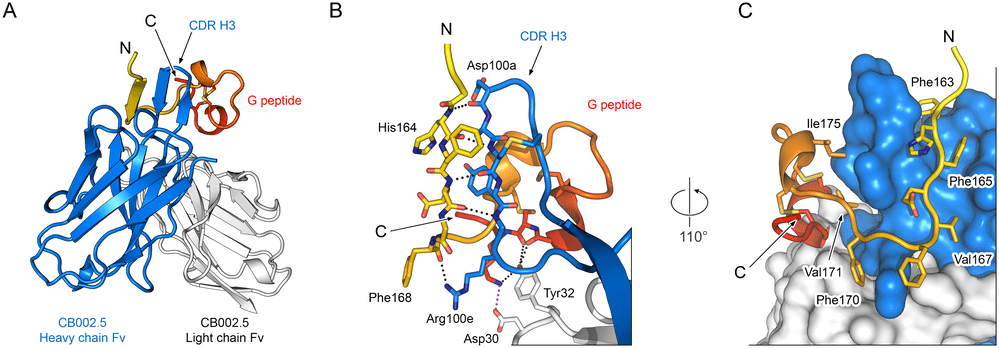 Fig.1
Structural basis for antibody recognition of the RSV G central conserved region. The crystal structure reveals how the antibody penetrates the steric barrier to bind the critical cystine noose element.1
Fig.1
Structural basis for antibody recognition of the RSV G central conserved region. The crystal structure reveals how the antibody penetrates the steric barrier to bind the critical cystine noose element.1
FAQs
Can you generate antibodies that distinguish between the pre-fusion and post-fusion conformations of RSV F protein?
Yes. The pre-fusion and post-fusion conformations expose different glycan and protein epitopes. By using conformation-stabilized antigens and specific counter-screening protocols, we can isolate antibodies that are specific to the pre-fusion state, which is often the preferred target for potent virus neutralization.
How do you handle the high heterogeneity of O-glycans on the RSV G protein during antibody development?
O-linked glycosylation is inherently heterogeneous. To address this, we can use a dual approach: generating antibodies against the conserved peptide backbone (using deglycosylated antigens) or targeting specific, dominant O-glycan motifs using defined synthetic glycopeptides. This ensures we can provide tools for both broad detection and strain-specific analysis.
Do you offer services for mapping antibody epitopes relative to glycosylation sites?
Absolutely. We provide epitope mapping services using site-directed mutagenesis (removing N-glycan sites like N27 or N70) and Hydrogen-Deuterium Exchange Mass Spectrometry (HDX-MS). This allows us to precisely determine if an antibody's binding is blocked, enhanced, or unaffected by specific glycans.
What host species are available for immunization?
We offer immunization in mice, rats, and rabbits. Rabbits are particularly useful for generating high-affinity antibodies against difficult epitopes, such as glycopeptides or small conserved domains within the RSV glycan shield. We also offer human antibody discovery via phage display libraries.
Are your antibodies suitable for therapeutic development or only for research?
Our custom antibody development services are primarily for research use (RUO). However, we can perform developability assessments (e.g., stability, aggregation, humanization) to help you identify the best candidates for downstream therapeutic preclinical studies.
What Our Customers Say
"The complexity of the RSV G protein mucin domains made it difficult for us to find specific binders. Creative Biolabs designed a glycopeptide strategy that worked perfectly. The antibodies we received are highly specific for the glycosylated form we were targeting."
"We needed reagents to distinguish between pre-fusion and post-fusion F protein in a crude viral prep. The team provided us with a panel of mAbs, and two of them showed excellent conformational specificity in our ELISA and neutralization assays."
"Their expertise in glycan shielding is impressive. They helped us understand why our previous vaccine candidates were failing to elicit neutralizing antibodies. The epitope mapping service was a key turning point for our project."
"Professional communication and timely delivery. The report included detailed SPR data and glycan array results, which gave us high confidence in the specificity of the antibodies before we even started our own experiments."
Reference:
- Jones, Harrison G.; et al. "Structural basis for recognition of the central conserved region of RSV G by neutralizing human antibodies."" PLoS Pathogens. 2018, 14(3): e1006935. Distributed under Open Access license CC BY 4.0, without modification. https://doi.org/10.1371/journal.ppat.1006935