
Cross-reactive background:
Shared E-protein architecture can produce broad binding that is useful for some programs but undesirable for serotype-specific reagents.


Creative Biolabs supports flavivirus programs in which the antibody must resolve more than simple envelope-protein binding. Our anti-flavivirus glycan shield antibody development service draws on the anti-viral glycan shield antibody development platform to connect glycosite-aware antigen design with serotype or species panels, matched controls, and the assay where the candidate will ultimately be used.
Shared E-protein architecture can produce broad binding that is useful for some programs but undesirable for serotype-specific reagents.
An intact N-X-S/T motif does not by itself establish full occupancy or the same glycan composition in every expression context.
Potent antibodies may bridge two E protomers or depend on the dimer lattice, which is not reproduced by all soluble monomeric antigens.
DENV1-4, ZIKV, WNV, JEV, and other flaviviruses require deliberate panel selection so breadth and exclusion claims match the tested set.
We combine target-specific design with a panel strategy appropriate to the intended breadth. Service components can be expanded or narrowed as the data develop.
| Program Component | Primary Question | Representative Options |
|---|---|---|
| Epitope and glycosite scoping | Is the desired epitope glycan-dependent, glycan-adjacent, glycopeptide, or conformational? | E-protein glycosylation loop, defined glycopeptide, soluble E dimer, cell-displayed E/prM, or particle-like antigen. |
| Antigen and control production | Which materials will reveal the recognition mechanism without losing relevant structure? | Wild-type and glycosite-altered antigens, matched serotypes, deglycosylated controls, unrelated glycoproteins, or host-cell background. |
| Discovery and hit selection | Which route is compatible with the epitope class and desired antibody format? | Immunization-based discovery, display screening, single-domain or recombinant formats, followed by differential screening. |
| Cross-panel characterization | How broad or selective is each candidate within the planned panel? | DENV1-4, ZIKV, WNV, JEV, selected strains, glycosite mutants, and non-flavivirus controls. |
Differential screening is configured around the intended breadth. Cross-reactive candidates are retained or removed deliberately, then prioritized for glycan dependence, dimer recognition, competition, or other project-specific characterization.
Cross-reactivity is not inherently a failure or an advantage. It is useful when the program seeks a conserved epitope and problematic when a reagent needs to distinguish closely related viruses. We therefore interpret breadth alongside epitope context. A clone can bind several E proteins because it recognizes a conserved protein surface, a shared glycan-associated region, or an assay-dependent feature of the recombinant constructs.
| Panel Objective | Core Comparisons | Useful Outcome |
|---|---|---|
| DENV serotype discrimination | DENV1, DENV2, DENV3, and DENV4 antigens prepared in a comparable format | Identifies serotype-preferential, subgroup, or broadly DENV-reactive candidates. |
| DENV-ZIKV breadth | Selected DENV serotypes plus ZIKV wild-type and relevant glycosite controls | Separates shared envelope recognition from virus-specific or glycan-loop-dependent binding. |
| Broader flavivirus specificity | DENV/ZIKV plus selected WNV, JEV, or other relevant flaviviruses | Defines the tested breadth and reveals unintended group-reactive binding. |
| Glycosite dependence | Wild-type and glycosite-altered E materials within one or more viruses | Evaluates whether candidate binding changes when the targeted glycan site is altered, with structural caveats documented. |
We clarify whether the desired reagent is serotype-specific, species-specific, DENV-group reactive, DENV/ZIKV cross-reactive, or broader within the tested flavivirus set.
Positive antigens, close relatives, glycosite controls, and unrelated glycoproteins are selected according to the claim and available materials.
The discovery route and primary screen are matched to the antigen presentation, with early removal or retention of cross-reactive clones based on project intent.
Candidates are compared on glycosylated and altered materials, soluble versus higher-order formats, or selected expression-host variants where these comparisons are informative.
Affinity, competition, imaging, cell binding, antigen QC, or neutralization-related research assays are applied to prioritized clones.
Target flavivirus, DENV serotype, strain, and E-protein sequence or construct details.
Target glycosylation site, epitope region, or evidence suggesting glycan-dependent recognition.
Desired breadth or specificity claim and the viruses or serotypes that need positive or negative coverage.
Available recombinant proteins, cells, particles, glycosite mutants, or reference antibodies.
Expression host, antigen maturation state, biosafety constraints, and permitted assay systems.
Included Information: Clone identifiers, agreed antibody format, concentration, and primary target binding. Optional Expansion: Sequence delivery, recombinant conversion, labeling, or alternate formats when scoped.
Included Information: Binding across selected viruses, serotypes, strains, and negative controls. Optional Expansion: Additional flaviviruses, expression-host comparisons, or glycosite-mutant panels.
Included Information: Candidate grouping by breadth, selectivity, glycan dependence, and antigen-format sensitivity. Optional Expansion: Competition groups, kinetic measurements, or orthogonal array profiling.
Develop reagents that distinguish or group selected DENV serotypes and related flaviviruses in defined analytical systems.
Examine how N153/N154 or another selected glycosite contributes to antibody recognition within matched constructs.
Prioritize candidates that retain binding to E dimers, cell-displayed proteins, or particle-like materials.
Compare candidate recognition of engineered immunogens, glycosite variants, and expression formats without treating external literature as proof of project performance.
Select candidates for approved assays that test attachment, post-attachment events, fusion-related competition, or other defined steps.
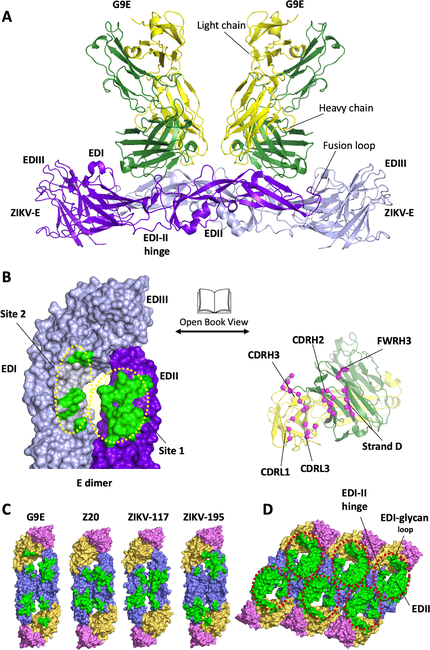
Adams and colleagues characterized the human ZIKV antibody G9E using X-ray crystallography and cryo-electron microscopy. The Fab contacted a quaternary epitope spanning an E-protein homodimer, with one part of the interface involving the N154 glycan loop and hinge region of the adjacent protomer. Mutational and fusion-related experiments showed that cross-linking the dimer was important to the observed neutralization mechanism. The study illustrates why dimer presentation, glycan-loop context, and functional follow-up can matter in flavivirus antibody research; it does not demonstrate Creative Biolabs service outcomes.
Please provide the target virus or DENV serotype, E-protein sequence and antigen format, target glycosylation site or epitope, desired cross-reactivity profile, viruses or strains to exclude, available mutants or controls, planned functional assay, preferred antibody format, and biosafety limitations. These details allow us to build a panel that matches the intended claim. Creative Biolabs will use this information to align the panel with the intended breadth and downstream study.