Creative Biolabs is offering the most comprehensive services for antibody development projects. With strict regulation and effective execution, we are dedicated to providing the most valuable solutions to complete your projects.
HighlightsCreative Biolabs is offering the most comprehensive services for antibody development projects. With strict regulation and effective execution, we are dedicated to providing the most valuable solutions to complete your projects.
HighlightsCreative Biolabs has established a broad range of platforms for developing novel antibodies or equivalents. These cutting-edge technologies enable our scientists to meet your demands from different aspects and tailor the most appropriate solution that contributes to the success of your projects.
HighlightsWith deep understanding in antibody-related realms and extensive project experience, Creative Biolabs offers a variety of references to help you learn more about our capacities and achievements, including infographic, flyer, case study, peer-reviewed publications, and all kinds of knowledge that can assist your projects. You are also welcome to contact us directly for more specific solutions.
HighlightsGet a real taste of Creative Biolabs, one of the most professional custom service providers in the world. We are committed to providing highly customized comprehensive solutions with the best quality to advance your projects.
HighlightsAntibodies serve as indispensable investigative tools for studying lysine succinylation biology, enabling substrate identification and mechanistic analysis of this post-translational modification (PTM). Creative Biolabs employs the High-Affi™ platform to support global scientific efforts through an extensive selection of pan-specific and site-directed anti-succinyllysine antibodies. These antibodies show high specificity binding to succinylated lysine residues while exhibiting minimal cross-reactivity with unmodified lysines or structurally analogous modifications.
Lysine succinylation, a relatively recent addition to the PTM landscape, involves covalent attachment of a succinyl moiety to lysine's ε-amino group. This evolutionarily conserved modification occurs broadly across cellular organisms. Though recognized as dynamic and reversible, its regulatory enzymes remain poorly characterized. Current models propose succinyl-CoA as a potential modifying cofactor, while SIRT5 and CobB have been identified as mammalian and prokaryotic desuccinylases, respectively. Functional parallels with lysine acetylation are hypothesized under certain biological contexts, though succinylation induces more pronounced structural perturbations. The succinyl group reverses lysine's charge from +1 to -1, contrasting with acetylation's neutralization (+1 to 0) and methylation's charge preservation.
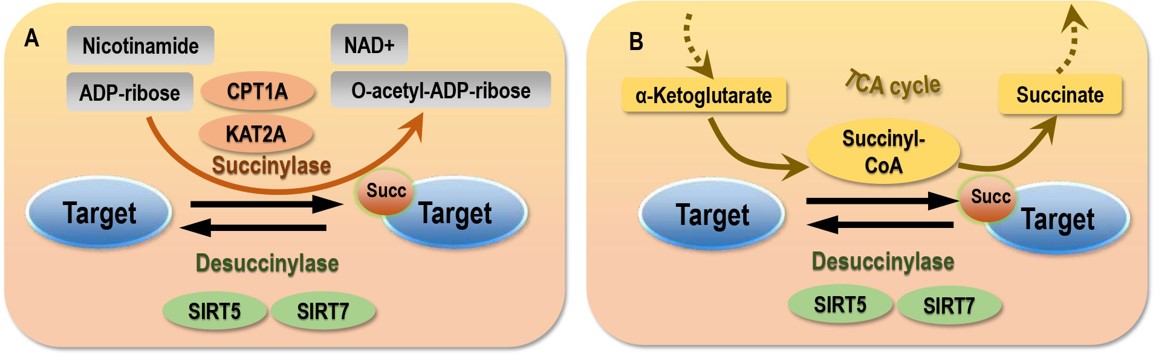 Fig.1 Mechanism of succinylation.1
Histone mapping reveals distinct spatial patterning: succinylation favors C-terminal globular domains, whereas acetylation concentrates in N-terminal regions. These differential features suggest unique functional roles for succinylation in protein regulation. Emerging studies document succinylation's involvement across diverse protein classes - histones, metabolic enzymes, transcriptional regulators, and membrane transporters - linking it to pathological processes including diabetes, oncogenesis, neurodegeneration, and age-related pathologies.
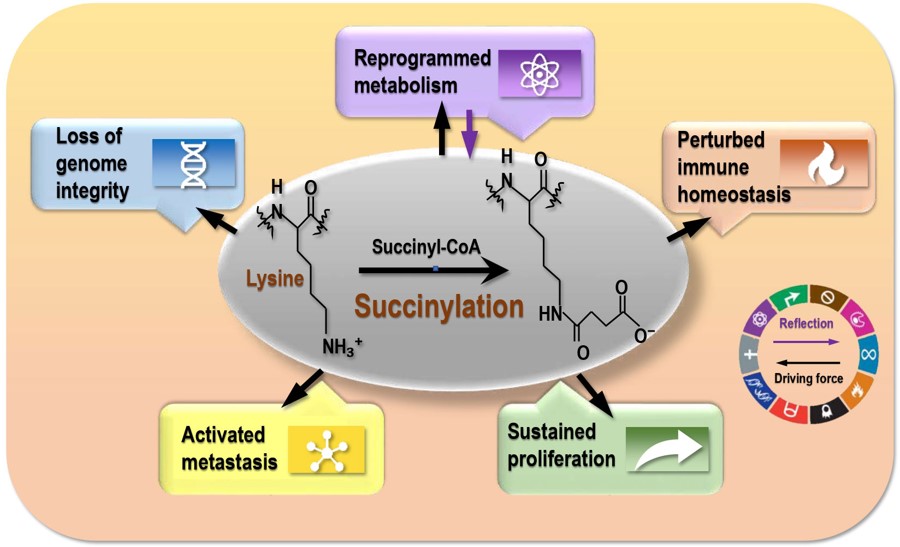 Fig.2 Role of succinylation on cancer.1
As a pioneer in antibody development, Creative Biolabs combines decades of technical expertise with customer-centric innovation. Our research teams deliver tailored antibody solutions through optimized development pipelines, ensuring reliable performance across experimental systems to accelerate both basic research and therapeutic discovery initiatives.
We offer expert services for generating top-tier polyclonal, monoclonal, site-specific, and pan anti-succinylation antibodies customized for your research.
Polyclonal Antibodies: Produced through animal immunization, these sera contain varied antibodies targeting multiple epitopes near succinylated lysine. Their multi-epitope binding enhances detection sensitivity, though batch variations.
Monoclonal Antibodies: Derived from single immune cell clones, these antibodies bind specifically to one epitope on succinylated lysine or adjacent regions. Their uniformity ensures consistent results with minimal background, ideal for quantitative studies. However, they may miss targets with sequence variations.
Site-Specific Anti-Succinylation Antibodies: These detect succinylation at precise lysine sites within specific proteins, made using site-directed peptide antigens. Essential for studying localized modification effects, they require confirmed site information prior to development.
Pan Anti-Succinylation Antibodies: These reagents identify succinyl groups independent of surrounding sequences, crucial for proteome-wide studies and novel substrate discovery. They offer broad detection and are ideal for exploratory studies despite lacking site resolution.
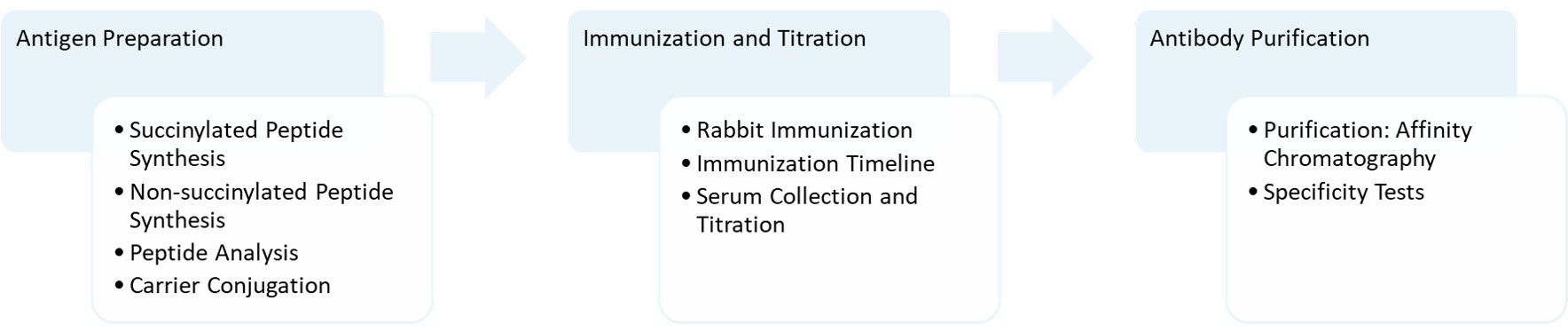
This method begins with animal immunization using carrier proteins conjugated to succinylated antigens. Initial serum contains antibodies against both the carrier and succinylation motifs. To isolate specific antibodies, a dual purification strategy is applied: first removing unmodified peptide-specific antibodies via affinity columns with the unmodified peptide, then enriching succinylation-targeting antibodies using immobilized succinylated antigens. Final elution under controlled pH conditions produces purified polyclonal antibodies with enhanced specificity.
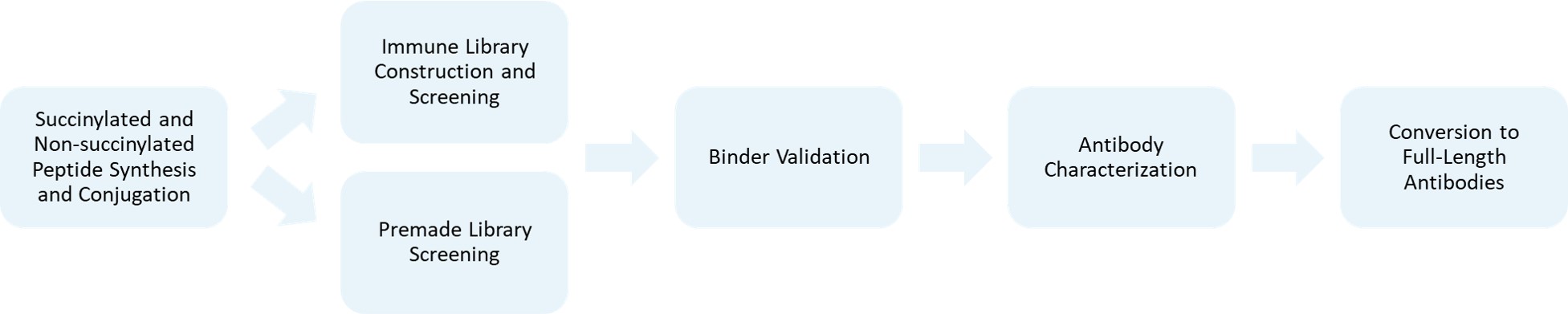
This in vitro approach uses phage display to screen antibody fragment libraries against immobilized succinylated targets. Phage display screens both immune libraries from immunized animals and prefabricated libraries from non-immune animals or human sources. Negative screening with non-modified peptides and positive screening with succinylated peptides ensures modification specificity. After incubation and washing, bound phages are amplified and iteratively selected. High-affinity clones are expressed as full IgG, yielding monoclonal antibodies with succinylation recognition profiles.
This classical method is initiated by immunizing mice with succinylated antigen conjugates. Post-immunization, spleen-derived B cells are fused with immortal myeloma cells to generate hybridomas. Cell cultures are systematically screened for succinylation-specific antibody secretion using antigen-coated plates. Selected hybridomas undergo clonal expansion and stability testing before scaling up antibody production, ensuring consistent monoclonal antibody batches for research applications.

Custom Succinyl Immunogen Design: We engineer customized succinylated peptide/protein conjugates to maximize antibody specificity for modified residues. Strategic antigen design focuses on optimal epitope exposure while minimizing carrier protein interference.
High-Affinity Antibody Development: Our platform develops monoclonal and polyclonal antibodies with superior binding affinity for succinylated lysine across target proteins. Advanced selection protocols prioritize both binding strength and modification-specific recognition.
Rigorous Specificity Evaluation: Multi-platform validation ensures minimal cross-reactivity against unmodified lysine and structurally similar PTMs through ELISA, Western blot, and SPR analysis. Each batch undergoes stringent quality control.
Epitope Mapping and Characterization: Comprehensive epitope profiling identifies antibody binding sites through mutagenesis and competitive binding assays, informing molecular interaction mechanisms and potential cross-reactivity risks.
Q: What types of succinylation-specific antibodies can you generate?
A: Our services cover all major antibody formats for succinylation research: polyclonal, monoclonal, site-specific, and pan-reactive variants. We customize antibody development based on your experimental goals, whether you need wide-spectrum detection or precision targeting of individual modified residues.
Q: How do you select the best immunogen for succinylation antibodies?
A: Immunogen design starts with synthesizing succinylated peptides or protein conjugates optimized for antigenicity. We prioritize peptide sequence relevance, carrier protein selection, and conjugation chemistry to maximize immune recognition of the succinyl group. Collaborative discussions ensure the final design aligns with your specificity requirements.
Q: What are the typical timelines for antibody discovery projects?
A: Project duration varies by antibody type and target complexity. Polyclonal development usually takes 14-16 weeks, while monoclonal projects involving hybridoma or phage display require 20-24 weeks. Site-specific antibodies often need extended validation phases. Transparent timeline estimates are provided during project planning.
Q: Can you generate site-specific antibodies targeting specific succinylated lysine residues?
A: Yes. We develop antibodies precisely targeting user-defined succinylation sites using sequence-verified peptide antigens. Multi-stage screening protocols isolate clones recognizing only the specified modified lysine, validated through orthogonal binding assays.
Q: What information do you require from the customer to initiate a project?
A: Project initiation requires details about your target protein's sequence, confirmed or predicted succinylation sites, preferred antibody format, and intended applications. Sharing existing characterization data or experimental constraints helps us optimize the development strategy during our initial consultation.
All listed services and products are For Research Use Only. Do Not use in any diagnostic or therapeutic applications.