Candida auris-derived Exosome Research & Application
Workflow Research Insights Advantages Testimonials FAQs
Candida auris is an emerging multidrug-resistant fungal pathogen that has gained global attention due to its persistence and adaptability in clinical environments. Recent studies have revealed that Candida auris-derived exosomes act as potent mediators of communication between fungal cells and their surrounding environment, including host immune systems and microbial competitors. These vesicles are rich in proteins, lipids, and RNAs that influence fungal adaptability and antifungal drug resistance.
At Creative Biolabs, we provide specialized support for the isolation, customization, and characterization of Candida auris-derived exosomes to accelerate fundamental research on fungal adaptation and resistance mechanisms. Our workflows are optimized to maintain vesicle integrity and to deliver reproducible, research-grade exosome preparations suitable for molecular and biochemical analysis.
Exosome Isolation Workflow
Creative Biolabs' standard workflow for developing Candida auris-derived exosomes follows a carefully validated sequence of culture, purification, and quality verification steps. Optional assays are available depending on species database availability and client-specific study objectives.
Culture Establishment
Preliminary Clarification
Concentration Process
Purification by Ultracentrifugation
Optional Characterization and Profiling
Culture Establishment
-
A single Candida auris colony is revived and expanded on Sabouraud dextrose agar or broth under optimized temperature and aeration conditions.
-
The primary liquid culture is scaled up to ensure sufficient biomass and exosome yield.
-
Continuous monitoring ensures fungal viability and contamination-free growth.
Preliminary Clarification
-
The culture medium is centrifuged to remove yeast cells and large debris.
-
The supernatant is carefully collected to retain only extracellular components.
-
(Optional) Filtration through 0.45 μm and 0.22 μm membranes for additional clarification.
Concentration Process
-
The clarified supernatant is concentrated using a cellulose-based ultrafiltration system.
-
This step enriches vesicles while maintaining vesicle structure and composition.
-
(Optional) Buffer exchange may be conducted for downstream biochemical assays.
Purification by Ultracentrifugation
-
Sequential ultracentrifugation and iodixanol density gradient centrifugation are used to separate Candida auris-derived exosomes from soluble proteins and macromolecules.
-
Pellet fractions containing intact vesicles are resuspended in sterile buffer.
-
Purity and integrity are verified via nanoparticle tracking analysis (NTA).
Optional Characterization and Profiling
-
(Optional) Protein, lipid, or RNA profiling via LC–MS/MS, sequencing, or spectroscopic methods.
-
(Optional) Electron microscopy and proteomic comparison with parental cells.
-
(Optional) Drug susceptibility impact studies using exosome-enriched cultures.
Request a consultation with Creative Biolabs to design your fungal exosome isolation plan.
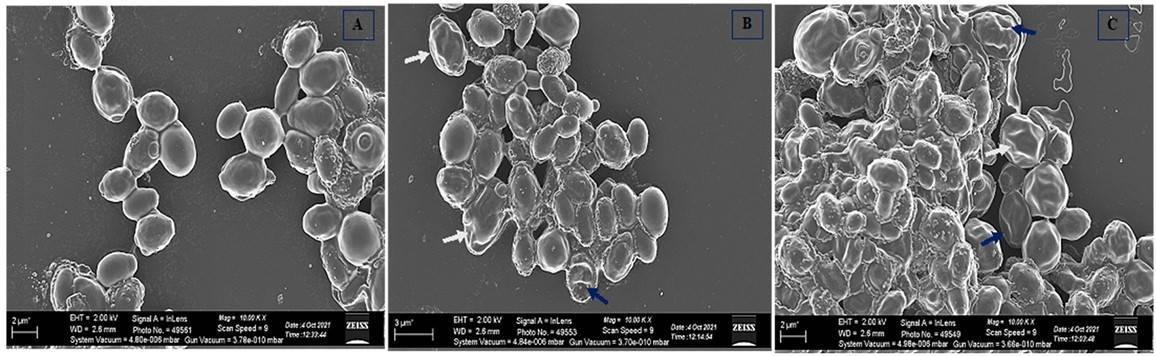 Fig. 1 SEM analysis of C. auris.1
Research Insights: C. auris-derived Exosomes
|
RESEARCH TOPIC
|
KEY FINDINGS
|
|
Proteomic Profiling of Exosomal Cargo
|
-
SDS-PAGE separation of C. auris-derived exosomes revealed distinctive protein bands around 25–35 kDa.
-
Mass spectrometry identified major proteins such as alcohol dehydrogenase 1, elongation factor 1α, phosphoglycerate kinase, and Xog1-like glycosidase.
-
Sequence comparison confirmed that Xog1 from C. auris-derived vesicles contains conserved catalytic and substrate-binding domains similar to C. albicans Xog1.
|
|
Drug Resistance-Associated Mechanisms
|
-
C. auris cultures treated with their own exosomes showed an increased minimum inhibitory concentration (MIC) for multiple antifungal agents.
-
This shift toward resistance occurred in a dose-dependent manner, suggesting vesicle-mediated transfer of adaptive factors.
-
The protective effect of exosomes persisted even when C. auris was exposed to liposomal antifungal formulations, indicating durable resistance-promoting interactions.
|
Learn more about how Creative Biolabs' fungal exosome analytics can advance your antifungal resistance studies.
Advantages of Creative Biolabs
 Fungal-Specific Expertise
-
Decades of mycology and exosome biology experience ensure project precision and reliability.
-
Expertise across both pathogenic and non-pathogenic fungal vesicles.
Comprehensive Customization
-
Modular workflow adaptable to strain type, culture scale, and desired analytical depth.
-
(Optional) Multi-omics profiling, including proteomics and transcriptomics, available upon request.
High Data Integrity
-
Standardized QC parameters, reproducible recovery rates, and traceable batch records.
-
Optional NTA, TEM, and Western blot QC reports to validate vesicle purity and yield.
Collaborative Project Management
-
Direct communication with Creative Biolabs' scientific team throughout every project phase.
-
Flexibility to integrate user-supplied data or co-develop assay protocols.
Reach out to Creative Biolabs to experience a tailored and transparent fungal exosome research partnership.
Client Reviews
"Partnering with Creative Biolabs for Candida auris exosome isolation gave our lab the precision we needed to study resistance mechanisms. Their scientists designed an efficient isolation workflow that preserved vesicle activity and provided detailed technical documentation."
— Dr. J. RivXXXX
"The Creative Biolabs team's professionalism and scientific communication stood out. Their optional proteomic profiling service helped us identify specific vesicle proteins linked to our strain's adaptive behavior. The dataset was robust and ready for publication."
— Dr. A. SchXXXX
"Creative Biolabs' fungal exosome expertise is unmatched. They handled our custom C. auris vesicle analysis with care, providing consistent results across biological replicates. Their support team was responsive and detail-oriented."
— Dr. Y. LeXXXX
Discuss your next fungal vesicle project with Creative Biolabs' expert team.
At Creative Biolabs, we are committed to supporting your research into fungal-derived exosomes, offering customized solutions to meet the specific needs of your project. Whether you're studying drug resistance mechanisms or exploring fungal-host interactions, our expert team is ready to collaborate with you. If you're interested in learning more about our Candida auris-derived exosome services or would like to discuss your research goals, feel free to contact us. We look forward to helping you advance your work with high-quality, reliable exosome research. Contact us to get started on your fungal exosome research project!
FAQs
Q: What are the primary roles of exosomes derived from Candida auris in cellular communication?
A: Candida auris-derived exosomes are known to play significant roles in intercellular communication within the host environment. They can transfer specific cargoes, influencing immune responses and potentially altering host cell functions. Understanding these roles is crucial for developing strategies to manipulate host-pathogen interactions.
Q: How do Candida auris exosomes influence the immune response of the host?
A: Research has shown that exosomes from Candida auris can modulate the host immune response by interacting with immune cells. They may promote immune evasion by delivering immunosuppressive factors or altering the expression of surface receptors, ultimately affecting the activation and function of immune cells such as macrophages and dendritic cells.
Q: What biomarkers can be identified in Candida auris exosomes, and how might they be used in diagnostic applications?
A: Candida auris exosomes contain specific proteins, lipids, and RNA species that can serve as potential biomarkers for infection. Ongoing research aims to characterize these components, which may lead to novel diagnostic tools that leverage the unique lipid and protein signatures of exosomal content for early detection of Candida auris infections.
Q: In what ways can the study of C. auris-derived exosomes contribute to vaccine development?
A: Understanding the immunogenic properties of C. auris exosomes can aid in identifying potential vaccine candidates. These exosomes might be engineered to serve as carriers for antigens or adjuvants, thereby enhancing the immune response against C. auris and providing a novel avenue for vaccine development.
Q: Are there any potential biotechnological applications for Candida auris exosomes?
A: Yes, potential biotechnological applications include utilizing C. auris-derived exosomes as delivery systems for therapeutic molecules or as tools for drug delivery in antifungal therapies. Their functions in antifungal resistance mechanisms are also being investigated by researchers, which may help with the development of novel antifungal drugs.
Q: What avenues for further investigation into Candida auris exosomes are being considered?
A: Future research focuses on understanding the mechanisms through which C. auris exosomes influence pathogenicity and host interactions. Additionally, there is interest in the potential use of exosomes in developing novel therapeutics and diagnostic tools, as well as studying their roles in the emergence and spread of antifungal resistance.
Reference
-
Rather, Irfan A., et al. "Antifungal activity of human cathelicidin LL-37, a membrane disrupting peptide, by triggering oxidative stress and cell cycle arrest in Candida auris." Journal of Fungi 8.2 (2022): 204. Distributed under Open Access license CC BY 4.0. The image was modified by revising the title. https://doi.org/10.3390/jof8020204.
For Research Use Only. Cannot be used by patients.
Related Services: