

Anti-Glycan Related Enzyme Antibody Development Service
Anti-Glycan Related Enzyme Antibody Development Service
Glycan-related enzymes build, trim, remodel, and modify glycans. Creative Biolabs develops research-use antibodies against glycosyltransferases, glycosidases, sialidases, sulfotransferases, heparanase, hyaluronidases, and other enzyme targets that shape glycan biology.
Plan an Enzyme Antibody Program
Recommended Platform
Glycosyltransferase & Glycosidase Substrate Microarray
Substrate-focused profiling to support enzyme-pathway research and application-specific antibody validation studies.
Learn MoreAntibodies for the Enzymes that Control Glycan Biosynthesis and Remodeling
Glycosylation is a non-template-driven process controlled by enzyme networks that synthesize activated sugar donors, transfer monosaccharides, trim glycan intermediates, add functional modifications, and remodel extracellular matrices. Changes in these enzymes can reshape the glycome of cells, tissues, pathogens, and biologics. Antibodies against glycan-related enzymes are useful research tools for pathway studies, biomarker discovery, target-engagement research, and assay development.
Many enzyme targets are technically challenging. Glycosyltransferases are frequently Golgi- or ER-associated type II membrane proteins, and closely related family members may share conserved catalytic domains. Glycosidases and hydrolases may require active-site, maturation-state, or processing-state discrimination. GAG-modifying enzymes such as heparanase, sulfotransferases, and hyaluronidases may be secreted, matrix-associated, membrane-associated, or proteolytically processed depending on the target. Creative Biolabs evaluates sequence, topology, isoforms, domains, species conservation, and assay requirements before recommending the immunogen.
Our service supports research-use antibodies for Western blot, ELISA, immunofluorescence, immunohistochemistry, flow cytometry, immunoprecipitation, enzyme-pathway readouts, and application-specific reagent development.
Cancer Glycosylation Enzyme Evidence
3Biomarker-discovery routes described by Meany and Chan: enzyme markers, improved glycoprotein markers, and glycomic or glycoproteomic discovery.
12Proteins increased in all four matched tumor cases in one breast-cancer glycoproteomic example summarized by Meany and Chan.
20Human sialyltransferases are described in Rodrigues and Macauley; at least 9 were reported to be overexpressed in malignant disease states.
Data summarized from the two cited open-access reviews on cancer glycoproteomics and hypersialylation; the numbers are presented as literature context, not as diagnostic claims.1,2
Why Enzyme Antibody Projects Need Careful Design
Family Conservation
Closely related enzymes can share catalytic motifs, donor-binding regions, and structural folds. Isoform-specific antibodies require unique antigen selection and counter-screening.
Membrane Topology
Many glycosyltransferases are Golgi or ER membrane proteins. The appropriate antigen may be a luminal domain, a unique peptide region, or a recombinant soluble fragment.
Processing State
Some enzymes are synthesized as precursors, cleaved into active forms, or modified post-translationally. Antibody validation should match the desired state.
Schedule a Technical Feasibility Discussion →
Dedicated Tracks
Explore Anti-Glycan Related Enzyme Antibody Development Tracks
13 target tracks customized by target
Anti-Glycosyltransferase Antibody Development View service Anti-Glycosidase (Glycoside Hydrolase) Antibody Development View service Anti-Sialidase (Neuraminidase) Antibody Development View service Anti-Fucosyltransferase (FUT) Antibody Development View service Anti-Sialyltransferase (ST) Antibody Development View service Anti-Mannosidase Antibody Development View service Anti-Hexosaminidase Antibody Development View service Anti-Sulfotransferase Antibody Development View service Anti-Endoglycosidase Antibody Development View service Anti-Heparanase Antibody Development View service Anti-GlcNAc-transferase (GnT) Antibody Development View service Anti-Galactosyltransferase (GalT) Antibody Development View service Anti-Hyaluronidase Antibody Development View service
Anti-Glycosyltransferase Antibody DevelopmentAnti-Glycosidase (Glycoside Hydrolase) Antibody DevelopmentAnti-Sialidase (Neuraminidase) Antibody DevelopmentAnti-Fucosyltransferase (FUT) Antibody DevelopmentAnti-Sialyltransferase (ST) Antibody DevelopmentAnti-Mannosidase Antibody DevelopmentAnti-Hexosaminidase Antibody DevelopmentAnti-Sulfotransferase Antibody DevelopmentAnti-Endoglycosidase Antibody DevelopmentAnti-Heparanase Antibody DevelopmentAnti-GlcNAc-transferase (GnT) Antibody DevelopmentAnti-Galactosyltransferase (GalT) Antibody DevelopmentAnti-Hyaluronidase Antibody Development
From Enzyme Sequence to Validated Antibody
1
Bioinformatic Review
We analyze domains, transmembrane regions, signal peptides, isoforms, homologs, species conservation, PTMs, catalytic motifs, and predicted antigenicity.
2
Antigen Strategy
Targets can be approached through synthetic peptides, recombinant catalytic domains, soluble fragments, unique loop regions, cell-displayed proteins, or full-length immunogens when technically appropriate.
3
Discovery Platform
Hybridoma, polyclonal, recombinant display, immune library, and single-domain antibody formats can be considered based on target accessibility, antigen design, required specificity, and downstream use.
4
Specificity Screening
Candidate antibodies can be screened against related isoforms, tags, carriers, inactive or processed fragments, and relevant positive and negative samples when suitable materials are available.
5
Application Validation
Validation can be customized for WB, ELISA, IHC, ICC/IF, flow cytometry, IP, enzyme-pathway assays, or research pharmacodynamic readouts.
6
Engineering and Delivery
Final services can include sequencing, recombinant production, affinity maturation, isotype conversion, labeling, conjugation, and lot-to-lot consistency support.
Deliverables Built Around Enzyme Biology
An enzyme antibody project should deliver more than a positive binding signal. For glycan-related enzymes, clients often need to know which isoform is recognized, whether the antibody detects endogenous protein, whether the signal changes after knockdown or overexpression, and whether the antibody binds precursor, mature, cleaved, or otherwise modified forms. Creative Biolabs can build these questions into the research project plan so that screening and validation data support the intended biological interpretation.
For glycosyltransferases, this may mean selecting a unique peptide outside conserved donor-binding motifs, validating against related family members, and testing Golgi localization. For glycosidases, sialidases, heparanase, or hyaluronidases, the package may include precursor-versus-active form analysis, secreted versus cellular sample comparison, or compatibility with enzyme inhibitor studies. For microbial glycan enzymes, specificity against homologous human or host enzymes can be a priority. By linking antigen selection with validation, the final antibody becomes a practical research reagent rather than a generic binder.
| Question | Recommended Validation |
|---|---|
| Does the antibody distinguish isoforms? | Cross-screen against recombinant homologs or isoform-overexpressing lysates. |
| Does it detect endogenous enzyme? | Test native cell or tissue samples with positive and negative expression controls. |
| Does it recognize active or precursor forms? | Compare processed fragments, full-length protein, and enzyme-treated samples when available. |
| Is it suitable for localization studies? | Validate by IF/IHC using expected ER, Golgi, lysosomal, extracellular, or membrane patterns. |
| Can it support drug discovery? | Evaluate target engagement, pathway modulation, or pharmacodynamic response in relevant assays. |
Request a Deliverable Plan →
Application-Focused Validation
Application-Driven Validation Options
Different enzyme targets require different validation logic. Creative Biolabs aligns antibody screening and characterization with the client's intended assay, biological model, and acceptable cross-reactivity profile.
01
Cancer Glycosylation
For GALNTs, FUTs, STs, GnTs, and related targets, validation can focus on disease-associated expression, pathway perturbation, and localization in research samples.
02
Glycoprotein QC
For OST subunits, glucosidases, mannosidases, and ER/Golgi processing enzymes, antibodies can support pathway monitoring and glycoprotein quality research.
03
Matrix Biology
For heparanase, hyaluronidase, and sulfotransferases, validation can emphasize extracellular matrix remodeling and inflammatory microenvironment research.
04
Pathogen Research
For microbial glycosyltransferases and glycosidases, projects can support capsule, LPS, cell-wall, and virulence-pathway studies using suitable positive and negative controls.
05
Discovery Support
For therapeutic enzyme targets in research programs, antibody panels can be evaluated for target engagement, pathway readouts, and research pharmacodynamic assays.
Published Data: Enzyme-Driven Glycosylation Changes
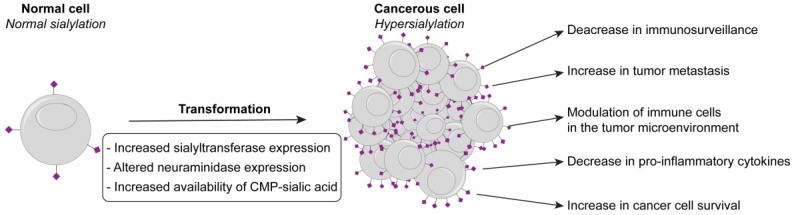
Fig. 1 Mechanisms and effects of hypersialylation in cancer.1
Rodrigues and Macauley describe elevated sialic acid on cancer cells and illustrate mechanisms that can contribute to hypersialylation, including altered sialyltransferase expression, altered neuraminidase expression, and changes in CMP-sialic acid availability. This literature evidence supports the research rationale for developing antibodies against enzymes that regulate disease-associated glycosylation.
sialyltransferasesneuraminidasestumor glycosylation| Enzyme Group | Short Form | Aberrant Glycosylation Implication |
|---|---|---|
| Polypeptide N-acetylgalactosaminyltransferase | ppGalNAc-T | Increased incomplete synthesis of O-glycans |
| N-acetylglucosamine transferase V | GlcNAcT-V | Increased beta1-6 branching of N-glycans |
| alpha2-3 sialyltransferases | ST3Gal I, ST3Gal IV | Increased expression of sialylated glycans |
| alpha2-6 sialyltransferase | ST6GalNAc | Altered sialylated glycan expression |
Table 1. Enzymes associated with aberrant glycosylation as cancer biomarkers.2
Meany and Chan reviewed how altered expression of glycosyltransferases and glycosidases can contribute to cancer-associated glycan changes. Their examples include enzymes involved in mucin O-glycosylation, N-glycan branching, and sialylated glycan formation. For research-use antibody development, these enzyme classes provide practical target categories for expression profiling, pathway investigation, and assay reagent generation.
ppGalNAc-TGlcNAcT-VsialyltransferasesHow to Start an Enzyme Antibody Project
For the fastest project setup, clients can provide the enzyme name, accession number, species, desired isoform, preferred assay, and any related family members that must be excluded. If the enzyme is membrane-bound, information about the desired antibody orientation is useful: some projects require antibodies against luminal or extracellular regions, while others need cytoplasmic-domain detection for Western blot or immunoprecipitation.
If recombinant antigen is unavailable, Creative Biolabs can evaluate peptide, domain-expression, or cell-based immunization strategies. For enzyme families with high conservation, we may recommend a two-stage program: first generate a broad candidate panel, then apply stringent counter-screening against homologs and application-specific samples. This approach helps avoid losing potentially useful clones too early while still protecting the final reagent from misleading cross-reactivity.
Useful Starting Materials
- Target sequence, isoform, species, and accession number.
- Known domain boundaries, transmembrane regions, and processing information.
- Positive and negative cell lines, tissue samples, or recombinant controls.
- Required assay format and acceptable cross-reactivity profile.
Discuss Your Project →
Frequently Asked Questions
Can Creative Biolabs develop antibodies against membrane-bound glycosyltransferases?
Yes. We can design antigens from soluble domains, luminal or extracellular loops, cytoplasmic regions, recombinant fragments, peptides, or cell-based immunogens depending on topology and application.
Can the project aim for isoform-specific recognition?
Yes. We analyze homologous family members and select unique antigen regions, then use counter-screening against related isoforms when materials are available.
How do you validate antibodies against enzymes with precursor and active forms?
We can compare full-length protein, processed fragments, positive samples, negative controls, and application-specific samples to understand which enzyme state the antibody detects.
Which assays can be included?
Common options include ELISA, Western blot, immunofluorescence, immunohistochemistry, immunoprecipitation, flow cytometry, peptide arrays, and activity-related or target-engagement assay formats.
Can you work with microbial, plant, or animal enzyme targets?
Yes. Human, animal, plant, microbial, and engineered enzyme targets can be included if sequence information or antigen material is available.
What if recombinant enzyme antigen is difficult to express?
Creative Biolabs can evaluate peptide, domain-expression, cell-based, or DNA-assisted immunization strategies according to the target and intended antibody use.
Can the final antibody support drug discovery?
Yes, for research and drug-discovery support. We can design validation around target engagement, pathway modulation, research pharmacodynamic readouts, or screening-assay compatibility.
What information should we provide first?
Please provide the target name, accession number, species, isoform, domain preference, intended assay, and any related enzymes that must be excluded.
References:
- Rodrigues, Emily, and Matthew S. Macauley. "Hypersialylation in Cancer: Modulation of Inflammation and Therapeutic Opportunities." Cancers 10.6 (2018): 207. Distributed under Open Access license CC BY 4.0. https://doi.org/10.3390/cancers10060207
- Meany, Danielle L., and Daniel W. Chan. "Aberrant glycosylation associated with enzymes as cancer biomarkers." Clinical Proteomics 8.1 (2011): 7. Distributed under Open Access license CC BY 2.0. https://doi.org/10.1186/1559-0275-8-7
Featured Products





For Research Use Only. Not For Clinical Use.
Related Services:
- Anti-Glycosyltransferase Antibody Development
- Anti-Glycosidase Antibody Development
- Anti-Sialidase Antibody Development
- Anti-Fucosyltransferase Antibody Development
- Anti-Sialyltransferase Antibody Development
- Anti-Mannosidase Antibody Development
- Anti-Hexosaminidase Antibody Development
- Anti-Sulfotransferase Antibody Development
- Anti-Endoglycosidase Antibody Development
- Anti-Heparanase Antibody Development
- Anti-GlcNAc-transferase (GnT) Antibody Development
- Anti-Galactosyltransferase (GalT) Antibody Development
- Anti-Hyaluronidase Antibody Development
Loading case studies...
Online Inquiry