
Target Definition
Confirm the exact GalT gene or isoform, species, topology, molecular form, required/excluded family reactivity, and intended assay.


Creative Biolabs develops custom anti-galactosyltransferase antibodies for researchers who need a reagent against a defined GalT rather than an unspecified enzyme family.
Creative Biolabs develops custom anti-galactosyltransferase antibodies for researchers who need a reagent against a defined GalT rather than an unspecified enzyme family. Within our Anti-Glycan Related Enzyme Antibody Development Service, we connect family-member selection, topology, antigen presentation, homolog counter-screening, and the final assay so the development plan is aligned with the biological conclusion the customer needs to make.
“GalT” can refer to several enzymes that transfer galactose to different acceptors and build different linkages. B4GALT family members, C1GALT1, A4GALT, and other galactosyltransferases are not interchangeable targets. Many also share Golgi localization or related structural features, so a Golgi pattern or broad catalytic-domain signal cannot by itself support a gene-specific conclusion. The project should therefore resolve family member, molecular orientation, and assay objective before candidate generation.
For projects that begin at the broader enzyme-family level, our Anti-Glycosyltransferase Antibody Development Service provides a related entry point.
| Target Context | What Must Be Defined |
|---|---|
| B4GALT family research | Select the exact B4GALT member, species, donor/acceptor context, desired ortholog reactivity, and the assay in which gene-level specificity is required. |
| C1GALT1-focused studies | Define C1GALT1 molecular form and whether native association with its chaperone COSMC is relevant to the intended experiment. |
| Glycolipid-associated GalTs | Name the responsible GalT and the pathway-specific readout rather than using a generic “GalT” label. |
| Golgi localization, capture, or function | Map cytosolic, transmembrane, stem, and lumenal catalytic-domain boundaries where applicable, then select an epitope compatible with the intended native or denatured assay. |
The starting specification should include gene symbol, protein accession, species, isoform, domain architecture, membrane topology, desired cross-reactivity, and final readout. A western-blot antibody may recognize a denatured lumenal fragment, whereas a native capture reagent must recognize an accessible surface on the folded enzyme. Localization studies require an additional layer of specificity because closely related GalTs can occupy the same compartment.
A conserved catalytic-region antigen may favor family reactivity, while a highly unique tail or stem sequence may be poorly suited to native recognition. We make that trade-off explicit in the design plan and use downstream validation to test whether the selected region supports the intended conclusion.
A five-step workflow keeps the family-member question visible from antigen design through final application testing.
Confirm the exact GalT gene or isoform, species, topology, molecular form, required/excluded family reactivity, and intended assay.
Select accessible divergent regions and an antigen format that reflects the target topology and native or denatured state required downstream.
Choose an immunization- or display-based route according to antigen feasibility and the desired binder format.
Combine target binding with paralog counter-screening, ortholog comparison, and controls for tags, coating conditions, or Golgi-associated background.
Test shortlisted candidates in the nominated endogenous detection, localization, capture, interaction, or enzyme-function context.
We do not treat family-member specificity as a sequence-only prediction. Candidate ranking should combine matched biochemical comparisons with biological controls and the final assay conditions, especially when closely related enzymes share localization or catalytic-domain features.
| Validation Route | What We Look For | Key Guardrail |
|---|---|---|
| Family-member specificity | Reproducible target binding with defined separation from nominated GalT paralogs and relevant orthologs. | Match antigen format, tag, and presentation where possible so assay design does not create false selectivity. |
| Endogenous detection / localization | Signal tracks with target-positive versus target-reduced or otherwise appropriate controls under the final fixation or lysis conditions. | A Golgi pattern supports compartment consistency but does not prove target identity. |
| Capture / partner analysis | Recovery of the nominated GalT under native conditions with controlled nonspecific and paralog recovery. | Avoid an epitope that masks the proposed interaction interface unless disruption is intentional. |
| Enzyme-function studies | Catalytic output is measured separately from antibody binding and protein abundance. | Do not infer mechanism from expression change or antibody binding alone. |
For C1GALT1 or other partner-dependent systems, the validation context should also reflect whether complex formation is part of the biological question. Reciprocal or orthogonal evidence can help distinguish true partner association from changes created by the capture reagent itself.
Family-resolved anti-GalT antibodies can support research on glycoprotein and glycolipid biosynthesis, Golgi organization, enzyme trafficking, complex formation, and changes in defined glycan structures. They can also connect a selected transferase with downstream glycan or enzymatic readouts when the study needs to move beyond expression alone.
For projects that also require enzyme-substrate profiling, the Glycosyltransferase & Glycosidase Substrate Microarray is a related Creative Biolabs platform that may complement antibody-based observations.
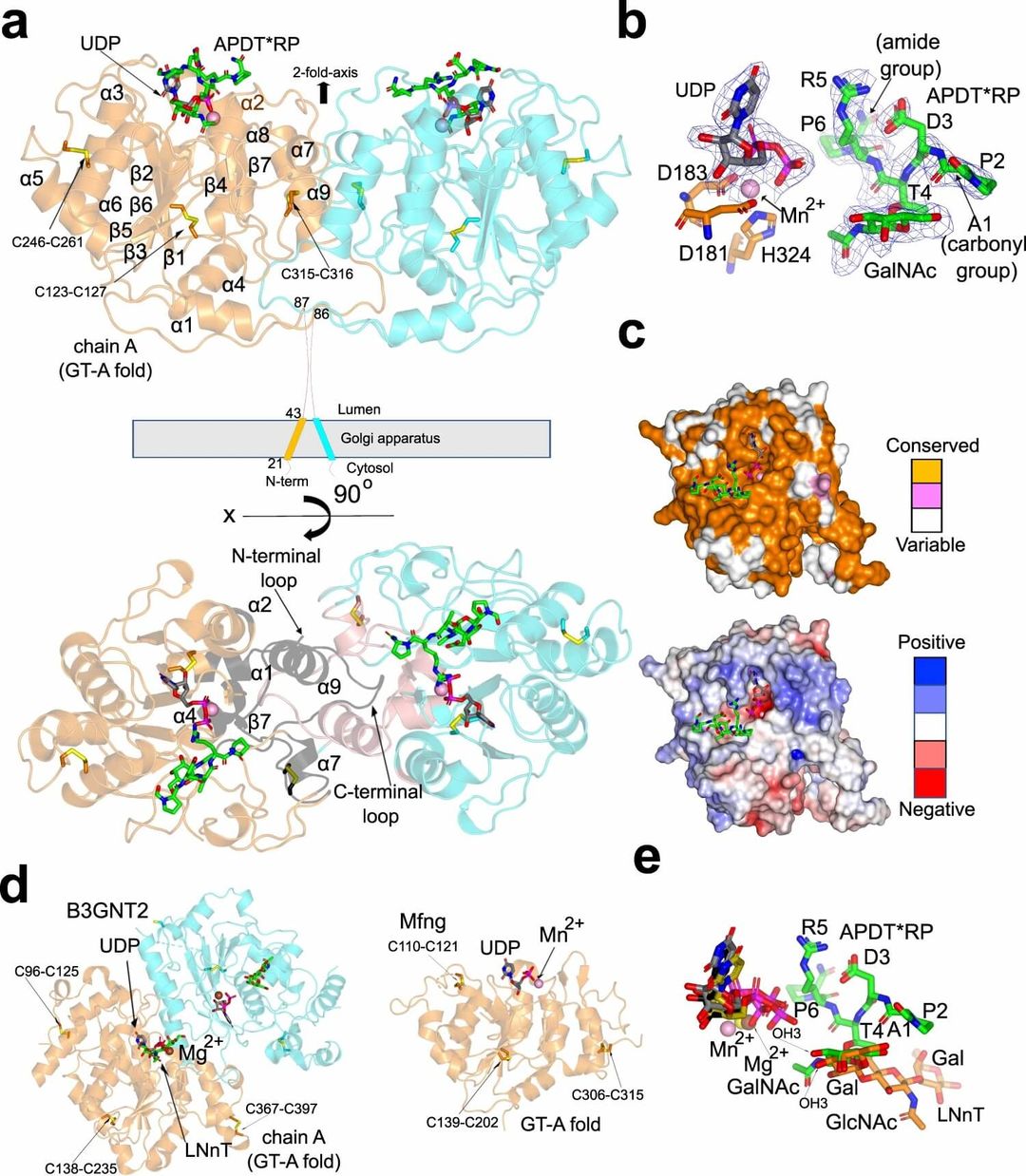
González-Ramírez and colleagues reported structural work on C1GalT1, the enzyme responsible for core 1 O-glycan synthesis, and described features involved in catalysis and partner-dependent function. For antibody planning, the study is useful because it resolves domain architecture, accessible surfaces, and interaction interfaces for a specific GalT rather than treating the family label as the target. These structural details can help distinguish regions that are surface-accessible from regions that are functionally important but poorly suited to antigen presentation. The broader development lesson is that epitope selection should be tied to the molecular state and assay: a region suitable for denatured detection may not support native capture, and an interface-adjacent epitope can affect the interaction being measured.
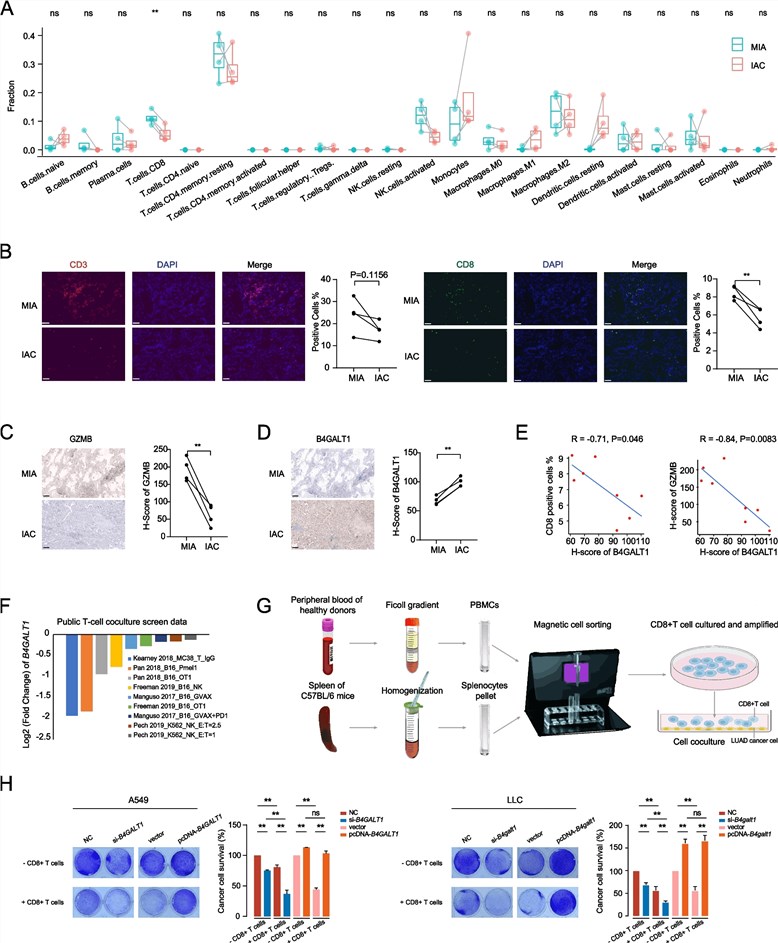
Cui and colleagues examined B4GALT1 in lung adenocarcinoma using expression, immunohistochemical, immune-profiling, and functional analyses. The study linked B4GALT1 status with changes in PD-L1 regulation and immune-cell context, providing an example of how a GalT-specific reagent can be interpreted alongside orthogonal biological measurements rather than in isolation. For antibody-development planning, the important point is not the disease model itself but the requirement for gene-level specificity when several glycosyltransferases occupy related cellular environments. A reagent intended to support B4GALT1-specific conclusions should therefore be screened against relevant family members and validated in a biological context where target status can be independently assessed.
Depending on project scope and the agreed experimental plan, the project may include the following inputs and outputs. Not every item is required or included in every project.
Share the exact GalT gene or accession, species, relevant molecular form, desired or excluded family reactivity, final assay, and available controls. Creative Biolabs can use these inputs to frame a family-aware development and validation plan for research use only.