
Target Definition
Confirm HYAL isoform, species, sequence, compartment, molecular state, required/excluded homologs, and intended application.


Creative Biolabs develops custom anti-hyaluronidase antibodies for research programs that need isoform-selective recognition, a defined molecular-state profile, or performance in a nominated detection or functional assay.
Creative Biolabs develops custom anti-hyaluronidase antibodies for research programs that need isoform-selective recognition, a defined molecular-state profile, or performance in a nominated detection or functional assay. Within our Anti-Glycan Related Enzyme Antibody Development Service, the project is planned around the exact HYAL target, species, antigen format, homolog exclusions, and the biological context in which the antibody will be used.
A useful antibody specification begins with the biological question rather than the family name. Mammalian hyaluronidases differ in sequence, processing, localization, pH context, and substrate access. A reagent intended to detect lysosomal HYAL1 therefore requires a different design logic from one intended for HYAL2 cell-surface research or for controlled enzyme-inhibition experiments. The central challenge is to preserve the molecular feature needed for the final assay while avoiding cross-reactivity with closely related proteins.
| Research Need | Development Emphasis |
|---|---|
| Isoform-selective detection | Use sequence and accessibility differences to separate the nominated HYAL isoform from the nearest homologs. |
| State-aware recognition | Define whether the target epitope must be present on precursor, processed, native, denatured, cell-surface, or otherwise specified enzyme. |
| Localization or native binding | Match antigen presentation and validation conditions to extracellular topology, fixation, permeabilization, or compartment context. |
| Functional investigation | Keep binding and enzyme inhibition as separate outputs and add substrate-conversion testing only when the project objective requires it. |
The target record should identify species, HYAL family member, sequence accession, relevant construct boundaries, compartment, molecular state, and final application. For HYAL1 and HYAL2, sample context and processing are especially important because what is observable can change with localization, glycosylation, and assay conditions.
Where cell-surface recognition or native enzyme activity matters, more than one antigen presentation may be useful for early triage. The choice remains project-specific and should be tied to a measurable acceptance criterion before candidate generation.
We use a five-step framework so isoform specificity and end-use performance are addressed before candidates enter application-heavy validation.
Confirm HYAL isoform, species, sequence, compartment, molecular state, required/excluded homologs, and intended application.
Select divergent accessible regions and an antigen format compatible with processing, topology, and the native or denatured state required downstream.
Choose an immunization- or display-based route according to antigen feasibility and the desired antibody format.
Combine target binding with HYAL homolog counter-screening, ortholog comparison, and controls for tags, format, or matrix background.
Evaluate shortlisted candidates in the intended detection, localization, native capture/binding, or enzyme-function context using appropriate controls.
We connect recombinant recognition to target identity through more than one line of evidence. Positive binding to the immunogen establishes antigen recognition, but it does not by itself establish endogenous specificity or native-state performance.
| Validation Route | Evidence Sought | Interpretation Guardrail |
|---|---|---|
| Isoform specificity | Defined binding profile across the nominated HYAL target and relevant homolog panel. | Use matched protein formats where possible; apparent selectivity can be created by unequal presentation. |
| Detection / localization | Signal follows target status in appropriate biological material under the final lysis, fixation, or permeabilization conditions. | Co-localization or one expected band is supporting evidence, not standalone proof of identity. |
| Native binding / capture | Recognition or recovery is retained under the intended extracellular or native biochemical conditions. | A peptide-positive clone may fail if the corresponding region is inaccessible on the folded protein. |
| Enzyme inhibition | A reproducible change in substrate conversion is observed with suitable control antibodies and assay controls. | Reduced turnover can reflect steric interference, enzyme instability, or matrix effects rather than a defined inhibitory mechanism. |
For western blotting, multiple bands should be interpreted in light of glycosylation, processing, reduction conditions, and construct differences. For functional studies, binding and catalytic effects should be reported separately so a strong binder is not automatically described as a neutralizing reagent.
Hyaluronidase-focused antibodies can support research on hyaluronan turnover, extracellular-matrix remodeling, tissue injury, inflammation, tumor-microenvironment biology, and enzyme trafficking. The value of the reagent depends on whether it resolves the relevant isoform and molecular state in the spatial context of the study.
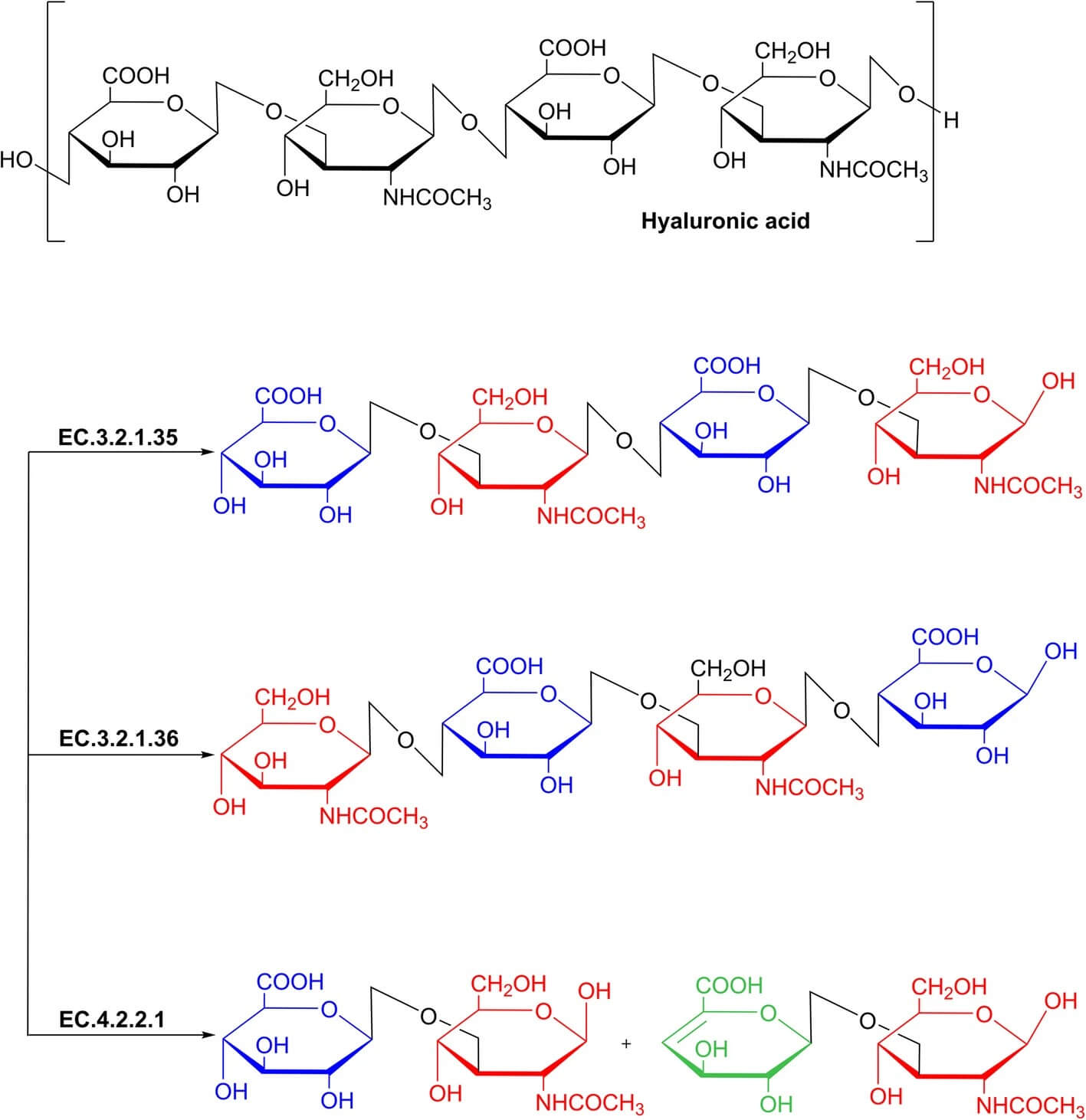
Lu and colleagues reviewed the mammalian hyaluronidase family and summarized differences in structure, catalytic context, post-translational modification, processing, and subcellular localization. For antibody planning, the key point is that family membership alone is not a sufficient target definition. HYAL1, HYAL2, and other hyaluronan-degrading proteins can differ in compartment, molecular presentation, and assay-relevant conditions. The schematic below also highlights that hyaluronan degradation can involve enzymes with different cleavage modes. A custom antibody program should therefore specify the exact protein, molecular state, and intended readout before immunogen selection, then use homolog-aware screening to test whether the chosen region actually provides the required selectivity.
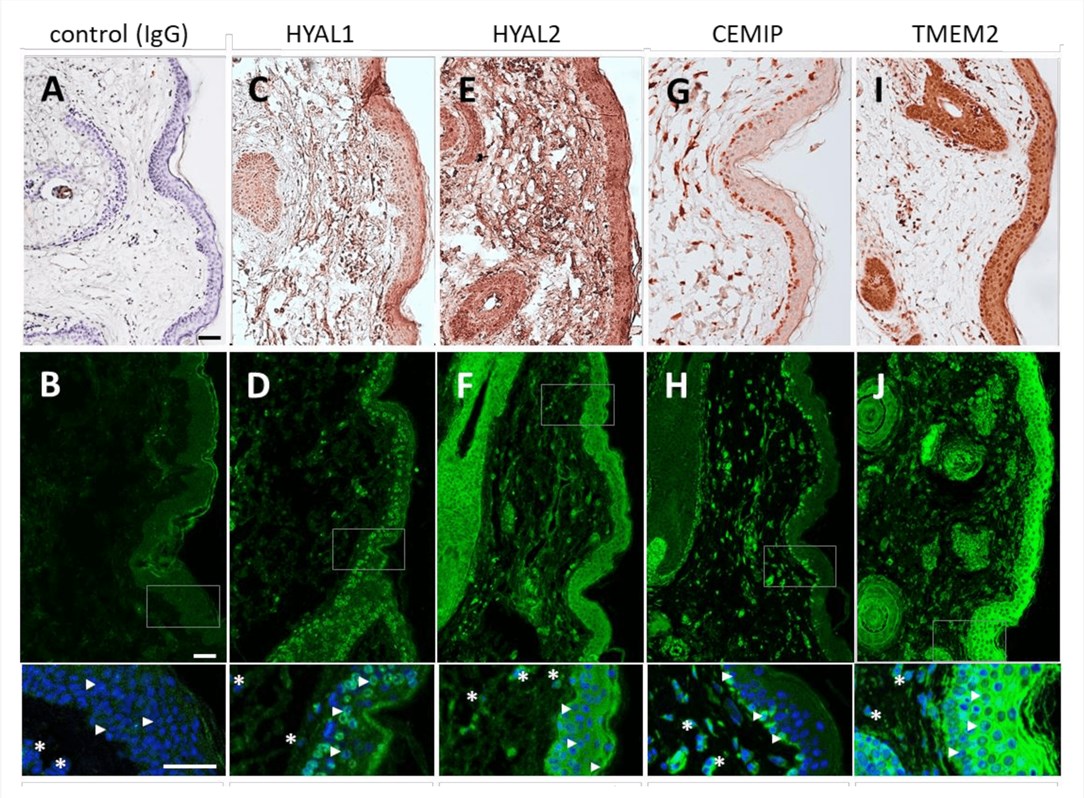
Žádníková and colleagues used antibody-based immunohistochemistry and immunofluorescence to compare the distribution of HYAL1, HYAL2, TMEM2, and CEMIP in human skin. The study reported distinct localization patterns, including predominantly intracellular HYAL1 and a broader HYAL2 distribution. For reagent development, this illustrates why localization should be interpreted together with isoform identity and appropriate controls: several hyaluronan-degrading proteins can be present in the same tissue while occupying different cellular or subcellular contexts. The figure below therefore supports a practical validation principle for custom antibodies—test the candidate in the intended tissue or cell context and avoid treating compartmental co-localization alone as proof of specificity.
Depending on project scope and the agreed experimental plan, the project may include the following inputs and outputs. Not every item is required or included in every project.
Share the HYAL isoform and species, sequence accession, intended antibody format, preferred application, sample context, and required homolog exclusions. Creative Biolabs can use these inputs to frame an isoform-aware development and validation strategy for research use only.