Corn derived Exosome Research & Application
Overview Services Workflow Research Highlights Platform Why Us Deliverables Testimonials FAQs
Overview
Corn (Zea mays) stands as one of the world's most abundant cereal crops, making it an attractive, sustainable source for plant-derived nanovesicles. Corn-derived exosomes are nanosized extracellular vesicles that facilitate intercellular signaling within plants and carry biologically active molecules such as proteins, lipids, and RNA. Their natural abundance and accessibility position them as valuable tools for research and innovation, particularly in agricultural biotechnology, cosmetics, and bioengineering sectors. At Creative Biolabs, we leverage our deep expertise to support custom production and research projects focused on corn exosomes, delivering reliable and scalable solutions tailored to scientific discovery.
Creative Biolabs' Service Offerings for Corn Exosome Research
Creative Biolabs' core service encompasses the custom isolation and preparation of corn-derived exosomes designed for foundational research use.
-
Our standard package includes tailored extraction and verification of corn exosomes.
-
Additional analyses are available as optional add-ons, including particle size and morphology characterization (NTA, TEM), molecular cargo profiling (proteomics, lipidomics, RNA-seq), surface marker identification, and stability testing.
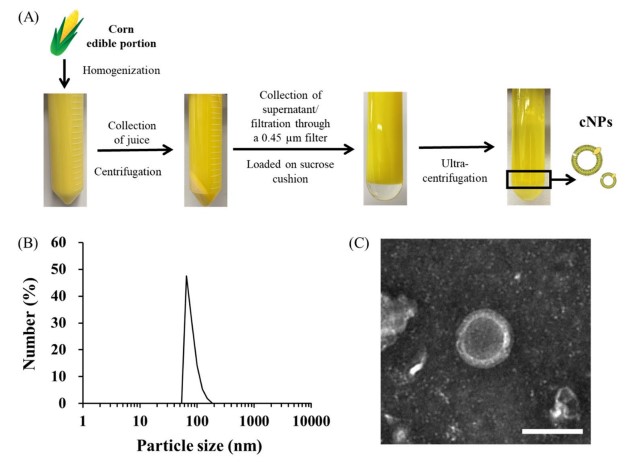 Fig.1 Isolation and characterization of corn-derived exosomes.1
Sample Processing & Isolation Workflow
Creative Biolabs employs a streamlined and robust workflow optimized specifically for corn exosome isolation:
-
Washing fresh sweet corn with purified water to remove surface contaminants
-
Homogenizing corn kernels to create a raw suspension
-
Filtering and centrifuging to exclude coarse particulates and debris
-
Ultracentrifugation to separate exosome populations
-
Final purification and resuspension in buffered solution for downstream applications
This workflow is scalable and adaptable, allowing customization based on project scale or research focus.
Key Scientific Findings on Corn-Derived Exosomes
|
Research Focus
|
Summary of Findings
|
|
Physical & Molecular Characterization
|
Corn exosomes exhibit a typical nanoscale size (~80 nm), a negatively charged surface, and characteristic cup-shaped morphology. Lipidomic profiling identifies major phospholipids like phosphatidylcholine and sphingomyelin, consistent with plant vesicles.
|
|
Cellular Uptake Dynamics
|
Fluorescent labeling studies reveal that corn exosomes are efficiently internalized by murine colon adenocarcinoma cells, fibroblasts, and macrophages, predominantly via cholesterol-dependent endocytosis pathways.
|
|
Anti-Proliferative Effects on Tumor Cells
|
Corn exosomes have demonstrated time-dependent inhibition of proliferation in colon, breast, and pancreatic cancer cell lines. Cell cycle analysis indicates G2 phase arrest upon treatment.
|
|
Immune Activation & Anti-Tumor Activity
|
ELISA assays confirm that corn exosomes stimulate macrophage secretion of TNF-α, promoting tumor cell apoptosis. Animal studies show significant tumor suppression in corn exosome-treated mice.
|
|
Surface Modification Enhances Functionality
|
PEGylation of corn exosomes increases circulation retention and tissue targeting efficacy, thereby enhancing anticancer effects in vivo.
|
Creative Biolabs combines cutting-edge analytical platforms and well-established protocols to ensure each client's research benefits from these advances in corn exosome science.
Advanced Technology & Analytical Platforms
Creative Biolabs' dedicated infrastructure supports comprehensive corn exosome research, including:
-
High-speed and ultracentrifuges for precise vesicle isolation
-
Density gradient systems for vesicle purification
-
Optional nanoparticle tracking analysis (NTA) and electron microscopy (TEM) for morphology and size distribution
-
Molecular profiling pipelines for proteomics, lipidomics, and RNA analysis
-
Surface modification and functionalization technologies, including PEGylation
Our platform flexibility enables clients to tailor the scope of their research, from basic isolation to advanced characterization.
Advantages of Partnering with Creative Biolabs
|
Years of focused experience in plant-derived exosome isolation and analysis
|
Stringent protocols to ensure purity, reproducibility, and biological relevance
|
|
Modular services that fit the unique needs and budgets of research teams
|
Comprehensive data protection and confidentiality agreements
|
Creative Biolabs is your trusted partner for pioneering research into corn exosomes and related applications.
Deliverables Overview
Clients receive:
-
Purified corn-derived exosome preparations in user-specified quantities
-
Summary of isolation protocols and basic quality control (Particle size and concentration data by NTA testing) reports
|
Optional deliverables upon request:
-
Electron microscopy images (TEM)
-
Molecular profiling data (proteomics, RNA, lipids)
-
Stability test results under defined storage or environmental conditions
|
Client Testimonials
"Creative Biolabs' tailored corn exosome preparations were essential for our project investigating plant nanovesicles. Their professionalism and detailed reporting made our data robust and publishable."
— University Research Group, USA
"The optional molecular profiling added significant depth to our understanding of corn exosomes. Creative Biolabs' flexibility and expert advice truly set them apart."
—R&D Team, Europe
Corn-derived exosomes offer a promising avenue for research innovation across multiple fields. Creative Biolabs' comprehensive expertise and customizable service offerings are designed to accelerate your foundational research with reliable, high-quality materials and data. Contact us today to explore your corn exosome project needs.
FAQs
Q: What are corn-derived exosomes, and how are they different from other plant-derived exosomes?
A: Corn-derived exosomes are nano-sized extracellular vesicles released by corn plants. These exosomes contain various biomolecules, including proteins, lipids, and RNA, which can facilitate intercellular communication and influence various biological processes. Unlike exosomes from other plants, corn-derived exosomes are particularly abundant and have unique biochemical compositions that may enhance their functionality in research and applications.
Q: What specific functions do corn-derived exosomes exhibit that make them interesting for research?
A: Corn-derived exosomes have been shown to possess antioxidant properties, carry signaling molecules, and potentially modulate immune responses. Their ability to deliver bioactive compounds directly into target cells enhances their role in various research applications, including agricultural biotechnology and bioengineering, where they may be used to improve crop resilience or nutrient delivery.
Q: What are the potential uses of exosomes derived from corn in skin care and cosmetic applications?
A: The unique composition of corn-derived exosomes, which may include hydrating lipids and skin-repairing proteins, positions them as promising ingredients in cosmetic formulations. Their potential for promoting skin cell regeneration and reducing inflammation makes them valuable for product development aimed at anti-aging, moisturizing, and skin barrier repair.
Q: Are there any current research trends in the study of corn-derived exosomes?
A: Current research trends include exploring the isolation methods to enhance yield and purity of corn-derived exosomes, studying their molecular cargo for various bioactive compounds, and investigating their potential as delivery systems for agricultural and biotechnological applications. Additionally, there is a growing interest in their role in plant stress responses and how that can translate into industrial applications.
Q: What challenges are researchers facing in studying corn-derived exosomes?
A: Researchers encounter several challenges, including the standardization of isolation and characterization methods, understanding the mechanisms of exosome communication within plant systems, and deciphering their interaction with human skin or other biological systems in non-clinical contexts. Reaching the full potential of exosomes generated from corn in a variety of applications requires overcoming these obstacles.
Q: What potential innovations could arise from corn-derived exosome research?
A: Potential innovations include the development of sustainable agricultural practices through enhanced resilience of crops via exosome-mediated signaling, novel formulations in skincare products that leverage the natural components of corn-derived exosomes, and the creation of environmentally friendly biopesticides that utilize the molecular capabilities of these exosomes for plant protection.
Reference
-
Sasaki, Daisuke et al. "Development of nanoparticles derived from corn as mass producible bionanoparticles with anticancer activity." Scientific reports vol. 11,1 22818. 24 Nov. 2021, doi:10.1038/s41598-021-02241-y. Distributed under Open Access license CC BY 4.0. The image was modified by revising the title.
For Research Use Only. Cannot be used by patients.
Related Services: