Extracellular Vesicle Targeting Service
Overview Services Features FAQs
Overview
Endowing Extracellular Vesicles with Targeting Specificity
Extracellular vesicles (EVs) are particles naturally released by cells, which have a lipid bilayer structure. Because EVs have the advantages of low tumorigenic risk, weak autoimmune response and toxicity, small size, low complexity of structure and composition, easy production and preservation, etc., EVs have become a hot topic for research, transformation, and modification. In order to improve the efficiency of EV targeting lesions, a large number of researchers have immobilized molecules with targeting functions on the surface of EV, so that EVs can gather in target tissues or cells more efficiently, which improves the usage efficiency of drugs encapsulated in EV. Common targeting molecules include peptides, nucleic acid aptamers, superparamagnetic nanoparticles, etc. Commonly used modification methods include endogenous modification and exogenous modification. Creative Biolabs has been paying attention to and summarizing molecules with targeting functions that can be constructed on EV and can provide the best EV targeting modification services according to customer needs.
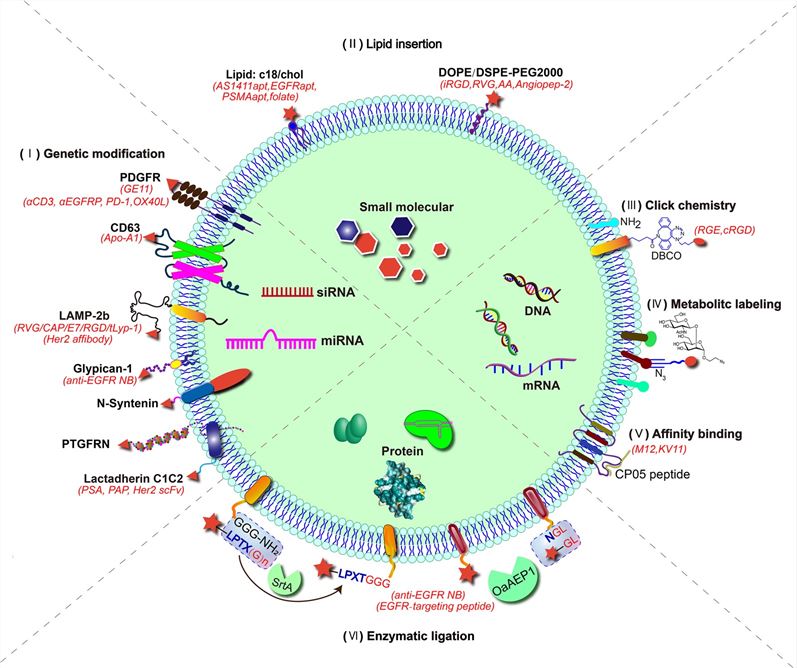 Fig.1 Strategies for the membrane modification and targeted delivery of EVs.1,2
Services
Endogenous Targeting Modification Service for Extracellular Vesicle
The endogenous targeting modification of EV is carried out on donor cells through genetic recombination, and these engineered donor cells can release EVs with targeting molecules. Specifically, peptides or proteins with targeting functions are fused to EV membrane proteins, so that these targeting molecules are displayed on the outside of EV membranes. Commonly used EV membrane proteins for anchoring targeting molecules include Lamp2b, tetraspanins (such as CD63, CD9, CD81, etc.), the C1C2 domain of lactadherin, etc. At present, there is a set of relatively mature and general operating methods for targeting the modification of EV using genetic means. By establishing stable cell lines, targeted EVs can be produced in large quantities within a long period of time.
Exogenous Targeting Modification Service for Extracellular Vesicle
Exogenous targeting modification of EV is carried out on isolated EVs by chemical methods. The commonly used modification method is non-covalent binding relying on hydrophobic interactions or receptor-ligand interactions. Hydrophobic interaction-dependent modification needs to attach a hydrophobic tail to the targeting molecule so that the targeting molecule can be modified on the EV surface through the hydrophobic interaction between the tail and the EV membrane. The modification that depends on the receptor-ligand interaction needs to connect a receptor or a ligand to the EV membrane protein and the targeting molecule, respectively, so that the targeting molecule can be modified on the EV surface through the complementary pairing of the receptor and the ligand. Compared with endogenous targeting modification methods, exogenous targeting modification methods can modify more diverse molecules on the surface of EV, such as nucleic acids, lipids, and nanoparticles.
Features
-
Dual Surface Modification Strategies
-
Enhanced Targeting Specificity
-
Customizable Modifications for Diverse Applications
-
Scalable and Reproducible Production
Creative Biolabs has extensive experience in modifying EV and has established a library of targeted molecules that can be modified on the surface of EV. If you are interested in EV targeting modification services, please contact us with your specific idea. Our professional team will provide you with EV isolation and characterization services and formulate the most suitable EV targeting modification plan based on experience. In addition, we also provide EV loading services, EV profiling services, and EV functional research and verification services to further verify the efficiency of targeted EVs for you.
FAQs
Q: What information is needed when designing a surface modification experiment?
A: Please provide detailed information on the desired targeting molecules (such as peptides or ligands), the specific cell types or tissues to be targeted, and any preferences regarding the modification strategy (endogenous vs. exogenous).
Q: How do you ensure the successful attachment of targeting molecules in exogenous surface modification?
A: For exogenous surface modification, we use optimized conjugation protocols to ensure the effective and stable attachment of targeting molecules. Additionally, we validate the modification using various characterization techniques such as flow cytometry, particle size distribution analysis, and zeta potential measurement to confirm the successful attachment and proper functionality of the targeting ligands.
Q: How should exosomes carrying target molecules be stored to prevent a loss of activity?
A: Modified extracellular vesicles should be stored at -80°C to maintain their stability and functionality. Our technical experts recommend avoiding repeated freezing and thawing, as this can affect the structure of the exosomes, leading to a reduction in both their activity and targeting capability.
Q: Can I request specific quality control tests for my modified extracellular vesicles?
A: We offer a range of exosome characterization services, including marker protein detection, particle size and count analysis, and morphological observation of exosomes. You can request specific tests based on your research needs, and we will provide the results to confirm the success and quality of the surface modification.
Q: Can surface modification be combined with drug loading in extracellular vesicles?
A: Yes, we can combine surface modification with drug loading to create a multifunctional delivery system. Our team will help design an optimal strategy to achieve both effective drug loading and targeted delivery, considering factors like loading efficiency, targeting specificity, and vesicle stability.
References
-
Liu, Q.; et al. Targeted therapy using engineered extracellular vesicles: principles and strategies for membrane modification. Journal of Nanobiotechnology. 2023, 21(1):334.
-
Distributed under Open Access license CC BY 4.0, without modification.
For Research Use Only. Cannot be used by patients.
Related Services: