Why QDs?
Quantum dots (QDs) are colloidal nanocrystalline semiconductors and possess properties such as a quantum confinement effect. The three major kinds of QDs include the core-shell structures (CdTe/CdS), homogeneous structures (CdTe, CdSe), and ternary structures (CdTeSe). QDs with particle sizes of 1-10 nm provide a new type of nanomaterial with unique optical and electronic properties. The excellent optical properties include but not limited to the following:
- Broad and consecutive excitation bands, high absorptivity.
- Narrow and symmetric emission, long fluorescence lifetime.
- Good photostability with low susceptibilities to photo-bleaching.
- Tunable emission wavelength.
Aptamer and QD Combination
Aptamers can be modified with a variety of fluorescent QDs providing extraordinary flexibility in the development of assays. Four major strategies can be used to modify aptamers onto ODs.
- Self-assembly between DNA and QDs
- Biospecific interactions such as biotin-avidin/streptavidin interaction
- Covalent interactions
- Nucleic acid hybridization
The combinations of QDs and aptamers are expected to offer various detection platforms, including optical, electrochemical and electrochemical luminescence, brings more opportunities for bioanalysis. Different QDs with different emissions can be excited by a single wavelength of exciting light, which enables simultaneous analysis of many targets in a single analytical run. The combination of the two brings more opportunities for biological analysis.
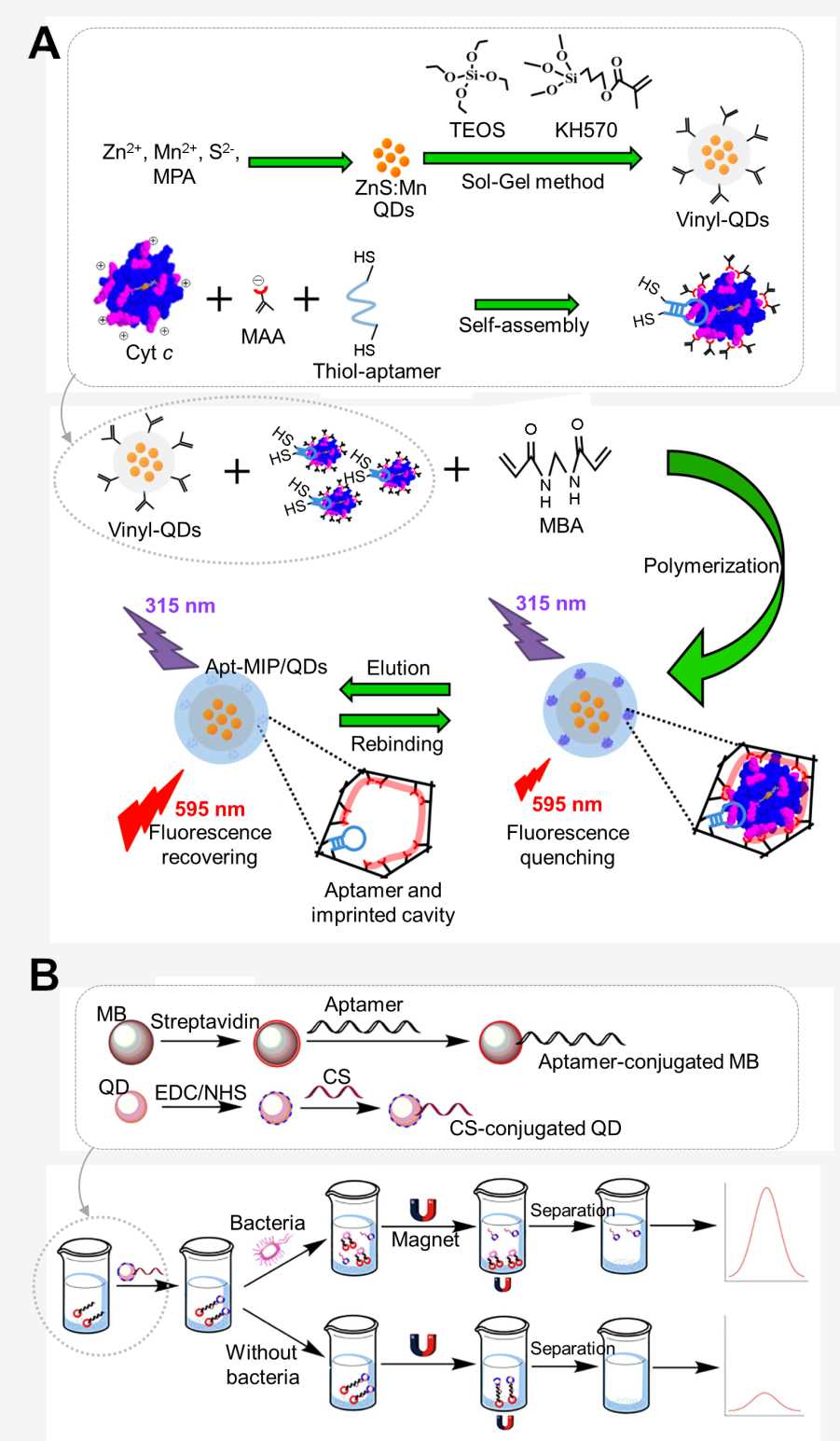 Fig.1 QD biosensing: optical signal modulation in aptamer-analyte binding.1
QD-based Aptasensors
QD-based aptasensors are regarded as an attractive choice for aptasensor fabrication given the emerging prevalence of QDs in various nanotechnologies.
Self-assembly QDs-based aptasensor for Ochratoxin A (OTA) detection
A continual precursor injection method could be used to synthetize thick-shell CdSe/CdS QDs instead of a purification process. A self-assembling aptasensor was fabricated by precisely attaching three phosphorothioate-modified capture aptamers onto the single thick-shell QDs in a controllable manner.
Taking pathengon detection for instance, scientists developed a fluorescent aptasensor for P. aeruginosa detection. 5-carboxyfluorescein-labeled complementary DNA (FAM-cDNA) was combined with QDs. In the absence of target bacteria, the fluorescence of FAM could be quenched by Graphene oxide QDs (GOQDs). When the target bacteria were added, the aptamer was used as a biological recognition element to specifically bind to P. aeruginosa, while FAM-cDNA tended to hybridize with the aptamer, which resulted in the desorption of FAM-cDNA from GOQDs, thus restoring the fluorescence of FAM.
Creative Biolabs believes that QDs-based aptasensor will contribute to the solution of many analytical or other problems based on target recognition in the future. We provide QDs-based aptasensor development services for global clients.If you are interested in our services, please feel free to contact us for more information.
Reference
- Kim, Dongmin, and Seungmin Yoo. "Aptamer-conjugated quantum dot optical biosensors: Strategies and applications." Chemosensors 9.11 (2021): 318. Distributed under Open Access license CC BY 4.0, without modification.
For Research Use Only.