Colorectal Cancer-Targeted Exosome Modification Service
Overview Services Features FAQs
Overview
Finding out the specific target of colorectal cancer (CC) and killing CC cells is a precise and efficient treatment method. To achieve precise treatment and reduce the toxic side effects of the treatment process on normal cells, researchers have been looking for an optimal drug delivery carrier.
Exosomes are natural nanobiological carriers with stability and membrane permeability. Because exosomes can recognize specific cells, delivery of therapeutic drugs via exosomes has better efficacy and fewer off-target effects than other biological carriers, such as liposomes. Therefore, exosomes can be efficiently transported and transferred, such as drugs, miRNAs, small interfering RNAs (siRNAs), short hairpins, and transfer RNAs (shRNAs), etc., for the treatment of CC. Furthermore, improving the specificity of exosome targeting and being absorbed by CC cells by exosome display technology is a very promising strategy. Creative Biolabs can provide CC-targeted exosome modification service and other related technologies such as exosome display-based targeted delivery, cargo loading into exosomes, exosome profiling, etc., to assist global customers in the therapeutic research of CC.
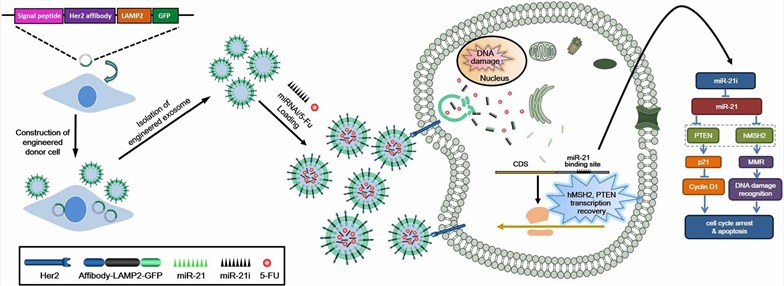 Fig.1 Engineered exosomes-based nanocarrier for 5-FU and miR-21i simultaneously deliver to human colon cancer cells for enhancing chemotherapy efficacy.1,2
Services
Colon Cancer-Targeted Exosome Construction Service
We offer a variety of engineered exosomes modified with targeting peptides, including but not limited to:
|
Engineered Exosome Type
|
Targeting Mechanism
|
Verified results
|
|
AS1411-Modified Exosomes (AS1411-Exo)
|
AS1411 is a nucleic acid aptamer that targets tumor cells with high nucleolin expression, enhancing cell uptake efficiency.
|
AS1411 is conjugated to the surface of exosomes, creating AS1411-Exo, which can be loaded with therapeutic agents like doxorubicin (DOX). AS1411-Exo effectively targets colon cancer (CC) cells both in vitro and in vivo, significantly inhibiting tumor growth.
|
|
Mucin 1 (MUC1) Targeting with 5TR1-Exo
|
Mucin 1 (MUC1) is a glycoprotein highly expressed on the membranes of colon cancer (CC) cells, making it an ideal target. The 5TR1 aptamer exhibits a high binding affinity to MUC1.
|
5TR1-modified exosomes (5TR1-Exo) are used to increase DOX uptake by CC cells. 5TR1-Exo significantly inhibits tumor growth in mouse models.
|
|
HER2-Targeted Exosomes (HER2a-Exo)
|
Targeting Mechanism: Human epidermal growth factor receptor 2 (HER2) is highly expressed in CC and associated with poor prognosis.
|
Verified results: HER2a-Exo can be loaded with anticancer agents, such as 5-Fluorouracil and miR-21 inhibitors. This approach effectively reverses 5-Fluorouracil resistance in CC cells and significantly inhibits CC progression.
|
Features
-
Innovative Targeted Research
-
Highly Specific Targeting
-
Ideal Carrier for Drug Delivery
-
New Strategies for Colorectal Cancer Research
Creative Biolabs can provide overall services from experimental design, exosome isolation, exosome -NGS, and exosome labeling to in vivo and in vitro function verification. We provide you with including but not limited to AS1411-Exo, 5TR1-Exo, and HER2a-Exo, to assist your CC precision treatment research. Please contact us with your ideas to develop the best overall solution for you.
FAQs
Q: How is the stability of modified exosomes ensured?
A: We use validated modification techniques to ensure the stability of exosomes during experiments. Our technical team can provide stability data for the exosomes, including information on their morphology, size, and activity.
Q: How can the targeting specificity of engineered exosomes be evaluated?
A: There are several methods to assess the targeting specificity of modified exosomes, such as fluorescence labeling, flow cytometry, or immunofluorescence staining. These techniques help detect the distribution of exosomes in cells or tissues, evaluating their efficiency in targeting colorectal cancer cells. Our technical team can also provide related technical support.
Q: What experimental models are suitable for the targeted exosome modification service you offer?
A: Our targeted exosome modification techniques are suitable for various experimental models, including in vitro cell cultures and in vivo animal models. We can assist you in selecting and optimizing the most appropriate experimental models to accurately study the function and efficacy of the exosomes.
References
-
Liang, G.; et al. Engineered exosomes for targeted co-delivery of miR-21 inhibitor and chemotherapeutics to reverse drug resistance in colon cancer. Journal of Nanobiotechnology. 2020, 18(1):10.
-
Distributed under Open Access license CC BY 4.0, without modification.
For Research Use Only. Cannot be used by patients.
Related Services: