
In the advancing field of cutaneous science, providing empirical evidence that a topical agent delivers nourishment to the scalp is a vital analytical challenge. While standard laboratory screenings often focus on basic cellular survival, our methodology targets specific biological markers associated with scalp health: the synthesis of structural barrier proteins, the functionality of water-transport channels, and the production of Natural Moisturizing Factors.
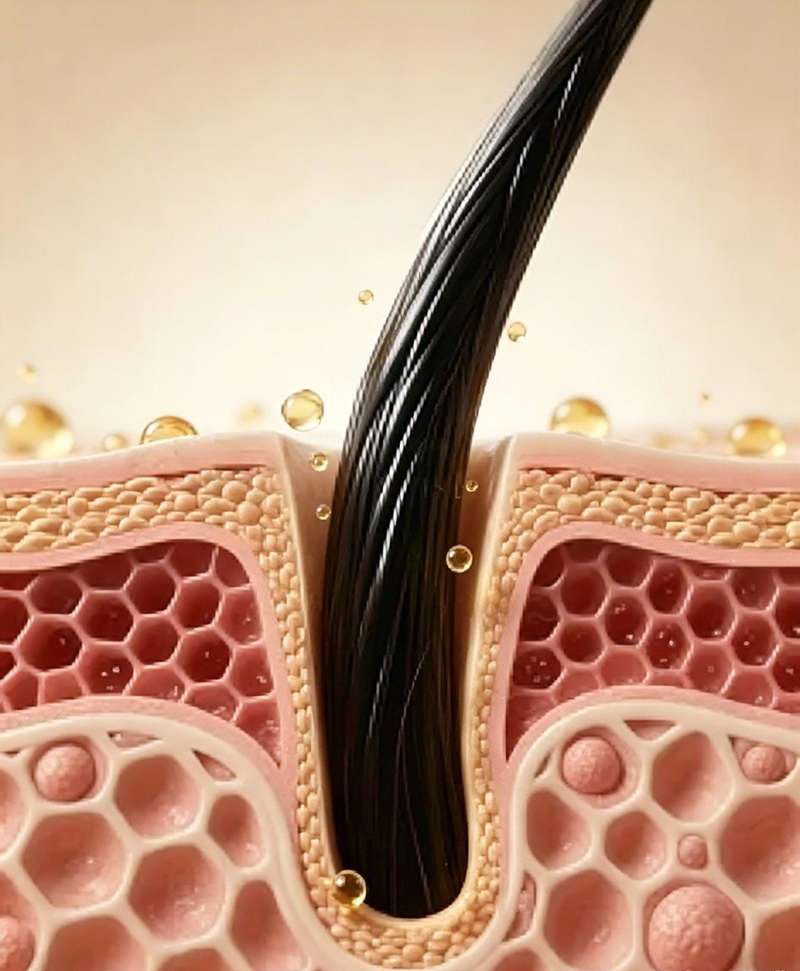
Creative Biolabs conducts this evaluation using a dual-model approach, incorporating both two-dimensional keratinocyte cultures and three-dimensional reconstructed human epidermal systems. The resulting data provides an overview of how candidate exosomes may reinforce the physical shield and enhance the moisture-retention properties of the scalp surface.
Consult Our Ph.D. Group to Structure Your Scalp Nourishment Investigation
Published data indicates that extracellular vesicles facilitate scalp nourishment through a trio of synergistic pathways: barrier enhancement, hydration regulation, and lipid restoration.

Exosomes have been observed to stimulate the production of essential structural proteins such as Filaggrin (FLG), Loricrin, Involucrin, and Claudin-1. These are critical for a resilient barrier that resists environmental irritants and minimizes dehydration.

Specific vesicles can increase the expression of Hyaluronic Acid Synthase 2 (HAS2) and the resulting production of Hyaluronic Acid, which supports the internal moisture levels of the scalp tissue.

Evidence shows that certain stem‑cell‑derived exosomes can induce the synthesis of ceramides, which improves the hydration of the stratum corneum and lowers Transepidermal Water Loss (TEWL).
Connect With Us to Address Your Service Requests
Creative Biolabs follows a structured, stepwise evaluation workflow designed to examine each sample with consistent analytical precision and full methodological openness.

- Molecular Analysis. We employ quantitative Real-Time Polymerase Chain Reaction and Enzyme-Linked Immunosorbent Assay to track the expression of FLG, Aquaporin-3, and HAS2.
- Tissue Level Evaluation. Using three-dimensional skin equivalents, we evaluate morphology via histological staining, measure TEWL, and profile essential lipids.
Connect with Our Project Consultant
Creative Biolabs conducts all testing within a unified framework designed to produce consistent, traceable results across different production batches.



Reach Out to Us for Service Inquiry
Creative Biolabs' exosome capabilities extend beyond scalp nourishment. Researchers can access a full suite of hair care efficacy tests, quality control procedures, and supporting bioengineering workflows, all designed to support laboratory research applications and biological assessments.
 Exosome extraction, purification and quantification
Recovery and refinement of exosomal vesicles from conditioned media, biological fluids, or stem cell‑derived systems using standardized operating procedures to secure inter‑batch uniformity and specified purity levels.
Exosome identification and quality analysis
Physical parameter determination (particle size and concentration) via NTA, morphological verification through TEM, along with immunodetection of established exosomal markers including CD63, CD81, and TSG101.
Exosome profiling and proteomic detection
Characterization of protein and nucleic acid cargo (e.g., miRNA, mRNA) to elucidate molecular compositions and potential signaling pathways relevant to hair biology.
Exosome engineering (optional)
Surface decoration or cargo encapsulation approaches intended to enhance targeted delivery efficiency and functional performance in follicular environments.
Scalable exosome production
Generation of exosomes from adipose‑derived or alternative mesenchymal stem cell sources at production scales adjustable to research specifications.
Exosome Anti-Hair Loss Efficacy Test
Validation of follicle regeneration and hair cycle stimulation.
Exosome Scalp Repair Efficacy Test
Evaluation of dermal tissue restoration and cellular vitality recovery.
Exosome Scalp Oil-Control Efficacy Test
Assessment of sebum regulation and the maintenance of scalp surface equilibrium.
Connect with Us to Learn More About Services
A: Yes. We provide the ability to customize the biomarker panel, the exposure duration, and the specific cell lineages used to ensure the study aligns with your developmental requirements.
A: While two-dimensional cultures are excellent for molecular analysis, three-dimensional models provide a physiologically relevant view of how a substance influences the actual layers of the scalp, including barrier integrity and tissue morphology.
A: We frequently execute dose-response studies. This allows you to identify the relationship between application volume and biological effect, which is vital for establishing optimal concentrations.
A: We recommend using fresh or correctly frozen material. For freeze-dried or long-term stored samples, we can assess quality via NTA upon arrival to ensure suitability for testing.
A: Yes. Our consultants tailor personalized testing plans, confirm sample requirements, and propose a timeline after receiving your requirements list.
A: Two-dimensional assays provide high-speed mechanistic data regarding gene and protein expression. Three-dimensional models offer a realistic readout of barrier performance and stratum corneum integrity. Both complement each other to provide a complete efficacy profile.
Request a Scientific Consultation to Design Your Exosome Efficacy Study