Trichomonas-derived Exosome Research & Application
Overview Workflow Insights Advantages Testimonials FAQs
Exosomes released by Trichomonas vaginalis have emerged as essential mediators of parasite communication, influencing cell adhesion, immune modulation, and strain-specific behavior. At Creative Biolabs, we provide tailored services for Trichomonas-derived exosome research—ranging from exosome isolation and profiling to functional analysis. By integrating high-precision workflow systems and flexible analytical modules, Creative Biolabs empowers researchers to uncover how Trichomonas-derived vesicles orchestrate pathogenic and intercellular events in protozoan systems.
Overview of Trichomonas-Derived Exosomes
Trichomonas vaginalis exosomes are extracellular vesicles that facilitate molecular exchange between parasites and host cells.
These exosomes carry distinct RNA and protein cargoes that mediate inter-parasite communication and regulate host–parasite interactions.
Studies suggest that Trichomonas exosomes promote the formation of cytonemes and filopodia—membrane extensions that enable direct communication and coordination between mixed parasite populations.
The vesicles' molecular contents, especially tRNA-derived fragments and conserved protein factors, play essential roles in parasite adaptation and colonization.
Discuss your research goals with Creative Biolabs' exosome experts for customized analysis options.
Exosome Isolation Workflow
At Creative Biolabs, the Trichomonas-derived exosome preparation workflow combines standard development with customizable analytical options. Our process ensures high-quality, reproducible yields suitable for downstream molecular and functional assays.
Standard Exosome Development Steps:
-
Culture Preparation:
-
Grow Trichomonas vaginalis in suitable culture media under controlled conditions.
-
Wash parasite cultures thoroughly with sterile PBS to remove residual debris.
-
Conditioned Medium Collection:
-
Resuspend cells in serum-free media for 4–6 hours to induce exosome release.
-
Collect and centrifuge the culture supernatant to remove intact cells and large particles.
-
Purification and Enrichment:
-
Filter the supernatant through a 0.22 μm membrane to eliminate large vesicles.
-
Concentrate the filtrate and apply ultracentrifugation for exosome pelleting.
-
Further purify using a sucrose or iodixanol gradient to isolate high-purity Trichomonas-derived exosomes.
Optional Analytical Modules:
-
Characterization (optional): Electron microscopy, nanoparticle tracking analysis, and Western blot for exosome markers.
-
Compositional Profiling (optional): Proteomics, small RNA sequencing, or lipidomics (availability depends on species database resources).
-
Functional Testing (optional): Host-cell interaction assays or strain communication studies.
Reach out to Creative Biolabs to discuss adding optional profiling modules to your workflow.
Key Findings on Trichomonas Exosomes in Research
|
Research Focus
|
Scientific Insights from Published Studies
|
|
RNA Content
|
RNA sequencing identified abundant small RNA fragments, primarily 5′ tRNA halves, enriched within exosomes compared to intracellular RNA pools, indicating selective packaging mechanisms.
|
|
Strain-Regulated Cytoneme Formation
|
Parasite strains exhibit varying capacities for forming cytonemes and filopodia. The density and length of these structures correlate with strain-specific phenotypes and exosome activity levels.
|
|
Inter-Parasite Communication
|
Cross-strain exosome exposure induces enhanced cytoneme and filopodia production, suggesting vesicle-mediated signaling rather than direct cell contact as a communication route.
|
|
Proteomic Diversity
|
Proteomic analyses revealed conserved proteins associated with vesicle formation and motility, alongside strain-specific proteins influencing adhesion and communication.
|
|
Host-Interaction Modulation
|
Microscopic studies confirmed that exosome-mediated cytonemes extend from flagellar bases to contact host epithelial cells, strengthening parasite adhesion and colonization.
|
Creative Biolabs' scientific team can support customized validation of similar vesicle-mediated behaviors in your Trichomonas isolates.
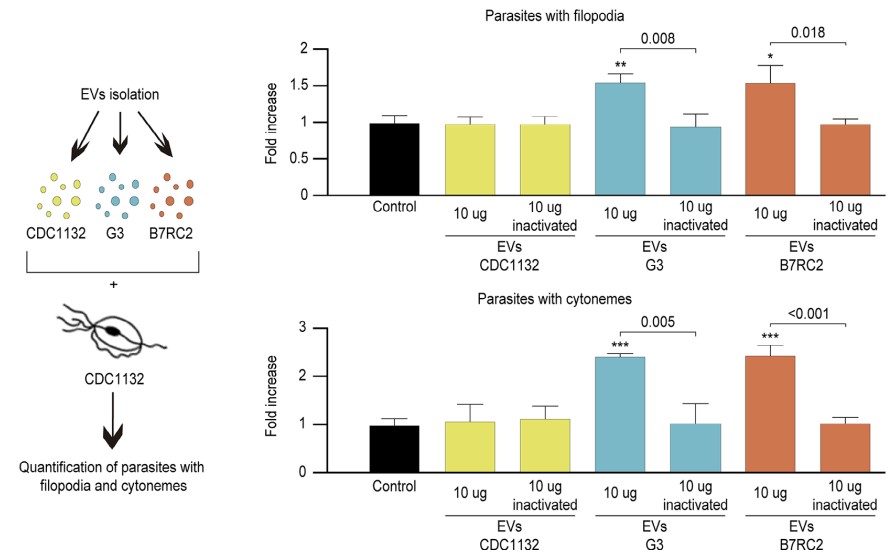 Fig.1 Treatment with Trichomonas-derived exosomes promoted the development of cytonemes and filopodia in parasites of different strain types.1
Advantages of Partnering with Creative Biolabs
 Comprehensive Customization
From basic isolation to optional molecular profiling, Creative Biolabs tailors each workflow to your project's scope and available resources.
High-Purity Isolation
Advanced gradient centrifugation and membrane-based filtration yield exosomes with minimal contamination.
Flexible Data Support
Optional bioinformatics and statistical interpretation available upon request.
Dedicated Scientific Support
Every project includes consultation with Creative Biolabs' parasitology-focused exosome specialists to ensure scientific depth and reproducibility.
Contact Creative Biolabs for a quotation or technical discussion tailored to your Trichomonas exosome research needs.
Customer Feedback
-
"Our collaboration with Creative Biolabs transformed how we investigate protozoan exosomes—their consistency and expertise set a benchmark."
-
"The workflow was highly adaptable. Creative Biolabs' scientists guided us from isolation optimization to RNA sequencing analysis seamlessly."
-
"Creative Biolabs provided clear communication and reliable data interpretation, enabling us to publish high-impact findings on Trichomonas vesicle biology."
Reach out today to begin your project.
Trichomonas-derived exosomes represent a vital research frontier for understanding protozoan communication and adaptation. With Creative Biolabs' integrated technology platform and flexible analytical services, scientists can precisely explore exosome-mediated signaling networks across parasitic strains. Whether you need pilot-scale exosome isolation or advanced molecular profiling, Creative Biolabs ensures reproducibility, quality, and scientific integrity every step of the way. Contact us to discuss your next Trichomonas-derived exosome study and receive a tailored project consultation.
FAQs
Q: What are the unique characteristics of Trichomonas-derived exosomes compared to those from other organisms?
A: Trichomonas-derived exosomes exhibit distinct lipid and protein compositions that reflect the parasitic nature of Trichomonas. The specific surface markers and payloads within these exosomes can influence immune responses, making them a focus for understanding host-parasite interactions.
Q: How can Trichomonas-derived exosomes be utilized as biomarkers in research?
A: Trichomonas-derived exosomes have the potential to serve as non-invasive biomarkers for infection status and disease progression. Their content can provide insights into the metabolic and physiological states of the host and may be analyzed for specific RNA or protein signatures.
Q: What role do Trichomonas-derived exosomes play in modulating host immune responses?
A: Research indicates that Trichomonas-derived exosomes can modulate the host's immune response by delivering bioactive molecules that affect cytokine production and immune cell function. Understanding these interactions is crucial for developing strategies to manage infections.
Q: Are there any known signaling pathways affected by Trichomonas-derived exosome components?
A: Yes, components of Trichomonas-derived exosomes can interfere with several signaling pathways in host cells, including those related to inflammation and apoptosis. Studies have shown that certain proteins or RNAs within the exosomes can activate or inhibit specific signaling cascades, potentially leading to altered host cell behavior.
Q: How might Trichomonas-derived exosomes contribute to our understanding of parasitic evasion mechanisms?
A: By studying these exosomes, researchers can gain insights into how Trichomonas evades host defenses. The exosomes may transfer factors that induce immunosuppression or inhibit host cell responses, providing a better understanding of their survival strategies in a host environment.
Q: What are the potential applications of Trichomonas-derived exosomes in developing diagnostic tools?
A: Trichomonas-derived exosomes could be engineered to carry specific biomarkers for sensitive detection of Trichomonas infections. Their ability to reflect the physiological state of the parasite and its interaction with the host can enhance early diagnosis and monitoring of treatment efficacy.
Q: How do Trichomonas-derived exosomes influence the microbiome of the host?
A: Exosomes released by Trichomonas may impact the host's microbiome by altering local immune functions and promoting an environment conducive to the survival of certain microbial populations. Investigating this interaction could provide valuable insights into the broader implications of Trichomonas infections on host health.
Q: Are there any innovative applications of Trichomonas-derived exosomes in biotechnology or therapeutic development?
A: Emerging research suggests that Trichomonas-derived exosomes could be used in targeted drug delivery systems or as platforms for vaccine development. Their natural ability to interact with host cells can be harnessed to enhance the efficacy of therapeutic agents.
Reference
-
Salas, Nehuén, et al. "Role of cytoneme structures and extracellular vesicles in Trichomonas vaginalis parasite-parasite communication." elife 12 (2023): e86067. Distributed under Open Access license CC BY 4.0. The image was modified by extracting and using only Part C of the original image and revising the title. https://doi.org/10.7554/elife.86067.
For Research Use Only. Cannot be used by patients.
Related Services: