Hybridoma Rescue Services
Overview Service Importance Published Data Features FAQ
Creative Biolabs specializes in providing cutting-edge hybridoma rescue services to recover and revitalize your invaluable monoclonal antibody (mAb)-producing cell lines. Leveraging our diverse, flexible, interactive, and cost-effective hybridoma development systems, alongside advanced technology platforms, we empower you to overcome unexpected challenges, ensuring the continuity and success of your critical projects.
Overview of Hybridoma Rescue
Hybridoma technology, while fundamental to mAb production, faces inherent challenges. Hybridoma cell lines can be lost or compromised due to several factors. These include genetic instability, suboptimal culture conditions, cryopreservation issues, and contamination. Successful reinitiation of hybridoma cultures from frozen stocks can be hampered by a low yield of viable cells. This issue commonly arises from suboptimal hybridoma cell viability prior to cryopreservation, deficiencies in the freezing protocol, or inadequate maintenance of frozen cell stocks.
Consequently, hybridoma rescue strategies are critical for salvaging valuable monoclonal antibody-producing hybridoma cells from compromised frozen or archived inventories. Our rescue services address these issues, employing advanced techniques to restore cell viability, stability, and antibody productivity. This key service plays a crucial role in reactivating dormant or lost mAb production lines, thereby safeguarding invaluable biological assets and accelerating scientific discovery.
Hybridoma Rescue Services
Using proprietary technology/medium developed by us, Creative Biolabs is an expert in rescuing hybridomas where only a few cells were viable. Cells are expanded and vials are frozen back. Creative Biolabs provides the following rescue services:
Cell lines from different sources, and different clones of the same cell line, may have highly specific nutritional requirements and may therefore prefer one medium over another. The use of serum-free medium is now common practice. Protein-free defined media guarantee easy purification and beneficial stability for tracing the antibody product. Our innovative serum-free medium formulation and cell culture process scale-up expertise allow us to provide cost-effective services for hybridoma suspension domestication.
Have you observed that the level of antibodies produced by hybridomas has steadily decreased over time? This could be caused by mainly two reasons. Some cells in the population have become non-producers. Since non-producer cells have a growth advantage over cells that actively produce antibodies, the proportion of non-producer cells will increase as the number of passages increases. On the other hand, the cell line is not monoclonal. In many cases, this is difficult to determine, but if you think this is a possibility, you can isolate the correct clone from the cell stock by further subcloning
Multiple rounds of FACS enrichment will be carried out and the top antibody-producing cells are expanded and frozen.
Our hybridoma optimization services can establish new clones that are selected for optimal growth and maximum antibody productivity.
Immortality of hybridoma cell lines is a property of myeloma cells that are fused to antibody-specific B cells. If your hybridoma no longer grows well, that might be a symptom of instability, and re-fusing a hybridoma to new myeloma cells can help. scientists at Creative Biolabs will re-fuse hybridomas to different myeloma cell lines and establish new monoclonal cell lines according to established protocols.
Importance of Hybridoma Rescue
Safeguarding Irreplaceable Reagents:
Many hybridomas produce antibodies with highly unique specificities or functionalities that are exceptionally challenging, if not impossible, to reproduce from scratch. The loss of such a cell line means the loss of a truly irreplaceable reagent, halting experiments and potentially erasing years of cumulative effort. Hybridoma rescue ensures continued access to these vital tools.
Ensuring Research Continuity and Project Deadlines:
Research projects, particularly in drug discovery and diagnostic development, operate on strict timelines and budgets. The unforeseen loss of a key hybridoma can cause significant delays, jeopardizing grant funding, intellectual property filings, and clinical trial progress. Rapid and effective rescue minimizes these disruptions, allowing projects to remain on schedule.
Preserving Intellectual Property and Competitive Advantage:
Hybridoma cell lines often represent significant intellectual property, underpinning patented antibodies or proprietary research tools. Their unexpected loss can compromise a company's competitive position and erode the value of extensive R&D investments. Rescue services act as a vital safeguard, protecting these valuable assets.
Cost-Effectiveness Compared to De Novo Development:
Re-generating an antibody from the initial immunization stage through fusion, screening, and cloning is an extraordinarily resource-intensive process, demanding considerable time, reagents, and specialized personnel. Hybridoma rescue is consistently a far more cost-effective and time-efficient alternative, avoiding redundant efforts and accelerating the return on investment.
Published Data
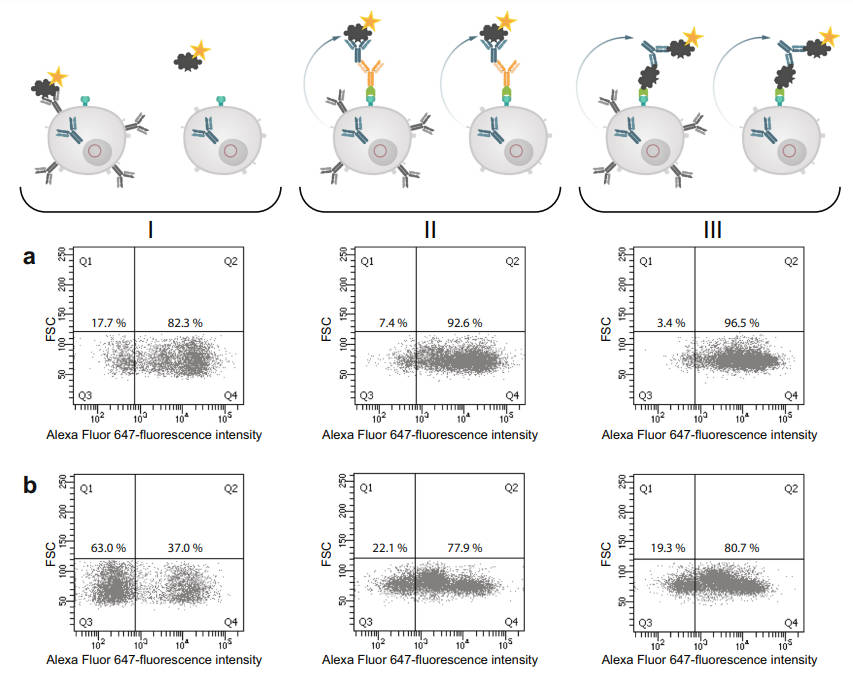 Fig.1 Comparison of three different sorting options for selecting specific hybridoma cells.1
The pivotal challenge in developing antigen-specific hybridomas lies in the absence of a direct link between the hybridoma cell and the antibody it produces. Consequently, it becomes imperative to employ limited dilution techniques to isolate individual cells, thereby guaranteeing monoclonality. In this article, the researchers examined three distinct methods for selecting specific hybridoma cells. They conducted an ovalbumin-specific fusion and, two weeks post-fusion, incorporated both isotype-specific and antigen-specific sorting techniques. Notably, the positively sorted cells from both procedures were plated individually in a 96-well plate and subsequently tested using ELISA. The presence of an ovalbumin-specific signal in each well indicated the successful outgrowth of the sorted hybridoma cells.
Features of Our Services
-
Customized Protocols: Every compromised hybridoma presents a unique challenge. We develop bespoke protocols meticulously tailored to the specific condition of your cell line, maximizing recovery success.
-
Rapid Turnaround Time: We recognize the urgency of your research. Our streamlined procedures and devoted team enable timely recovery, minimizing delays to your project timelines.
-
Comprehensive Quality Control: Rescued cell lines undergo rigorous quality control measures, including viability assessment, mycoplasma testing, and confirmation of antibody production and specificity, guaranteeing reliable outcomes.
-
State-of-the-Art Techniques: Utilizing the latest advancements in cell culture, flow cytometry, and molecular biology, we employ cutting-edge techniques for robust cell line resuscitation and stabilization.
-
Flexible Options for Scale-Up Production: Beyond rescue, we offer seamless transitions to large-scale antibody production, providing comprehensive solutions from initial recovery to downstream applications.
FAQ
-
Q: What are the most common reasons hybridoma cell lines become compromised or lost?
A: Hybridoma cell lines, while designed for longevity, are susceptible to several issues. Frequent culprits include genetic drift leading to reduced antibody production, contamination by mycoplasma or other microbes, suboptimal cryopreservation leading to low post-thaw viability, and even catastrophic events like freezer failures or mishandling in the lab. Understanding these risks is crucial for proactive cell line management.
-
Q: What information should I supply to provide when submitting a hybridoma for rescue?
A: To maximize the chances of a successful rescue, please supply as much information as possible. This includes the initial freezing date, known passage number, details about the freezing medium, any observed issues (e.g., low viability, contamination), the antibody isotype, and any relevant functional assay data for the original antibody. More context aids in tailoring our approach.
-
Q: How do you assess the viability and health of a hybridoma cell line upon receipt for rescue?
A: Upon receiving a cell line, our initial steps involve a thorough visual inspection, followed by viability assessment using methods like trypan blue exclusion. We also conduct mycoplasma testing and initiate small-scale culture to observe growth characteristics. Antibody production is typically confirmed via ELISA or flow cytometry, providing a comprehensive baseline of the cell line's current state.
-
Q: Can you rescue hybridomas that have been stored poorly or for a lengthy period of time?
A: While challenging, our advanced techniques significantly increase the chances of successful recovery even for cell lines stored under suboptimal conditions or for very long durations. The success rate depends heavily on the initial viability of the cells. We leverage optimized media, specialized resuscitation protocols, and sometimes re-cloning to revive even the most compromised samples.
-
Q: How do you ensure the rescued hybridoma still produces the correct antibody with the desired specificity?
A: Post-rescue, we rigorously verify the identity and functionality of the antibody. This includes performing ELISA or Western blot to confirm antibody production, and if feasible, functional assays to ensure the antibody retains its original specificity and binding characteristics. We can also provide sequencing of the variable regions to confirm clonal identity.
-
Q: What if my hybridoma is contaminated with mycoplasma? Can it still be rescued?
A: Absolutely. Mycoplasma contamination is a very common issue in cell culture and can severely impact hybridoma health and productivity. We employ highly effective mycoplasma decontamination protocols, including antibiotic treatments and specialized culture conditions, to eradicate the contamination while preserving the viability and productivity of your hybridoma cells.
-
Q: Do you offer services to optimize the rescued hybridoma for better growth or higher antibody production?
A: Yes, beyond mere rescue, we offer optimization services. Once a hybridoma is successfully rescued, we can perform subcloning by limiting dilution or employ enrichment techniques to select for clones exhibiting superior growth rates and significantly higher antibody production levels, ensuring a more robust and productive cell line for your ongoing needs.
-
Q: Can you provide a stable, high-producing cell bank of the rescued hybridoma?
A: Certainly. Upon successful rescue and optimization, we can establish a meticulously documented research cell bank (RCB) or master cell bank (MCB) of your revitalized hybridoma. This ensures a stable, consistent, and easily accessible supply of your valuable cell line for future research and production needs, safeguarding your long-term scientific investments.
Creative Biolabs specializes in high-quality monoclonal antibodies, particularly those which are difficult to produce. Our two main foci are perfect screening methodologies and excellent hybridoma rescue services, producing high-quality hybridoma cell lines. We also offer multiple additional services for your special needs. If you are interested in our services, please feel free to contact us for more information.
Reference
-
Listek, Martin, et al. "A novel selection strategy for antibody producing hybridoma cells based on a new transgenic fusion cell line." Scientific Reports 10.1 (2020): 1-12. Distributed under Open Access license CC BY 4.0, without modification.
All listed services and products are For Research Use Only. Do Not use in any diagnostic or therapeutic applications.