Creative Biolabs is offering the most comprehensive services for antibody development projects. With strict regulation and effective execution, we are dedicated to providing the most valuable solutions to complete your projects.
HighlightsCreative Biolabs is offering the most comprehensive services for antibody development projects. With strict regulation and effective execution, we are dedicated to providing the most valuable solutions to complete your projects.
HighlightsCreative Biolabs has established a broad range of platforms for developing novel antibodies or equivalents. These cutting-edge technologies enable our scientists to meet your demands from different aspects and tailor the most appropriate solution that contributes to the success of your projects.
HighlightsWith deep understanding in antibody-related realms and extensive project experience, Creative Biolabs offers a variety of references to help you learn more about our capacities and achievements, including infographic, flyer, case study, peer-reviewed publications, and all kinds of knowledge that can assist your projects. You are also welcome to contact us directly for more specific solutions.
HighlightsGet a real taste of Creative Biolabs, one of the most professional custom service providers in the world. We are committed to providing highly customized comprehensive solutions with the best quality to advance your projects.
HighlightsAs a leading provider of hybridoma services, Creative Biolabs has established a complete hybridoma suspension domestication system, specializing in seamless transition to serum-free suspension culture. With extensive experience and an established track record, we empower our clients with robust, high-performing cell lines. We bring to our customers cutting-edge technology, customized solutions, and dedicated support to accelerate their research and development.
Hybridoma cell culture in vitro is an important way for producing monoclonal antibodies (mAbs). Dulbecco's Modified Eagle's Medium (DMEM) and RPMI-1640 are the most frequently used basal media for hybridoma culture, typically supplemented with fetal bovine serum (FBS). Traditionally, serum supplementation has been essential for the long-term viability of cells in tissue culture. However, FBS and other animal-derived products often exhibit significant lot-to-lot variability in composition, including nutrient and vitamin content, and can harbor contaminants. Such inconsistencies substantially affect cell growth and antibody production, thereby complicating manufacturing processes. Moreover, FBS introduces contaminants that reduce the purity of mAbs.
Hybridoma cell suspension culture domestication is the process of adapting hybridoma cells to grow in suspension within a serum-free environment. However, the transition from adherent, serum-dependent cultures to serum-free suspension cultures can be a complex and demanding process. Hybridoma cells, which have evolved in a serum-rich environment, often struggle to adapt to the altered conditions. This adaptation can lead to reduced cell viability, decreased antibody production, and even cell death. Successful domestication requires careful optimization of culture conditions, including media composition, supplements, and physical parameters, to ensure the cells thrive and maintain their antibody-producing capabilities.
Hybridoma cell suspension cultures provide several advantages over traditional adherent cultures, including enhanced scalability, increased homogeneity, and simplified purification of the resulting monoclonal antibodies. Serum-free media are highly effective for culturing parental cells before fusion and for selecting hybridomas immediately after fusion. Besides, substituting serum-free alternatives for serum-containing media offers substantial ethical and scientific benefits, particularly for subsequent antibody purification.
We offer specialized services for hybridoma suspension and adaptation, enabling the revitalization of hybridoma cell lines and facilitating the rapid, large-scale production of antibodies. Our established protocols for hybridoma suspension adaptation allow cells to proliferate and express antibodies in serum-free media, thereby ensuring consistent antibody quality and eliminating potential animal virus contamination.
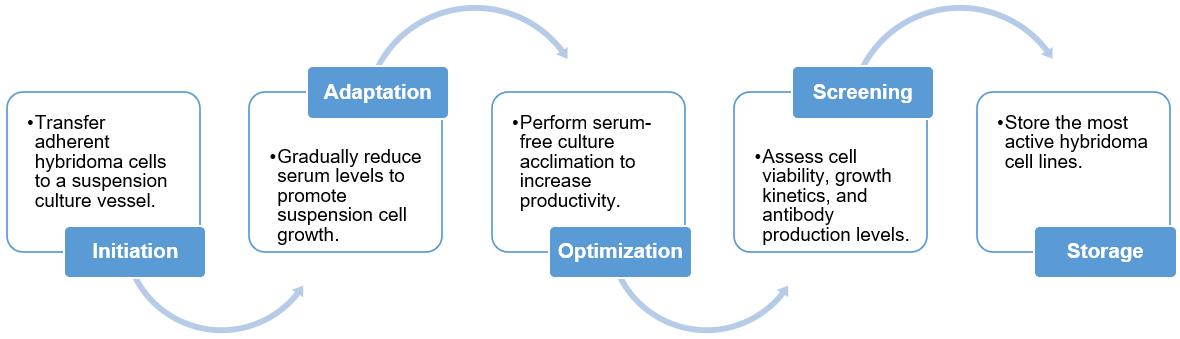 Fig.1 Hybridoma suspension domestication workflow.
We begin by assessing the starting hybridoma cell line, whether frozen or in culture, employing specialized techniques for maximum recovery. This initial assessment, crucial for determining the optimal revival strategy, evaluates cell viability, density, and contamination. For frozen stocks, we use rapid thawing and specialized media to minimize damage and promote quick recovery. For existing cultures, we assess the growth phase and overall health for optimal transition.
Cells are gradually weaned off serum-containing media and introduced to suspension culture. This step-wise approach minimizes stress, promoting cell survival. This critical transition involves progressive serum reduction and introduction to agitation, allowing cells to adapt their metabolism and morphology to the new environment, ensuring long-term viability and productivity.
We optimize culture conditions—media composition, agitation speed, and other parameters—to enhance cell growth and antibody production in suspension. This optimization maximizes performance. We evaluate serum-free media, growth factors, and supplements to identify the optimal composition. Agitation speed is controlled for oxygenation and nutrient distribution, while minimizing shear stress. Other parameters like temperature and pH are fine-tuned for ideal cell growth and antibody production.
We rigorously screen adapted cells to identify the most viable and productive clones, performing subcloning to isolate stable, high-producing cell lines. This process isolates the best-performing clones from the heterogeneous cell population. We use flow cytometry, ELISA, and limiting dilution to assess viability, antibody titer, and monoclonality. Subcloning ensures genetically identical cells that consistently produce high levels of the desired antibody.
The final, suspension-adapted hybridoma cell lines are cryopreserved for long-term storage and future use, ensuring preservation of cell viability and antibody-producing capabilities. Cryopreservation is critical for future use and preventing genetic drift. We use controlled freezing protocols and cryoprotective agents to minimize damage. Post-thaw viability and antibody production are rigorously tested to ensure desired characteristics are retained.
With deep understanding of hybridoma development, Creative Biolabs offers hybridoma suspension domestication service to help clients save valuable hybridoma clones and bring them back to good condition. If you are interested in our services, please feel free to contact us for more information.
All listed services and products are For Research Use Only. Do Not use in any diagnostic or therapeutic applications.