Kidney Organoids Introduction
The kidney is a vital organ responsible for filtering waste products from the blood, regulating blood pressure, producing hormones, and maintaining electrolyte balance. Kidney diseases, ranging from acute kidney injury to chronic kidney disease and end-stage renal disease, pose significant global health challenges. Organoids have emerged as an innovative method that provides a more accurate representation of kidney physiology. Unlike traditional organ models, which often fail to replicate the intricate cellular interactions and microenvironments found in vivo, kidney organoids are capable of self-organization and development into structures resembling actual kidney tissue. The emergence of kidney organoids signifies a promising shift towards more relevant in vitro models that can vastly improve our understanding of kidney function and disease.
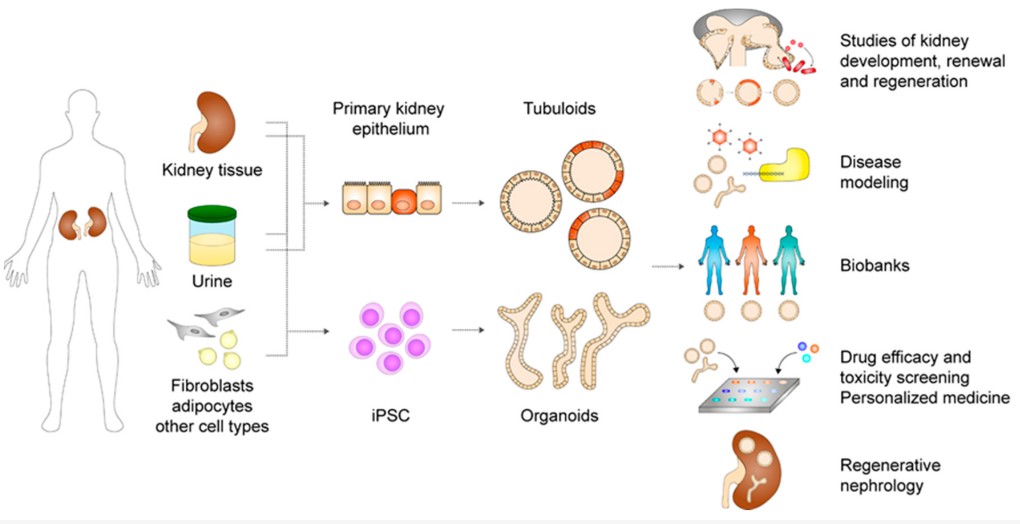 Figure 1 Establishment and applications of adult stem or progenitor cell-derived kidney organoids1,3.
What Are Kidney Organoids?
Definition
Kidney organoids are three-dimensional (3D) cellular structures self-assembled from pluripotent stem cells (PSCs), such as embryonic stem cells (ESCs) or induced pluripotent stem cells (iPSCs). These organoids recapitulate key aspects of kidney development and contain various renal cell types, including podocytes, tubular epithelial cells, and interstitial cells, organized into nephron-like structures.
Generation
Kidney organoids are generated through stepwise differentiation:
-
Induction of intermediate mesoderm: Using Wnt and FGF signaling activators (e.g., CHIR99021).
-
Formation of nephron progenitors: Guided by growth factors like FGF3.
-
Self-organization into renal vesicles: Mature into glomeruli and tubules.
Kidney Organoids: Tissue Structure and Cell Types
Tissue Structure of Kidney Organoids
Kidney organoids exhibit characteristic renal structures, including glomeruli, tubular formations, and stromal cells. While podocytes aggregate to form glomerular clusters, the absence of vascularization precludes the development of capillary loops and a functional glomerular filtration barrier. Ultrastructural analysis reveals distinct podocyte clustering with interwoven secondary foot processes and well-defined slit diaphragms. Notably, the renal tubules demonstrate brush border formation, indicating nascent reabsorptive capabilities.
Cell Types of Kidney Organoids
The cell types of kidney organoids broadly mirror those found in the native organ, including:
-
Podocytes
-
Mesangial cells
-
Podocyte precursor cells
-
Proliferating cells
-
Nephron progenitor cells
-
Neurons
-
Endothelial cells
-
Parietal epithelial cells (lining Bowman's capsule)
-
Proximal tubule cells
-
Loop of Henle cells
-
Distal tubule cells
-
Connecting segment cells
-
Collecting duct principal and intercalated cells
-
Stromal cells (e.g., fibroblasts)
Kidney Organoids Optimization
The field of kidney organoids is constantly striving for improvement. Optimization of kidney organoids focuses on several key areas:
-
Maturation: Current organoids often represent an embryonic or fetal stage of kidney development. Inducing greater maturity, including the formation of fully functional filtration barriers and specialized transport mechanisms, is a major goal.
-
Vascularization: A truly functional kidney requires a dense and organized blood supply. Strategies to improve vascularization include co-culturing with endothelial cells, using specific growth factors, and even transplanting organoids into living animals to allow host blood vessels to infiltrate.
-
Integration of collecting ducts: While nephrons can form, their organized connection to a functional, branched collecting duct system remains a significant hurdle. Recent breakthroughs are focusing on achieving this critical connection.
-
Reproducibility and Scalability: Ensuring that organoids can be consistently grown in large numbers for high-throughput drug screening or eventual therapeutic applications is crucial.
Applications of Kidney Organoids
Disease Modeling
They serve as powerful models for studying kidney diseases, including polycystic kidney disease, glomerulonephritis, and diabetic nephropathy. Researchers can introduce genetic mutations or expose organoids to disease-inducing agents to observe pathological changes and test potential therapeutic interventions.
Kidney organoids provide a more physiologically relevant platform than traditional cell lines for screening new drugs and assessing their efficacy and potential nephrotoxicity (kidney-damaging effects). This can accelerate the drug development process and reduce reliance on animal testing.
Developmental Biology Studies
By mimicking early kidney development, organoids offer insights into the complex cellular and molecular processes that govern nephrogenesis. This helps in understanding congenital kidney malformations and identifying critical developmental pathways.
Personalized Medicine
Organoids derived from patient-specific iPSCs can be used to create "disease in a dish" models, allowing for personalized drug screening and the identification of tailored treatments for individual patients.
Regenerative Medicine
While still in early stages, kidney organoids hold potential for regenerative therapies. They could theoretically be used to generate functional kidney tissue for transplantation, although significant challenges remain before clinical application.
Advantages of Kidney Organoids
-
Physiological Relevance: They better mimic the 3D architecture, cell-cell interactions, and tissue-specific functions of the human kidney compared to 2D cell cultures.
-
Human-Specific Model: Derived from human PSCs, they overcome species-specific differences encountered in animal models, making research findings more translatable to human health.
-
High-Throughput Screening Potential: Organoids can be cultured in a relatively high-throughput manner, making them suitable for drug screening and toxicity testing.
-
Reduced Animal Use: They offer an alternative to animal models, aligning with the 3Rs (Replacement, Reduction, Refinement) principles in research.
-
Patient-Specific Models: iPSC-derived organoids enable the creation of patient-specific disease models for personalized medicine.
Limitations of Kidney Organoids
Beyond the advantages listed above, specific limitations include:
-
Absence of a Vascular Network: A major limitation is the lack of a perfusable vascular network within the organoids, which is crucial for nutrient and oxygen supply, waste removal, and proper filtration function in a native kidney. This limits their long-term viability and functional maturity.
-
Immature Glomerular Filtration Barrier: While glomeruli form, the filtration barrier is often immature and leaky, not fully mimicking the selective filtration of the in vivo kidney.
-
Lack of Innervation: Kidney organoids typically lack neural connections, which play a role in kidney function regulation.
-
Scale and Complexity: Producing organoids at a scale large enough for therapeutic applications remains a significant challenge. Furthermore, they do not fully replicate the entire complexity of the native kidney, which includes multiple cell types, intricate vascularization, and interaction with other organs.
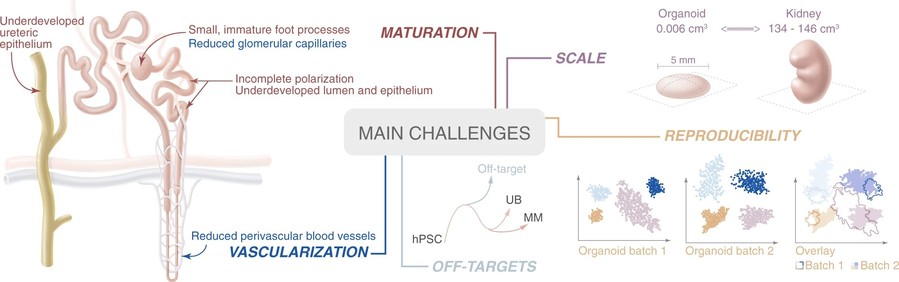 Figure 2 Kidney organoid challenges2,3.
Current Developments and Innovations of Kidney Organoids
 Organoid-on-Chip Technology
This approach integrates microfluidics with organoids to improve vascularization and the accuracy of drug response predictions. A "glomerular chip" model offers a novel platform for studying filtration functions.
 Gene Editing and Omics Integration
Single-cell RNA sequencing is used to identify off-target cells and optimize differentiation protocols. CRISPR screening helps uncover the molecular mechanisms behind Polycystic Kidney Disease (PKD) and diabetic nephropathy.
 3D Bioprinting
This approach enables the generation of structured kidney tissue slices, which are valuable for toxicity testing and drug screening. It also plays a crucial role in improving organoids' tissue complexity and overall functionality.
 Clinical Translation
Patient-derived organoid biobanks support precision medicine. Clinical trials utilize organoids to predict transplant patients' toxic reactions to immunosuppressants.
Frequently Asked Questions
Q: What are Kidney Organoids?
A: Kidney organoids are miniature, three-dimensional cellular structures derived from pluripotent stem cells (either embryonic stem cells (ESCs) or induced pluripotent stem cells (iPSCs)) that self-organize in vitro to resemble developing human kidneys. They contain various kidney-specific cell types, including podocytes, proximal and distal tubules, and associated endothelial and mesenchymal cells, arranged in structures akin to nephrons.
Q: What is the Purpose of Kidney Organoids?
A: Kidney organoids serve as powerful in vitro models for various research and potential therapeutic applications:
-
Studying Kidney Development: They allow researchers to investigate the complex processes of kidney formation, including cell differentiation, interactions between different cell types, and the role of various genes and signaling pathways in nephrogenesis.
-
Disease Modeling: Organoids can be generated from iPSCs of patients with specific kidney diseases (e.g., polycystic kidney disease). This enables researchers to study the underlying mechanisms of these diseases, observe disease progression, and identify potential targets for intervention.
-
Drug Discovery and Nephrotoxicity Testing: Kidney organoids provide a human-relevant platform to screen for new drugs, assess their efficacy, and test for potential kidney toxicity (nephrotoxicity) early in the drug development pipeline, reducing reliance on animal models.
Q: How do Kidney Organoids Compare to Real Kidneys?
A: While impressive, kidney organoids are not fully mature, functional organs.
-
Structural Complexity: They recapitulate many key structures of the kidney, including nephron-like units with podocytes and tubules. However, they typically lack the full complexity of a mature kidney, such as a defined corticomedullary axis, a fully developed collecting duct system, and a complete, perfusable vascular network.
-
Functionality: In vitro, kidney organoids generally do not perform complex functions like blood filtration and urine production. While they exhibit some reabsorptive properties in tubules, the lack of a perfusable glomerular filtration barrier limits true filtration. When transplanted into animals, some vascularization and limited filtration have been observed from host tissue.
-
Maturity: The cells within organoids often resemble fetal kidney tissue rather than fully mature adult kidney cells.
Conclusion
Kidney organoids have revolutionized nephrology by offering human-relevant models for studying disease, development, and drug discovery. While challenges such as immaturity and inadequate vascularization persist, advancements in microfluidics, gene editing, and 3D bioprinting are paving the way for their clinical application. As these technologies mature, kidney organoids are poised to transition from laboratory tools to cornerstones of personalized medicine and regenerative therapies. Future research will continue to prioritize enhancing the maturity, functionality, and standardization of organoids to more accurately mimic the complexity of the human kidney and provide more effective solutions for treating kidney diseases.
Elevate Your Research with Creative Biolabs' Advanced Kidney Organoids Models
Creative Biolabs is committed to providing researchers with superior kidney organoid models that drive groundbreaking discoveries in renal disease research and ultimately pave the way for novel therapeutic interventions and regenerative medicine strategies. Contact us today to discuss how our innovative solutions can empower your next research endeavor.
Organoid Models
Organoids Related Products
Creative Biolabs are at the forefront of this revolution, providing comprehensive services in kidney organoid construction, optimization, and analysis. We believe that by unraveling the mysteries of these miniature kidneys, we can unlock new avenues for understanding, treating, and ultimately conquering kidney diseases, offering hope to millions worldwide. Contact us today to learn more!
References
-
Yousef Yengej F A, Jansen J, Rookmaaker M B, et al. Kidney organoids and tubuloids. Cells, 2020, 9(6): 1326. https://doi.org/10.3390/cells9061326
-
Geuens T, van Blitterswijk C A, LaPointe V L S. Overcoming kidney organoid challenges for regenerative medicine[J]. NPJ Regenerative medicine, 2020, 5(1): 8. https://doi.org/10.1038/s41536-020-0093-4
-
Distributed under Open Access license CC BY 4.0, without modification.
Research Model
Related Sections: