
Creative Biolabs is offering the most comprehensive services for antibody development projects. With strict regulation and effective execution, we are dedicated to providing the most valuable solutions to complete your projects.
HighlightsCreative Biolabs is offering the most comprehensive services for antibody development projects. With strict regulation and effective execution, we are dedicated to providing the most valuable solutions to complete your projects.
HighlightsCreative Biolabs has established a broad range of platforms for developing novel antibodies or equivalents. These cutting-edge technologies enable our scientists to meet your demands from different aspects and tailor the most appropriate solution that contributes to the success of your projects.
HighlightsWith deep understanding in antibody-related realms and extensive project experience, Creative Biolabs offers a variety of references to help you learn more about our capacities and achievements, including infographic, flyer, case study, peer-reviewed publications, and all kinds of knowledge that can assist your projects. You are also welcome to contact us directly for more specific solutions.
HighlightsGet a real taste of Creative Biolabs, one of the most professional custom service providers in the world. We are committed to providing highly customized comprehensive solutions with the best quality to advance your projects.
HighlightsMonoclonal antibodies (mAbs) are laboratory-produced molecules engineered to bind to a single, specific epitope on a target antigen. Unlike polyclonal antibodies, which recognize multiple sites, mAbs originate from a single B-cell clone, ensuring absolute specificity and uniformity. This precision makes them indispensable tools for dissecting cellular signaling pathways, validating drug targets, and serving as the backbone of modern biologics.
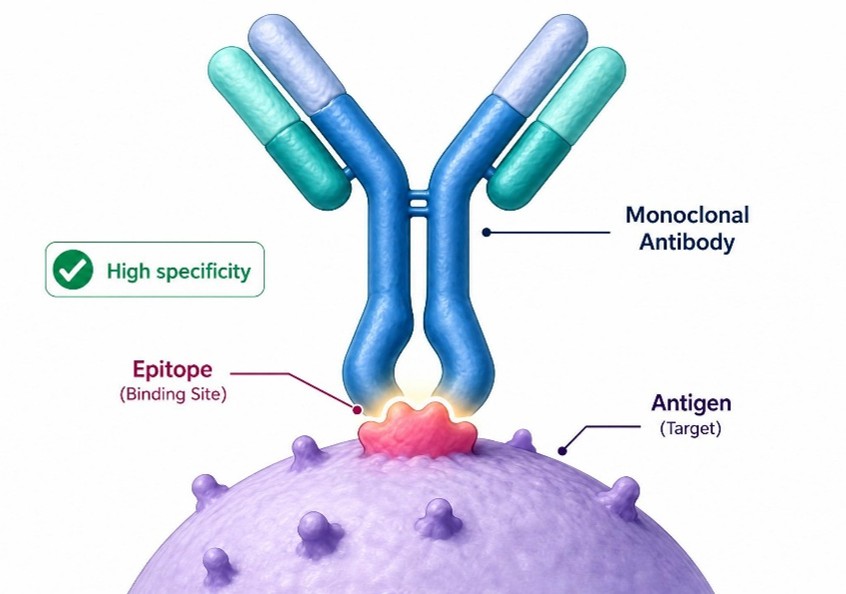 Fig.1 Monoclonal antibody binding to specific epitope.
Explore comprehensive overview of monoclonal antibody discovery. Compare traditional & advanced display technologies. Creative Biolabs provides end-to-end services to accelerate your lead discovery.
For decades, hybridoma technology fusing immortal myeloma cells with antibody-producing B cells from immunized animals was the gold standard. While effective for immunogenic targets, this approach suffers from long timelines (3-6 months), dependence on animal immune responses, and inability to generate antibodies against toxic or highly conserved self-antigens due to immune tolerance.
Modern display technologies such as Phage Display and Yeast Display have overcome these barriers. By linking genotype to phenotype in vitro, these platforms enable high-throughput screening of billions of diverse antibody variants without animal immunization. The result: faster discovery (weeks instead of months), access to difficult targets (GPCRs, ion channels, toxins), and direct isolation of fully human or humanized sequences.
| Traditional Hybridoma | Advanced Display Technologies |
| Time-consuming (3-6 months) | Rapid (4-8 weeks) |
| Immune-dependent | In vitro selection |
| Limited to immunogenic targets | Covers difficult targets (GPCRs, self-antigens) |
| Animal immunization required | No animals needed |
| Restricted to host species | Human, camelid, synthetic libraries |
Our integrated discovery pipeline transforms your target antigen into validated lead candidates with unmatched efficiency and transparency. Every step is customizable, from library design to final characterization.
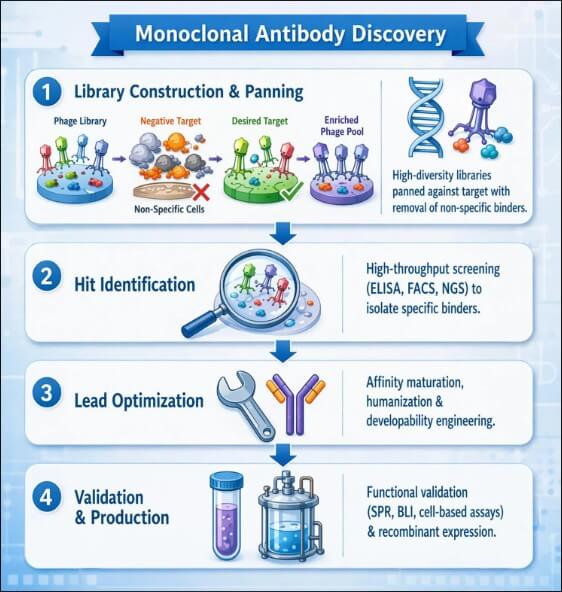 Fig.2 Flowchart.
High-quality monoclonal antibodies are more than therapeutics; they are precision probes that power fundamental discoveries.
Stable and specific antibody fragments, like Fabs and VHHs, are invaluable for crystallizing membrane proteins and stabilizing conformational epitopes for cryo-EM and X-ray crystallography.
Generate high-affinity reagents for ELISA, IHC, and flow cytometry to validate and quantify novel disease biomarkers in complex patient samples.
Use blocking or activating antibodies to dissect intracellular signaling cascades, neutralize cytokines, or modulate receptor activity with exquisite selectivity.
Develop lead candidates for ADCs, CAR-T, or bispecific antibodies, or use targeting moieties for site-specific drug delivery to tumors or inflamed tissues.
At Creative Biolabs, we don't just follow protocols; we engineer discovery workflows that prioritize data quality, reproducibility, and your specific research questions.
Offers fully human monoclonal antibody discovery via phage display and immune libraries, eliminating immunogenicity risks for therapeutic and research use.
Provides NHP monoclonal antibodies with high human homology, ideal for preclinical pharmacokinetic and toxicology studies.
Delivers mouse monoclonal antibodies using hybridoma or phage display, the most widely used system for standard target discovery.
Generates rat monoclonal antibodies capable of recognizing conserved epitopes poorly immunogenic in mice, with IgG2c offering superior complement fixation.
Produces rabbit monoclonal antibodies featuring unique CDR3 diversity and exceptionally high affinity for challenging targets.
Develops chicken IgY antibodies that recognize highly conserved mammalian antigens and do not cross-react with mammalian IgG, ideal for diagnostics.
Provides camelid VHH/sdAb discovery, enabling recognition of cryptic epitopes and blood-brain barrier penetration.
Offers shark VNAR-based monoclonal antibodies, the smallest natural scaffolds with exceptional stability and unique epitope access.
Generates bovine monoclonal antibodies with ultra-long CDR3 loops capable of accessing unique spatial epitopes.
Supports veterinary research and canine disease models through dog monoclonal antibody discovery.
Leverages the ancient alligator immune system to discover monoclonal antibodies with novel folding patterns and high thermal stability.
Provides guinea pig monoclonal antibodies for specific infection and immunology models.
Offers ferret monoclonal antibodies, essential for respiratory virus research (influenza, RSV) due to human-like physiology.
Generates hamster monoclonal antibodies that recognize conserved epitopes on human targets due to phylogenetic distance from mice and rats.
Produces goat monoclonal antibodies in large volumes, with robust responses to weakly immunogenic antigens.
Provides sheep monoclonal antibodies with similar advantages to goat, suitable for large-scale antibody production.
Develops horse monoclonal antibodies with distinct epitope recognition and low cross-reactivity, valuable for specialized diagnostics.
Offers donkey monoclonal antibodies with minimal cross-reactivity to human, mouse, and rabbit immunoglobulins, ideal for multiplex assays.
Generates porcine monoclonal antibodies to support translational research using pig models of human disease.
Produces duck IgY antibodies that recognize conserved mammalian epitopes without cross-reacting with mammalian Fc receptors, suited for diagnostics.
Provides zebrafish monoclonal antibodies featuring unique Ig classes (IgM, IgD, IgZ) for comparative immunology and conserved epitope studies.
All listed services and products are For Research Use Only. Do Not use in any diagnostic or therapeutic applications.








