
Creative Biolabs is offering the most comprehensive services for antibody development projects. With strict regulation and effective execution, we are dedicated to providing the most valuable solutions to complete your projects.
HighlightsCreative Biolabs is offering the most comprehensive services for antibody development projects. With strict regulation and effective execution, we are dedicated to providing the most valuable solutions to complete your projects.
HighlightsCreative Biolabs has established a broad range of platforms for developing novel antibodies or equivalents. These cutting-edge technologies enable our scientists to meet your demands from different aspects and tailor the most appropriate solution that contributes to the success of your projects.
HighlightsWith deep understanding in antibody-related realms and extensive project experience, Creative Biolabs offers a variety of references to help you learn more about our capacities and achievements, including infographic, flyer, case study, peer-reviewed publications, and all kinds of knowledge that can assist your projects. You are also welcome to contact us directly for more specific solutions.
HighlightsGet a real taste of Creative Biolabs, one of the most professional custom service providers in the world. We are committed to providing highly customized comprehensive solutions with the best quality to advance your projects.
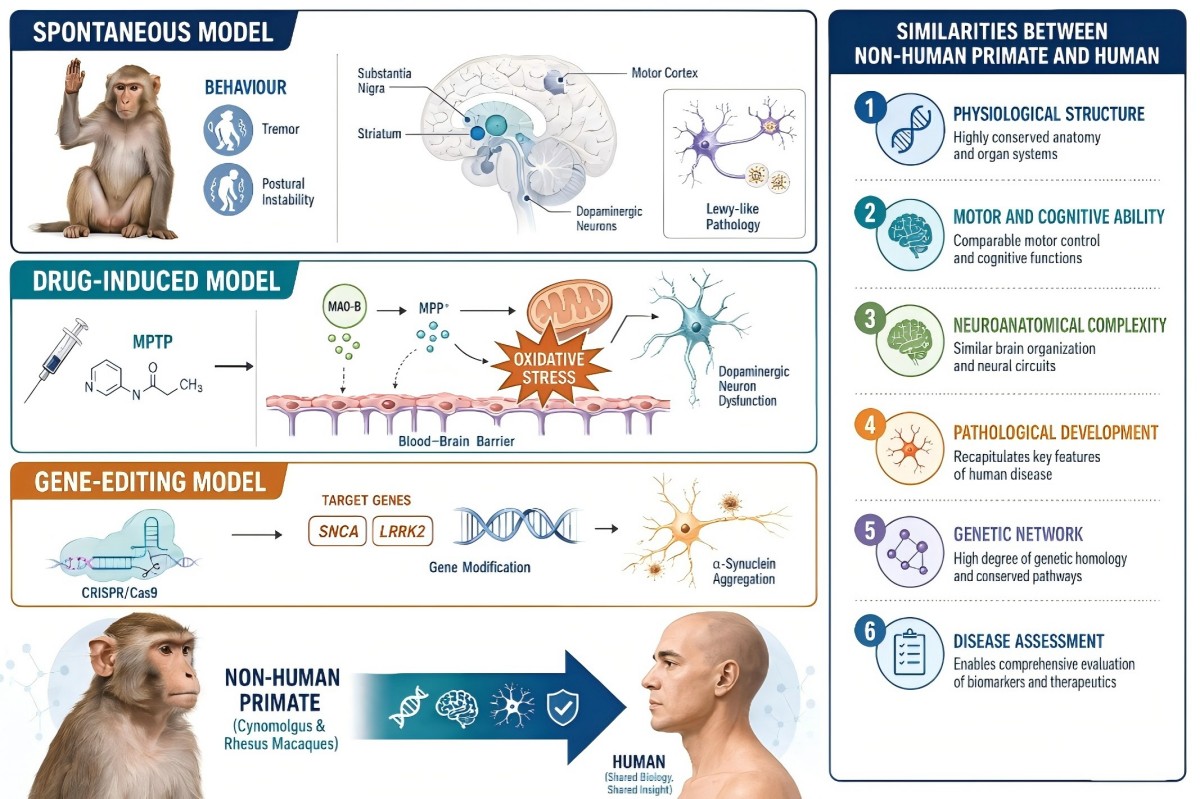
HighlightsNon-human primates (NHPs), especially cynomolgus and rhesus macaques, share high genetic, physiological and immunological homology with humans. This makes NHPs the most predictive models for translating basic research into preclinical drug development. Unlike rodents, NHP-derived antibodies better reflect human immune responses, thus proving indispensable for translational studies.
At Creative Biolabs, we use advanced phage display to deliver a premier NHP monoclonal antibody discovery service. Our integrated platform combines immunology, molecular biology and high-throughput screening to efficiently isolate full-length, functional monoclonal antibodies from NHP sources, including immunized and non-immunized B-cell repertoires (from peripheral blood, spleen or lymph nodes). By capturing the naturally matured antibody repertoire, we construct diverse immune libraries displaying NHP antibody fragments (scFv or Fab) on phage surfaces. Through rigorous in vitro biopanning, we isolate highly specific, high-affinity binders against virtually any target.
We are committed to providing high quality, natively paired, functional NHP monoclonal antibodies (monoclonal monkey antibody production) tailored to your needs, whether for target validation, surrogate antibody development, mechanistic studies, or preclinical efficacy evaluation. With decades of collective expertise, Creative Biolabs is your trusted partner in accelerating discovery from concept to clinic.
The rationale for NHP antibody discovery lies in the close genetic and immunological proximity between NHPs and humans. NHP antibodies share higher homology with human antibodies than rodent antibodies, offering better predictive value for human responses. This makes NHPs the gold-standard model for studying humoral immunity and preclinical evaluation.
Key drivers for adopting NHP antibody discovery:
NHPs share 75-98.5% of their genetic sequence with humans. This high identity allows NHP antibodies to closely mimic human antibody structure, framework and paratope geometry. Therefore, humanization (when needed) causes less disruption to affinity and specificity than with rodent antibodies.
NHP immune systems respond to antigens like humans do, with similar isotype distribution, affinity maturation and T-cell dependence. Anti-drug antibodies (ADAs) from NHP models often reflect human immunogenicity, enabling early risk assessment that rodents cannot provide.
Murine antibodies are immunogenic in humans, triggering HAMA responses that shorten half-life and reduce efficacy. NHP antibodies offer a more clinically relevant alternative, narrowing the translational gap between animal data and human outcomes.
Using CDR-grafting and back-mutation, NHP antibodies can be humanized with little loss of affinity or stability. This yields a better starting point for therapeutic antibodies, with higher chance of maintaining function, specificity and manufacturability throughout development.
Choosing Creative Biolabs for NHP antibody discovery offers strategic benefits that improve research quality, relevance and efficiency. Our platform delivers high-affinity antibodies with the biophysical properties needed for downstream success.
NHP antibodies are developed in a system mirroring human physiology, immunology and genetics, so they are more likely to exhibit desired pharmacological profiles (half-life, tissue distribution, effector functions) in clinical settings. Their predictive power significantly de-risks late-stage development.
NHPs are often the only preclinical species with cross-reactivity to target orthologs. NHP antibodies that recognize both human and NHP targets are essential for PK/PD and efficacy studies, enabling seamless transition from in vitro to in vivo validation.
Our NHP immune libraries capture matured repertoires with somatic hypermutations and affinity maturation, providing broad epitope coverage and high-affinity binders against challenging targets like GPCRs, ion channels and membrane proteins.
With over 20 years of expertise, Creative Biolabs offers an end-to-end pathway from library construction to lead optimization (including humanization and affinity maturation), ensuring a smooth, de-risked transition to preclinical development.
Monkey monoclonal antibodies are versatile reagents for research and preclinical use. Their properties (high specificity, human-like immunogenicity, cross-reactivity, and developability) make them essential for discovery and translation.
At Creative Biolabs, our world-class Phage Display Platform drives NHP monoclonal antibody discovery. It links genotype and phenotype by displaying antibody fragments on phage surfaces while preserving encoding DNA inside the particle. This enables rapid, high-throughput isolation of specific binders from libraries with billions of unique clones.
Our success relies on meticulous execution across every step:
1. Custom NHP Immune Library Construction
We isolate B-cells (PBMCs, spleen or lymph nodes) from immunized NHPs and amplify V-gene sequences using proprietary NHP-specific primers for maximum diversity. These are cloned into phagemid vectors to create immune libraries displaying NHP antibody fragments (scFv or Fab) with high fidelity.
2. High-Stringency Biopanning
Through iterative rounds of binding, washing and amplification with gradually increasing stringency, we isolate clones with highest specificity and affinity. Our flexible protocols accommodate soluble proteins, cell-surface antigens, membrane preparations and tissues, ensuring selection conditions mimic native target contexts.
3. Next-Generation Sequencing (NGS) Integration
We incorporate NGS to monitor enrichment at nucleotide level, providing data on library diversity, selection trajectories and clonal convergence. This allows capture of rare, high-affinity clones against challenging targets (GPCRs, ion channels, conformational epitopes) that conventional screening would miss.
4. Lead Validation and Characterization
Selected NHP antibody clones undergo rigorous validation for affinity, specificity and function. Our analytical suite includes SPR, BLI, ELISA, flow cytometry and cell-based assays, ensuring only the most promising leads advance to downstream development.
Creative Biolabs offers a comprehensive service suite to move your NHP antibody project from target identification to lead characterization with precision and speed. Our end-to-end pipeline is built on decades of expertise, rigorous quality control and client-focused execution.
We leverage the matured immune response of immunized NHPs to capture high-affinity, functional antibody genes. Libraries are optimized for diversity, stability and display efficiency. We work with multiple NHP species (cynomolgus and rhesus macaques) and support both immunized and non-immunized repertoires.
Our platform performs rigorous biopanning against soluble proteins, cell-surface antigens, membrane preparations and complex targets. We employ solid-phase, solution-phase, cell-based and tissue-based methods to enrich high-affinity, specific binders while preserving native target conformation.
Selected clones undergo validation for affinity, specificity and function. Our suite measures binding kinetics (SPR/BLI), epitope binning, cross-reactivity, structural integrity, aggregation and developability, providing comprehensive data for lead selection.
Using CDR-grafting and phage display-based back-mutation, we humanize NHP antibodies with minimal loss of affinity or specificity. Our team generates highly humanized variants with excellent biophysical properties and reduced immunogenicity risk.
All listed services and products are For Research Use Only. Do Not use in any diagnostic or therapeutic applications.








