







We have successfully generated antibodies against >500 targets, including challenging targets such as GPCRs, ion channels, and membrane proteins. Our platforms have delivered leads with affinities as low as picomolar range.

Creative Biolabs is offering the most comprehensive services for antibody development projects. With strict regulation and effective execution, we are dedicated to providing the most valuable solutions to complete your projects.
HighlightsCreative Biolabs is offering the most comprehensive services for antibody development projects. With strict regulation and effective execution, we are dedicated to providing the most valuable solutions to complete your projects.
HighlightsCreative Biolabs has established a broad range of platforms for developing novel antibodies or equivalents. These cutting-edge technologies enable our scientists to meet your demands from different aspects and tailor the most appropriate solution that contributes to the success of your projects.
HighlightsWith deep understanding in antibody-related realms and extensive project experience, Creative Biolabs offers a variety of references to help you learn more about our capacities and achievements, including infographic, flyer, case study, peer-reviewed publications, and all kinds of knowledge that can assist your projects. You are also welcome to contact us directly for more specific solutions.
HighlightsGet a real taste of Creative Biolabs, one of the most professional custom service providers in the world. We are committed to providing highly customized comprehensive solutions with the best quality to advance your projects.
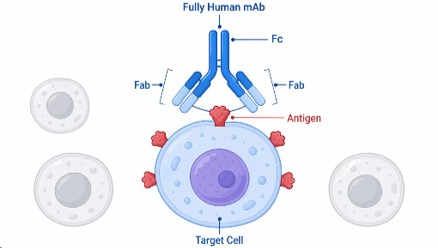
HighlightsA human monoclonal antibody is one in which both the variable and constant regions are derived entirely from human immunoglobulin gene sequences. In contrast, traditional mouse monoclonal antibodies originate wholly from mouse. Human mAbs are generated using technologies such as transgenic mice, phage display, or single B-cell cloning, yielding sequences that closely match naturally occurring human antibodies.
Key Differences from Traditional Mouse Monoclonal Antibodies
Need a fully human antibody discovery project? Learn more about our monoclonal human antibody production service – full support from target to lead candidate.
At Creative Biolabs, we offer four complementary technology platforms for human monoclonal antibody discovery, each with distinct strengths that can be matched to your specific project goals.
An in vitro selection platform that bypasses immune tolerance and enables the screening of exceptionally large repertoires. Our phage display libraries routinely achieve diversities exceeding 1011 unique clones, allowing the identification of high-affinity binders against virtually any target—including toxic, conserved, or self-antigens that would fail to elicit an immune response in vivo. The genotype-phenotype linkage ensures rapid and reliable hit identification. This platform is particularly powerful when combined with immune antibody libraries, capturing the "best of both worlds": in vivo affinity maturation from immunized hosts and in vitro screening power of phage display.
A eukaryotic display system that leverages the post-translational processing machinery of yeast to ensure proper folding and surface presentation of antibody fragments. Yeast display enables high-throughput screening of large antibody libraries with efficient identification of specific binders, particularly valuable for challenging targets such as membrane proteins and GPCRs. The platform supports rapid discovery of high-affinity antibodies and is compatible with fluorescence-activated cell sorting (FACS) for quantitative selection based on binding and expression levels.
An in vivo immunization platform that leverages transgenic mice carrying human immunoglobulin loci. These animals generate fully human antibodies with natural heavy- and light-chain pairing, yielding high-affinity, functionally mature candidates through complete somatic mutation and affinity maturation processes. We utilize advanced transgenic platforms and can tailor immunization strategies to maximize the immune response against your target of interest. This approach bypasses the need for subsequent antibody humanization, mitigating the risks of immunogenicity and preserving the antibody's native affinity and specificity.
A direct ex vivo approach that isolates individual antigen-specific B cells from human PBMCs or immunized animals. By capturing native VH:VL pairing directly from the B-cell repertoire, this platform preserves the authentic antibody repertoire without the biases introduced by in vitro recombination. This is particularly valuable when seeking antibodies with complex conformational epitope recognition or when working with limited sample volumes. Our proprietary Native™ Antibody Discovery Platform enables high-throughput screening and generation of natural monoclonal antibodies with extremely high in vivo specificity and affinity.
Our antibody discovery workflow follows a structured, milestone-driven process managed by PhD-level scientists. From antigen design to fully characterized, production-ready antibodies, we provide a comprehensive, end-to-end solution.
Immunization / Library Preparation
Custom immunization in humanized mice or high-diversity library construction from human/murine/synthetic sources with codon optimization. Library diversity >109.
Biopanning / Screening
Iterative biopanning with increasing stringency using solid-phase, solution-phase, or cell-based formats. Next-Generation Sequencing (NGS) monitors enrichment to preserve rare, high-affinity clones.
Hit Identification & Validation
High-throughput screening by ELISA, FACS, or SPR confirms specificity and affinity. Success rate >95% for soluble targets; validated hits in 8–12 weeks.
Lead Optimization
Affinity maturation, humanization, and developability assessment (stability, aggregation, PK). Deliver drug-like candidates ready for preclinical development.
We have successfully generated antibodies against >500 targets, including challenging targets such as GPCRs, ion channels, and membrane proteins. Our platforms have delivered leads with affinities as low as picomolar range.
From antigen preparation and animal immunization to library construction, screening, humanization, and affinity maturation—we provide a fully integrated service pipeline. This seamless integration reduces project timelines and minimizes the risks associated with technology transfer between vendors.
We understand that every project has unique budgetary and strategic constraints. Our engagement models range from fee-for-service (e.g., screening-only) to collaborative partnerships and functional service provider (FSP) arrangements, allowing you to choose the level of involvement that best suits your needs.
We provide regular, detailed project updates and comprehensive data packages at every milestone—including raw sequencing data, binding kinetics, and functional assay results. Our commitment to transparency ensures that you have full visibility into the discovery process and can make informed decisions at every stage.
All listed services and products are For Research Use Only. Do Not use in any diagnostic or therapeutic applications.
