3D Organoid Models
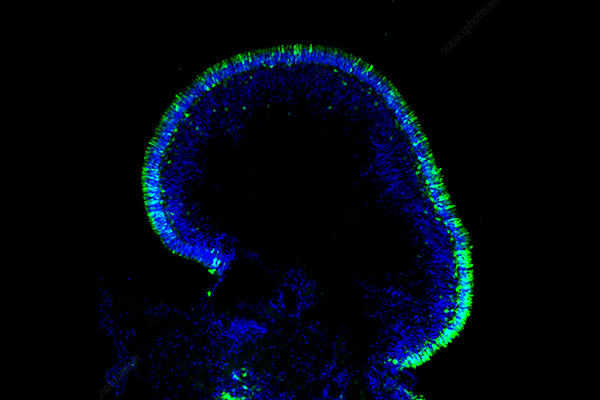
3D in vitro organoids are powerful predictive tools for studying normal disease development processes and disease-based drug discovery. In short, 3D in vitro organoids are microscopic self-organizing 3D structures grown from adult stem cells, which summarize the key structural and functional characteristics of the original source. An optimized HUB protocol has been established for developing models from normal and diseased tissues (including tumor tissues) (for a more in-depth discussion of HUB tumor organoids, please refer here). Based on data from numerous studies (e.g. see here and here), organoids represent the first clinically relevant 3D in vitro model, displaying the following:
-
Genomic and phenotypic stability after long-term cultivation and cryopreservation
-
Enhance clinical predictive ability
-
Compared to in vivo models, it is easy to expand
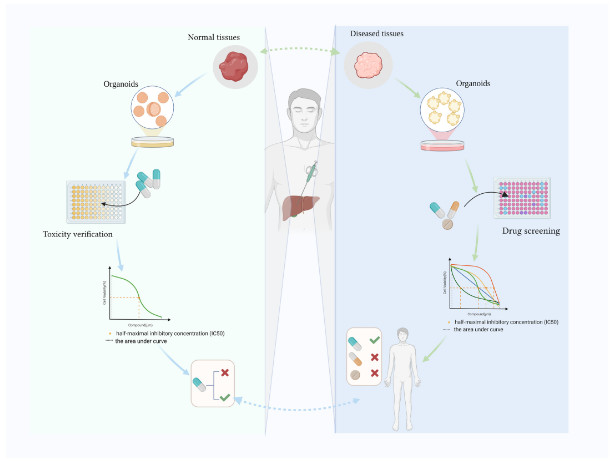 Figure 1 Human hepatobiliary organoids for drug toxicity verification and drug screening.1,3
What Is Drug Toxicity Screening?
The toxicity testing of new compounds is crucial for the drug development process. Preclinical toxicity testing of various biological systems revealed species, organ, and dose specific toxic effects of the experimental products. Drug toxicity is one of the key areas of pharmacological research, leading to the loss of about one-third of candidate drugs and the main reason for the high cost of drug development. It involves the concept of 'cell viability', which is typically understood as describing the overall characteristics of the number and proportion of live and dead cells in a population. Developing reliable, accessible, and scalable methods for detecting cell death related effects based on biomarkers is crucial for effectively screening drug toxicity. The toxicity of substances can be observed through the following methods: (a) studying accidental exposure to substances; (b) Conduct in vitro studies using cells/cell lines; (c) Perform in vivo contact on experimental animals.
Cell Sources of Organoids for Drug Toxicity Screening
|
Cell Source
|
Description
|
Advantages
|
|
Embryonic Stem Cells (ESCs)
|
Derived from the inner cell mass of blastocysts
|
High differentiation potential, can form a wide variety of organoids
|
|
Induced Pluripotent Stem Cells (iPSCs)
|
Generated by reprogramming adult somatic cells
|
Patient-specific, can be used to model genetic diseases, avoid ethical issues associated with ESCs
|
|
Adult Stem Cells
|
Present in various adult tissues, such as hematopoietic stem cells in bone marrow, intestinal stem cells in the gut
|
Readily available from the patient, low immunogenicity
|
|
Organ-Specific Progenitor Cells
|
Cells with a more restricted differentiation potential, specific to a particular organ
|
Can directly give rise to organoid structures relevant to their tissue of origin
|
Benefits of 3D Organoids versus 2D Cell Line Cultures
The majority of high-throughput screening of potential drugs is done using 2D cell lines due to their easy establishment and operation, which allows providing results for early decision-making. Although their physiology is not fully relevant, 2D cultures have contributed significantly to the field of cancer biology and continue to be important in the context of target validation and more fundamental biological questions such as defining cell signaling pathways, although they are far from being ideal to inform on clinical responses.
It is in this context that an increasing number of 3D in vitro organoid models are being used as a link between 2D cell lines and in vivo models. As compared to 2D cell lines, 3D organoids present relevant structures in terms of cell-cell interactions, and cell-matrix connections, which are associated with different nutrient supply areas, gradients of oxygen concentration, different sources of environmental pressure. These factors, combined, are known to influence various cell processes such as proliferation, response to drugs, signal transduction, differentiation, and survival. In contrast to in vivo models, these 3D organoids are, however, still lacking some of the physiological conditions provided by in vivo models.
Just as 2D cell lines, 3D organoids can be used for high-throughput drug screening. Moreover, they are more cost-effective than in vivo models, in terms of long-term development and maintenance, providing an opportunity to act in an early decision-making setting rather than waiting for more definitive data from in vivo models at a later time. In addition, since the organoids preserve many of the key features of the original tumor, matched in vivo models can be generated which allow for seamless transition from in vitro to animal-based validation studies.
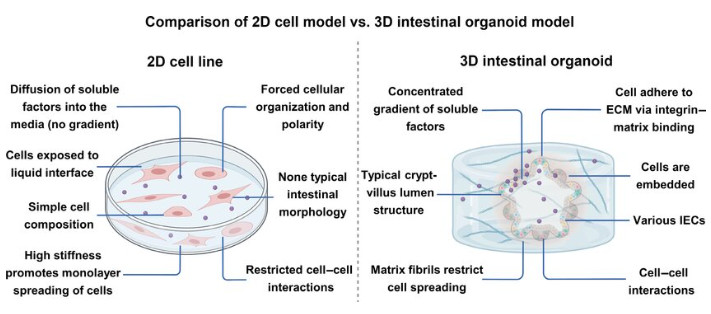 Figure 2 Comparison of 2D cell lines vs. 3D intestinal organoid models.2,3
Flexible Drug Screening Settings
Predictive 3D organoid models can be used for typical in vitro drug screening experiments related to oncology, including:
-
High throughput screening: Tumor organoids can be propagated in 384 well plates, and are amenable to high throughput library screening to assess efficacy, toxicity and drug combination effects. Diverse organ models can be utilized, including models from matched healthy tissues, different tumor types, and/or different genetic backgrounds. Models with specific properties (fluorescent labeling, etc) can be engineered using gene editing, transduction, etc.
-
Co culture for Immunotherapy Applications: A fast-growing application area which allows for in vitro testing of novel immunotherapies by co culturing tumor organoids with various human immune cell types (TIL, CAR-T, or components of the tumor microenvironment (TME)).
Frequently Asked Questions
Q: Can organoid models be used to assess specific types of toxicity, such as hepatotoxicity or cardiotoxicity?
A: Yes, organoid models can be used to assess specific types of toxicity. For example, liver organoids can be used to evaluate hepatotoxicity, kidney organoids for nephrotoxicity, cardiac organoids for cardiotoxicity, brain organoids for neurotoxicity, and intestinal organoids for gastrointestinal toxicity. Organoid models can provide insight into direct cellular damage, changes in metabolic activity, and functional impairment within the target organ. With the development of co-culture systems, more complex toxicities can also be assessed, such as immune-mediated toxicity when co-cultured with immune cells.
Q: Are organoid models scalable for high-throughput screening of drug candidates?
A: The scalability of organoid models for high-throughput screening (HTS) has been a challenge in the past due to the manual nature of organoid culture. However, significant progress has been made with the development of automated liquid handling systems, microfluidic platforms, and standardized protocols. Companies like Creative Biolabs are actively developing and implementing HTS compatible organoid platforms, enabling the rapid and efficient screening of large compound libraries. Automation is a key factor for their integration into industrial drug discovery pipelines.
Transform Your Research Using Organoid Model from Creative Biolabs
Creative Biolabs is a global leader in 3D biology and organoid research dedicated to accelerating drug discovery and drug development with advanced organoid models for drug toxicity testing. Our complete service offerings and products are designed to support the pharmaceutical, biotechnology and academic communities. Contact us today to learn more!
Organoid Models
Organoids Related Products
References
-
Fang H, Xu H, Yu J, et al. Human hepatobiliary organoids: recent advances in drug toxicity verification and drug screening. Biomolecules, 2024, 14(7): 794. https://doi.org/10.3390/biom14070794
-
Bao L, Cui X, Bai R, et al. Advancing intestinal organoid technology to decipher nano-intestine interactions and treat intestinal disease. Nano Research, 2023, 16(3): 3976-3990. https://doi.org/10.1007/s12274-022-5150-4
-
Distributed under Open Access license CC BY 4.0, without modification.
Research Model
Related Sections: