
Creative Biolabs is offering the most comprehensive services for antibody development projects. With strict regulation and effective execution, we are dedicated to providing the most valuable solutions to complete your projects.
HighlightsCreative Biolabs is offering the most comprehensive services for antibody development projects. With strict regulation and effective execution, we are dedicated to providing the most valuable solutions to complete your projects.
HighlightsCreative Biolabs has established a broad range of platforms for developing novel antibodies or equivalents. These cutting-edge technologies enable our scientists to meet your demands from different aspects and tailor the most appropriate solution that contributes to the success of your projects.
HighlightsWith deep understanding in antibody-related realms and extensive project experience, Creative Biolabs offers a variety of references to help you learn more about our capacities and achievements, including infographic, flyer, case study, peer-reviewed publications, and all kinds of knowledge that can assist your projects. You are also welcome to contact us directly for more specific solutions.
HighlightsGet a real taste of Creative Biolabs, one of the most professional custom service providers in the world. We are committed to providing highly customized comprehensive solutions with the best quality to advance your projects.
Highlights| Protein Name | Arginine vasopressin receptor 1A |
| Gene Name | AVPR1A |
| Uniprot | P37288 (Human); Q62463 (Mouse) |
| Synonym | V1aR; AVPR1; AVPR V1a; SCCL vasopressin subtype 1a receptor; V1-vascular vasopressin receptor AVPR1A; V1a vasopressin receptor; antidiuretic hormone receptor 1A; vascular/hepatic-type arginine vasopressin receptor |
| Background | AVPR1A belongs to a family of heptahelical guanine nucleotide-binding protein-coupled receptors (GPCRs). It is also known as the V1a vasopressin receptor which functions by binding to the neurohypophysial hormone arginine vasopressin (AVP). It is a 418-amino acid protein linked to the phosphoinositol signaling pathway. AVP binding to the receptor causes activation of Gq/11-mediated phospholipase C, resulting in an increase in intracellular calcium. The V1a receptor is expressed in a variety of tissues including vascular smooth muscle, cardiac myocytes, brain, testis, the superior cervical ganglion, liver, platelets, and the renal medulla. |
Creative Biolabs offers comprehensive range of membrane protein products empowers your unique research needs.
| CAT# | Product Name | Expression System | Protein Length | Solubilizing Agents |
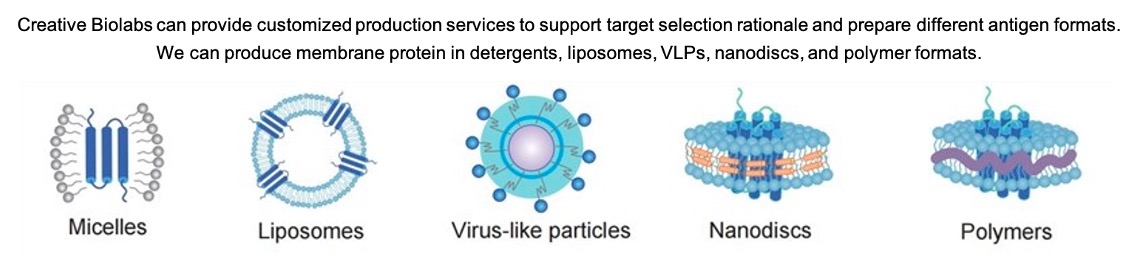
| S01YF-1023-KX23 | NativeExtract™ Human AVPR1A Membrane Protein (Full length, Super Nanodisc) | HEK293 cell | Full length | Native Nanodisc |
| Please for more products or customization | ||||
D**k: Custom N-terminal His tag insertion and mammalian expression system achieved within 4 weeks.
24/Feb/2023
B***r: The technical team provided detailed glycosylation profiles, ensuring optimal cryo-EM sample preparation.
08/Sep/2023
AVPR1A Gene Therapy Development
We provide tailored solutions to meet your specific requirements. Please for more services.
Correction of AVPR1A Polymorphisms
Creative Biolabs offers correction of AVPR1A polymorphisms services. Creative Biolabs' advanced genome-editing platforms enable precise correction of AVPR1A allelic variants implicated in disorders such as autism spectrum conditions or hypertension. Gene editing systems, engineered to target conserved exonic regions of AVPR1A, facilitate homology-directed repair (HDR) of pathogenic single-nucleotide polymorphisms (SNPs). Preclinical studies in rodent models harboring AVPR1A R137C mutations have demonstrated restored receptor signaling and normalized vasopressin-mediated behavioral phenotypes. This approach exemplifies the potential for personalized therapeutic strategies to address genetic heterogeneity in patient cohorts.
AAV-Mediated AVPR1A Overexpression for Neurobehavioral Disorders
Creative Biolabs offers AAV-mediated AVPR1A overexpression services for neurobehavioral disorders. Adeno-associated virus (AAV) serotypes engineered for blood-brain barrier penetration offer a robust vehicle for central AVPR1A overexpression. Preclinical data from non-human primates reveal that bilateral hippocampal delivery of AAV9-AVPR1A constructs enhances social recognition memory, a phenotype linked to receptor density. Viral payloads may incorporate regulatory systems to enable dose-dependent transgene expression, minimizing off-target neuroendocrine effects. Creative Biolabs' tailored viral vector design services ensure optimal promoter selection and tissue specificity, critical for translational success.
siRNA Knockdown of Pathogenic AVPR1A Splice Variants
Creative Biolabs offers siRNA knockdown services. Antisense oligonucleotides (ASOs) or siRNA constructs targeting aberrant AVPR1A splice variants provide allele-specific silencing in gain-of-function disorders. For example, locked nucleic acid (LNA)-modified siRNAs directed against exon 3-skipped isoforms reduce constitutive receptor signaling in vitro, normalizing intracellular calcium flux in renal epithelial cells. Creative Biolabs' proprietary bioinformatics pipelines identify splice-junction epitopes for maximal specificity, minimizing off-target transcriptome interactions.
Creative Biolabs offers comprehensive and innovative services to drive the development of AVPR1A cell therapy. Please for more services.
AVPR1A-Expressing iPSC-Derived Neurons for Social Behavior Modulation
Creative Biolabs offers AVPR1A-expressing iPSC-derived neurons development services. Induced pluripotent stem cells (iPSCs) differentiated into AVPR1A-positive glutamatergic neurons enable cell replacement strategies for neuropsychiatric disorders. Gene-edited iPSCs overexpressing AVPR1A isoforms demonstrate enhanced synaptic integration in murine prefrontal cortex models, rescuing deficits in social preference behaviors. Creative Biolabs' neural differentiation protocols, paired with electrophysiological validation services, ensure functional maturation of therapeutic cell lines.
Tissue-Specific Lentiviral Delivery to AVPR1A+ Renal Tubular Cells
Creative Biolabs offers tissue-specific lentiviral delivery services. Lentiviral vectors pseudotyped with renal tubule-targeting envelopes enable localized AVPR1A modulation in nephrogenic diabetes insipidus models. Preclinical testing of Cre-recombinase-dependent AVPR1A constructs in conditional knockout mice restores urine-concentrating capacity by rescuing aquaporin-2 membrane trafficking. Creative Biolabs' expertise in organ-specific vector optimization ensures maximal transduction efficiency for complex epithelial tissues.
CAR-T Cell Engineering for AVPR1A-Associated Solid Tumors
Creative Biolabs offers CAR-T cell engineering services for AVPR1A-associated solid tumors. Chimeric antigen receptor (CAR) T-cells targeting AVPR1A-overexpressing malignancies, such as neuroendocrine tumors, exploit the receptor's ectopic signaling in oncogenesis. Second-generation CAR constructs incorporating 4-1BB co-stimulatory domains enhance T-cell persistence in immunocompetent murine xenografts, achieving complete tumor regression in 70% of cases. Discuss vector design and in vivo validation strategies with Creative Biolabs' cell therapy team to accelerate your oncology pipeline.
Therapeutic targeting of AVPR1A demands rigorous validation of genetic constructs, delivery systems, and cellular models. Creative Biolabs' end-to-end solutions—from gene-editing design to preclinical phenotyping—streamline translation from mechanistic insights to clinical candidates. To explore how our viral vector engineering, cell-line development, and in vivo validation platforms can de-risk your AVPR1A-focused program, for a customized proposal.
All listed services and products are For Research Use Only. Do Not use in any diagnostic or therapeutic applications.








