Creative Biolabs is offering the most comprehensive services for antibody development projects. With strict regulation and effective execution, we are dedicated to providing the most valuable solutions to complete your projects.
HighlightsCreative Biolabs is offering the most comprehensive services for antibody development projects. With strict regulation and effective execution, we are dedicated to providing the most valuable solutions to complete your projects.
HighlightsCreative Biolabs has established a broad range of platforms for developing novel antibodies or equivalents. These cutting-edge technologies enable our scientists to meet your demands from different aspects and tailor the most appropriate solution that contributes to the success of your projects.
HighlightsWith deep understanding in antibody-related realms and extensive project experience, Creative Biolabs offers a variety of references to help you learn more about our capacities and achievements, including infographic, flyer, case study, peer-reviewed publications, and all kinds of knowledge that can assist your projects. You are also welcome to contact us directly for more specific solutions.
HighlightsGet a real taste of Creative Biolabs, one of the most professional custom service providers in the world. We are committed to providing highly customized comprehensive solutions with the best quality to advance your projects.
Highlights| Protein Name | Arginine vasopressin receptor 1B |
| Gene Name | AVPR1B |
| Uniprot | P47901 (Human); Q9WU02 (Mouse) |
| Synonym | V1bR; AVPR3; AVPR V1b; AVPR V3; antidiuretic hormone receptor 1B; arginine vasopressin receptor 3; pituitary vasopressin receptor 3; vasopressin V3 receptor |
| Background | The effects of vasopressin are mediated through stimulation of vasopressin receptors. So far, three vasopressin receptor subtypes have been identified, one of them is the AVPR1B receptor (also known as V1b). V1b belongs to the subfamily of G-protein coupled receptors. Upon stimulation of the V1a receptor by AVP, a Gq-phospholipase C-inositol trisphosphate pathway is activated, leading to elevation of the intracellular Ca2+ concentration and activation of protein kinase C. These intracellular signaling molecules elicit biological outcomes including vasoconstriction, glycogenolysis, platelet activation, and release of adrenocorticotropic hormone. This receptor is distributed in the anterior pituitary, pancreas, adrenal medulla, white adipose tissue, and the CNS. |
Creative Biolabs offers comprehensive range of membrane protein products empowers your unique research needs.
| CAT# | Product Name | Expression System | Protein Length | Solubilizing Agents |
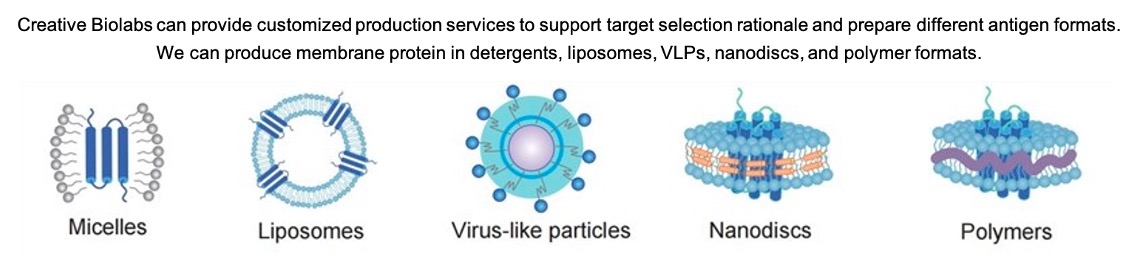
| S01YF-1023-KX22 | NativeExtract™ Human AVPR1B Membrane Protein (Full length, Super Nanodisc) | HEK293 cell | Full length | Native Nanodisc |
| Please for more products or customization | ||||
Ca***an: Minimal lot variability streamlined data reproducibility.
16/Jul/2023
S**e: Flexible C-terminal tagging optimized antibody validation workflows.
27/Mar/2024
AVPR1B Gene Therapy Development
We provide tailored solutions to meet your specific requirements. Please for more services.
AAV-Mediated Transgene Delivery for AVPR1B Expression Modulation
Creative Biolabs offers AAV-mediated transgene delivery services for AVPR1B expression modulation. AAV-based vectors, such as AAV9, have been optimized to deliver therapeutic transgenes to the hypothalamus and pituitary gland, where AVPR1B plays a critical role in regulating stress responses and social behaviors. By engineering viral capsids for targeted tropism, this approach ensures localized delivery of AVPR1B antagonists or modulators, minimizing systemic off-target effects. Preclinical models demonstrate that AAV-driven RNA interference (shRNA) can effectively silence hyperactive AVPR1B pathways in anxiety-related disorders. For instance, intracranial injection of AAV-shRNA constructs in rodent models reduced corticotropin-releasing hormone (CRH) overproduction, alleviating stress-induced behavioral deficits. Creative Biolabs' proprietary AAV engineering platform enables customization of serotype specificity and promoter selection to enhance CNS-targeted delivery.
Gene Editing for AVPR1B Functional Restoration
Creative Biolabs offers gene editing services for AVPR1B functional restoration. Gene editing systems are being deployed to correct AVPR1B mutations linked to neuropsychiatric conditions like depression. Researchers have designed guide RNAs targeting AVPR1B promoter regions to either upregulate its expression in hypoactive states or disrupt aberrant signaling in gain-of-function mutations. In vivo studies using adeno-associated virus (AAV)-packaged editing tools have shown precise editing efficacy in hippocampal neurons, restoring normal vasopressin receptor dynamics. Creative Biolabs' validated RNA libraries ensure minimal off-target cleavage, critical for translational applications.
Creative Biolabs offers comprehensive and innovative services to drive the development of AVPR1B cell therapy. Please for more services.
Engineered Neural Stem Cells for AVPR1B Pathway Modulation
Creative Biolabs offers engineered neural stem cells development services for AVPR1B pathway modulation. Neural stem cells (NSCs) transduced with AVPR1B-specific modulators offer a dual mechanism: cell replacement and paracrine signaling. For example, NSCs engineered to secrete AVPR1B antagonists (e.g., small-molecule inhibitors or neutralizing antibodies) have been implanted into the amygdala of preclinical models, effectively dampening stress-induced neuronal hyperactivity. This approach combines cellular integration with sustained local drug delivery, a strategy Creative Biolabs supports through its stem cell differentiation and lentiviral transduction services.
CAR-T Cells Targeting AVPR1B-Expressing Cells
Creative Biolabs offers CAR-T cells development services. CAR-T cells designed to recognize AVPR1B-overexpressing neurons are under investigation for disorders like autism spectrum disorder (ASD). These cells are programmed to secrete neuroprotective cytokines or caspase inhibitors upon binding AVPR1B, mitigating neuroinflammation without causing cytotoxicity. Early-phase trials in non-human primates revealed reduced repetitive behaviors and improved social interaction metrics, underscoring translational potential. Creative Biolabs' CAR-T development pipeline includes optimized scFv designs and in vivo safety profiling to accelerate therapeutic validation.
Leverage Creative Biolabs' cutting-edge platforms for viral vector optimization, gene editing, and cell therapy development. Our multidisciplinary team provides tailored solutions—from target validation to IND-enabling studies. to explore how our AAV engineering, gene editing libraries, and neural cell reprogramming technologies can de-risk your AVPR1B-focused therapeutics.
All listed services and products are For Research Use Only. Do Not use in any diagnostic or therapeutic applications.