Are you currently facing challenges in achieving a favorable therapeutic index for your antibody-drug conjugates (ADCs) or seeking a superior target-to-background ratio (TBR) for molecular imaging? Our Minibody Engineering service helps you optimize pharmacokinetics and enhance therapeutic potency through advanced fragment design, robust dimerization, and site-specific payload conjugation. We deliver precision-engineered fragments that clear quickly while maintaining high tumor avidity.
Contact our team to get an inquiry now!
The Minibody (typically 80 kDa) is a dimeric, bivalent antibody fragment strategically constructed from two scFv fragments fused to the CH3 domains of an IgG, offering intermediate size, superior stability, and a functional half-life. Minibody engineering arose as a critical design to bridge the gap between full IgG antibodies (which offer high affinity and stability but suffer from slow clearance, leading to high systemic drug exposure) and single-chain variable fragments (scFv), which are small but often unstable and too rapidly cleared by the kidney, leading to catabolite toxicity.
This format of BsAbs could accelerate systemic clearance and dramatically improving the target-to-background ratio (TBR) for both therapeutic delivery and diagnostic imaging. By retaining the CH3 domain, the Minibody benefits from the dimerization stability of the Fc region without incurring the long serum half-life conferred by the FcRn binding site, making this robust format widely recognized as essential for high-contrast imaging, where speed and minimal background are paramount, and for efficient, controlled cargo delivery with reduced systemic toxicity.
As an enhanced version of minibody, Tribi minibody is an optimal tool for targeting tumor cells. One of its chains is designed to recognize tumor antigens via its two Fv fragments, while the other chain, possessing an Fv fragment, takes charge of recruiting effector cells, such as T cytotoxic cells or NK cells. With the inclusion of this additional binding domain, the avidity of Tribi minibody is markedly greater than that of the bispecific minibody. Consequently, even when administered at a reduced dosage, the Tribi minibody continues to exhibit more potent cytotoxic activity compared to its bispecific counterpart.
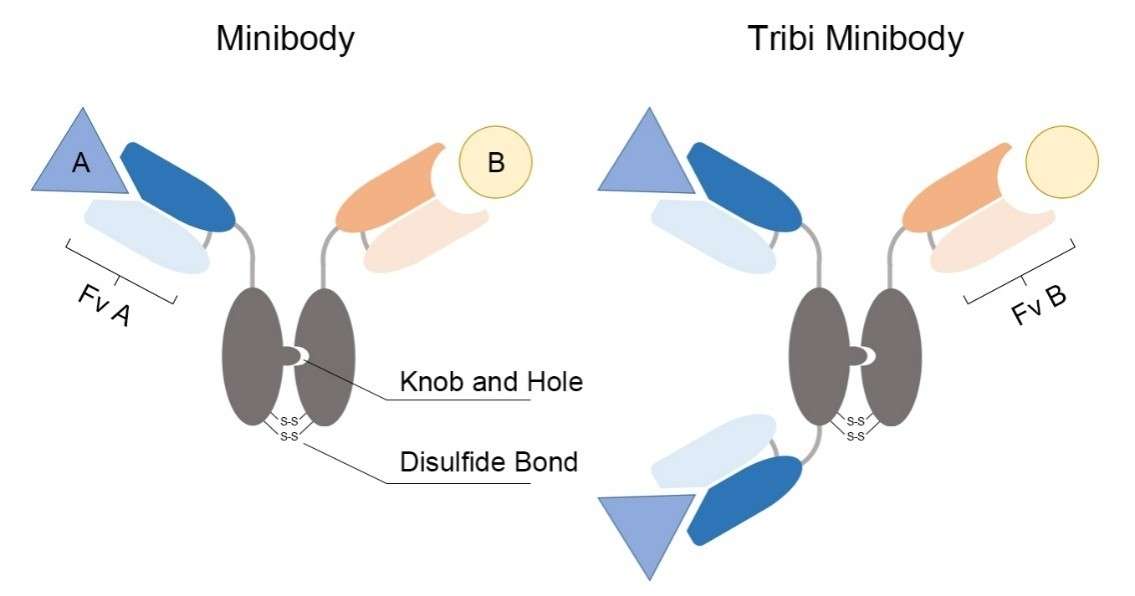 Fig.1 The structure of minibody and Tribi minibody.
Contact us to request your Minibody of interest!
Creative Biolabs is an industry partner in engineered antibody. Our expertise is grounded in decades of optimizing protein half-life and ensuring construct stability for demanding molecular and diagnostic applications. We solve problems others cannot by focusing on rational design over brute-force screening.
Experience the Creative Biolabs Advantage - Get a Quote Today
A: The Minibody's size is deliberately engineered to be larger than the glomerular filtration threshold of the kidney, which is approximately 60 kDa. While the Diabody is smaller and clears faster, its small size allows it to be rapidly filtered by the kidney, leading to catabolism in the renal tubules and the release of highly fluorescent degradation products that accumulate in the kidney and liver. This accumulation causes a persistently high, non-specific background signal. The 80 kDa Minibody size helps to significantly delay this rapid renal filtration, ensuring a cleaner systemic background and, consequently, a superior TBR.
A: Absolutely. Site-specific conjugation is a primary design goal. Our Minibody constructs are rationally designed to include non-native or engineered cysteines within the hinge region. This strategic placement allows for precise, controllable coupling via thiol-maleimide chemistry. This control over the coupling site prevents random conjugation across the molecule, minimizing the loss of binding function and ensuring a homogeneous product with a predictable cargo-to-Minibody ratio (CMR), which is essential for reproducible in vivo studies.
A: The Minibody's bivalent nature (two binding sites) significantly enhances its functional avidity (the total strength of binding). While the affinity (KD) of the Minibody is determined by the scFv core, the bivalent presentation allows for simultaneous binding to two target molecules, increasing the overall residence time on the cell surface. This increased avidity is critical for strong target engagement, especially on tumor cells with low antigen density, and the dimerized format is inherently far more structurally stable than a monomeric scFv fragment during purification, storage, and circulation.
A: Yes. The primary advantage of the Minibody is its intermediate size relative to full IgG. While still large enough to avoid rapid renal clearance, its smaller hydrodynamic radius allows it to penetrate dense tumor tissue more efficiently than full antibodies. This enhanced penetration capability ensures that a higher concentration of the Minibody or its attached payload reaches the core of the tumor, which is a key factor in improving signal delivery and concentration at the target site.
A: We employ a comprehensive, multi-step quality control process. Structural stability is guaranteed by engineered dimerization approaches like the CH3-based "knobs-and-holes" design, which often includes the addition of stabilizing inter-chain cysteine bridges within the hinge region. Homogeneity is confirmed rigorously via Size-Exclusion Chromatography (SEC), which verifies the purity of the dimeric species, and non-reducing SDS-PAGE, which confirms the integrity of the covalent dimerization. This approach ensures clients receive a purely dimeric, highly purified construct suitable for clinical translation.
Welcome! For price inquiries, we will get back to you as soon as possible.
INQUIRY





SERVICES
PRODUCTS
PLATFORMS