What is Alzheimer's Disease?
Alzheimer's disease (AD) is the most familiar type of Alzheimer's disease, responsible for over 50 million cases. AD is also one of the three leading causes of death worldwide. Despite considerable advancement in neuroscience, no available drugs treat this illness, which is known for its substantial socioeconomic burden. The symptoms of the majority of clinical AD events occur after the age of 65 and are collectively referred to as sporadic AD (SAD). Familial AD (FAD) events only account for 2-5% of AD cases, which are characterized by early-onset symptoms and associated with APP, PSEN1, and PSEN2 gene mutations. AD is characterized by the synergistic toxicity of NFTs that are generated by neuronal deposition and over-phosphorylation of amyloid beta (A β) and tau. A β plaques in AD brains are created by the buildup of monomeric A β peptides into toxic A β oligomers, which is then followed by the generation of insoluble fibers.
Alzheimer's Disease Organoid Model Introduction
An Alzheimer's Disease (AD) organoid model is a three-dimensional (3D) cellular model, usually developed from human induced pluripotent stem cells (iPSCs), that is manipulated or allowed to naturally exhibit characteristics and phenotypes of AD. Organoid models strive to recreate in vitro a significant portion of human brain cellular heterogeneity and organization, including the existence of neurons, astrocytes, oligodendrocytes, and microglia, as well as the brain's architectural features, such as the creation of a multi-layered structure in some organoids that mimics that of the cerebral cortex. Additionally, by using iPSCs from AD patients (which can harbor mutations associated with familial AD) or by introducing AD-causing mutations into healthy iPSCs, researchers can create and study the emergence of AD hallmarks in a human cellular context. This can include the development of amyloid-beta plaques, the formation of hyperphosphorylated tau tangles, neuroinflammation, and neuronal dysfunction.
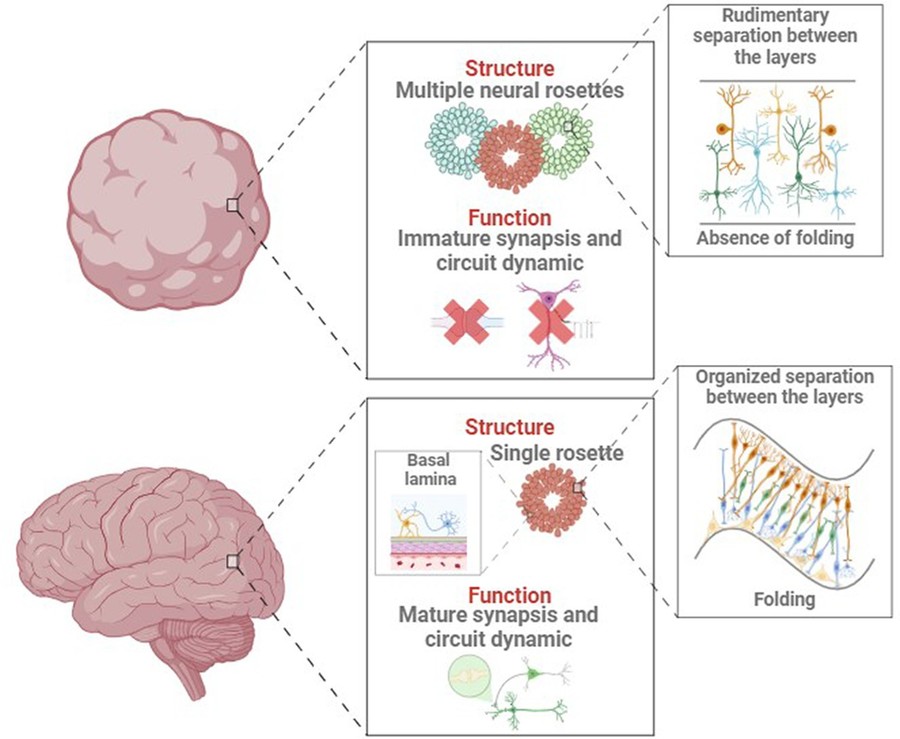 Figure 1 Main structural and functional differences between in vivo and in vitro developing brain and organoid.1,3
Modeling AD With hPSC-Derived Organoids
The improvement of in vitro iPSC differentiation protocol has led to the establishment of "organoids", which are three-dimensional (3D) self-organizing structures that share similarities in morphology and function with complex organs such as the brain. The formation of brain organoids depends on the self-organizing ability of hiPSCs, which can be promoted by additional exogenous components such as matrix glue. The development of brain organoids displays organized structures, similar to different regions of the brain, thus maintaining the characteristics of key developmental processes involved in brain formation. In the past few years, various attempts have been made to use organoids to simulate specific brain substructures. In this context, the forebrain, midbrain, hippocampus, and retinal organoids have evolved from hiPSCs. One of the main discussion points regarding the optimization of organoid formation schemes is whether the induction of cell fate should be promoted by adding exogenous morphogenetic factors and signaling molecules, or not at all. Some schemes support spontaneous nerve induction by avoiding the supplementation of exogenous factors in organoid culture media, thereby obtaining heterogeneous cell populations corresponding to different brain regions.
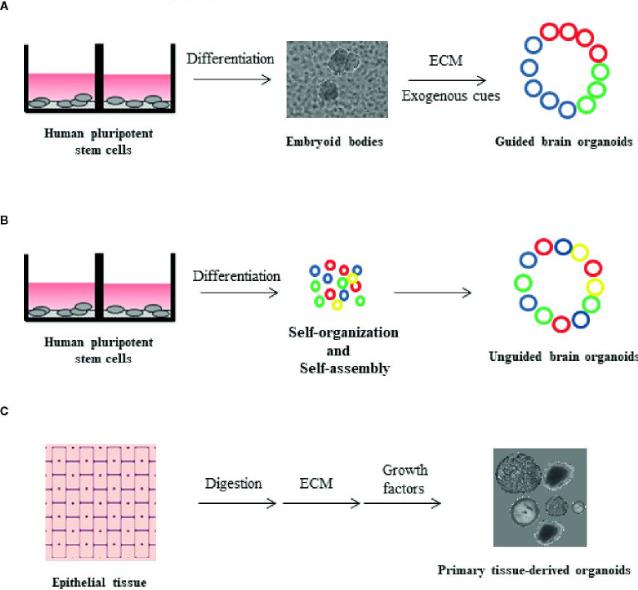 Figure 2 Organoid formation technologies from human pluripotent stem cells (hPSCs) and primary tissue.2,3
-
Embryoid Body (EB) formation: hiPSCs are cultured in suspension under conditions that allow EBs to form (aggregates of pluripotent cells).
-
Neuroectodermal induction: EBs are then cultured in neural induction medium to induce differentiation to neuroectodermal cells. Growth factors such as Noggin and SB431542 are often added to the culture to inhibit BMP and TGF-β signaling, respectively, and promote neural fate commitment.
-
Neural rosette formation and expansion: The neural ectodermal cells will self-organize to form neural rosettes, structures reminiscent of the neural tube. The neural rosettes are then passaged to expand the number of cells.
-
Matrigel embedding: Neural progenitor aggregates are then embedded in a 3D extracellular matrix scaffold (Matrigel) which provides structural support and key growth factors, allowing the aggregates to undergo further differentiation and 3D organization. The stiffness and composition of the Matrigel can impact organoid development.
-
Long-term maturation in rotating bioreactors: The embedded organoids are placed in specialized neural maturation medium and placed in rotating bioreactors. Rotation of the bioreactor allows for uniform diffusion of nutrients and oxygen throughout the organoid. This method also helps prevent the formation of necrotic cores that can occur in the center of large 3D cultures. Over the course of weeks to months, organoids will mature and form distinct brain regions, neuronal subtypes (e.g. excitatory neurons, inhibitory neurons), and glial cells (astrocytes, oligodendrocytes).
Limitations of Organoids in Modeling AD
HPSC derived brain organoids exhibit most of the advantages of 2D culture, while also providing the ability to simulate complex cell-cell interactions, as they typically contain multiple cell populations. Due to its advantages, hPSC derived brain organoids have been used to simulate AD and study the impact of pharmacological factors on disease progression, however, serious technical barriers still need to be addressed. In addition, the organoid generation techniques used to simulate neurodegenerative diseases (including AD) so far need to be reviewed and updated. A key limitation of using hPSC derived organoids to simulate AD is related to aging. Aging is the main risk factor for the development of AD, especially in the case of SAD, where the aging process is accompanied by many genetic changes that lead to changes in the overall cellular transcriptional profile. However, iPSC derived neural cells exhibit a transcriptional profile similar to that of the prenatal brain, making it difficult to generalize aging related phenotypes.
Future Perspectives of the Organoid Technology
The patient derived organoid provides a unique model system as it is closer to the in vivo situation than any other cell culture to date. However, all attempts to immediately produce organoids from raw materials have focused on epithelial tissue. Given that research on neurodegenerative diseases requires the establishment and maintenance of non-epithelial cell cultures, one of the most important challenges in the future is to adapt current patient derived organoid technologies to disease models encountered in non-epithelial tissues. Considering the numerous advantages of patient derived organoids, this field is expected to soon expand this cutting-edge technology to non-epithelial tissues. The biggest challenge in this process will be to determine the optimal culture medium components that support in vitro generation and maintenance of patient derived brain organoids. The next step after establishing hPSC free brain organoids will be to implement gene manipulation and drug delivery methods to achieve personalized treatment approaches. Following these ideas and considering the advantages of patient derived brain organoids in terms of functionality and biosafety, the potential application of this system in regenerative medicine will be greater than any other system to date.
Customer Review
"Creative Biolabs' 3D spheroid models are top notch. The custom cerebral organoids designed for our Alzheimer's project were remarkably physiologically relevant for tau pathology studies. The quality and consistency of their organoids sped up our drug discovery pipeline tremendously. The scientists there were so knowledgeable and were very supportive throughout the whole process."
— Dr. Elara Vance, Senior Neuroscientist
"We collaborated with Creative Biolabs to generate patient-specific AD organoids and were extremely impressed by the quality of the final product. Having a human-derived model that recapitulated the formation of amyloid plaques so well was a powerful tool for our mechanistic studies. They have a clear focus on scientific rigor, and their cutting-edge facilities make them a great partner in neurodegenerative disease research."
— Professor Julian Thorne, Head of Neurobiology Department
Transform Your Research Using Alzheimer's Disease Organoid Model from Creative Biolabs
Creative Biolabs is a world leading biotechnology company offering a full range of services and products for 3D cell culture, organoids and neurodegenerative disease research. Our extensive knowledge in stem cell biology, tissue engineering and molecular pathology allows us to provide custom solutions for your research and drug development. Contact us today to learn more!
Organoid Models
Organoids Related Products
References
-
Urrestizala-Arenaza N, Cerchio S, Cavaliere F, et al. Limitations of human brain organoids to study neurodegenerative diseases: a manual to survive. Frontiers in Cellular Neuroscience, 2024, 18: 1419526. https://doi.org/10.3389/fncel.2024.1419526
-
Papaspyropoulos A, Tsolaki M, Foroglou N, et al. Modeling and targeting Alzheimer's disease with organoids. Frontiers in pharmacology, 2020, 11: 396. https://doi.org/10.3389/fphar.2020.00396
-
Distributed under Open Access license CC BY 4.0, without modification.
Research Model
Related Sections: