Stem Cell-derived Exosome Advantages and Applications
- Regulating Immune Cells
Introduction Types Applications Services FAQs
Why Stem Cell-derived Exosome (SC-Exo) can regulate immune cells?
Immune homeostasis refers to the state of maintaining the balance between the body's immune system and microorganisms, the body's own tissues, and the external environment. When the immune homeostasis is disturbed or destroyed, it will lead to the dysregulation of immune function, triggering various immune-related diseases, such as autoimmune diseases, chronic inflammation, allergy, and immunodeficiency.
In addition to maintaining cell stemness, inducing regeneration, and inhibiting apoptosis, stem cells have good immunoregulatory capabilities, and can regulate immune cell activity through direct cell-to-cell contact or paracrine effects. As paracrine substances, SC-Exos have been shown to regulate innate and adaptive immune responses. Compared with stem cell therapy, SC-Exo is more stable for the treatment of clinical diseases, and the possibility of immune rejection is lower after allogeneic SC-Exo administration in vivo.
With growing interest in cell-free therapies, SC-Exos are emerging as a promising tool for treating immune-related diseases. At Creative Biolabs, we're committed to advancing this field. Our services include comprehensive exosome isolation services and in vitro functional research services of exosomes. to help researchers better understand how SC-Exos influence immune cell behavior. Whether you're exploring their molecular mechanisms or testing therapeutic applications, we're here to support your next breakthrough.
How SC-Exo regulates various immune cells?
Scientists are discovering that stem cell exosomes (SC-Exos) act like the body's own smart courier service for immune regulation. These nano-sized biological packages deliver precise molecular instructions - including miRNAs, mRNAs and proteins - that can fine-tune our immune responses at the cellular level. Take MSC-derived exosomes for example: their miR-146a cargo acts like a molecular 'mute button' for macrophage inflammation, while their TGF-β payload helps keep T cell activity in check. To gain deeper insights into these effects, we provide a variety of exosome profiling services, including exosomal RNA isolation and qPCR analysis, exosomal protein isolation and profiling, as well as exosomal cytokine profiling. In addition, in the era of high-throughput analysis, we offer a range of exosomal RNA sequencing services, exosomal proteomics services, and exosome lipidomics and metabolomics services.
What's truly remarkable is how SC-Exos help maintain the delicate balance of our entire immune network. They interact with virtually all major immune cell types:
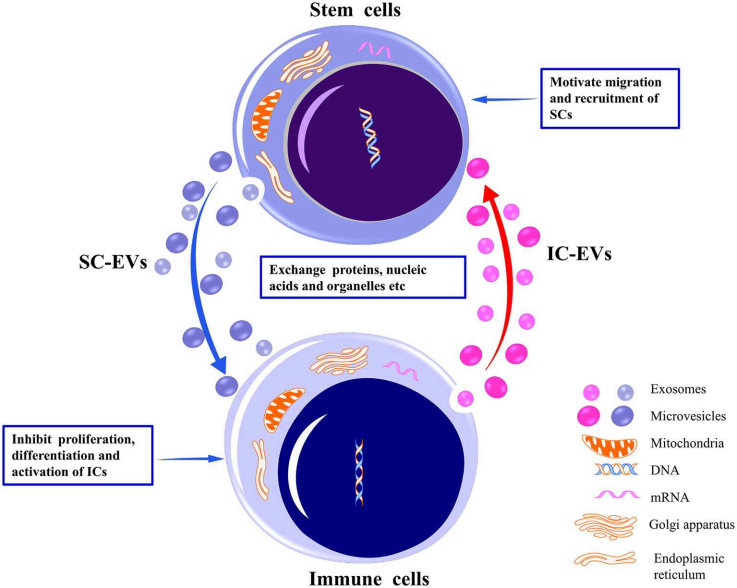 Fig.1 Bidirectional interaction between stem cells and immune cells through their respective EVs.1
Applications of SC-Exo in regulating immunity
-
Regulation of innate immune response
SC-Exos serve as the body's natural mediators for calming overactive immune responses. These remarkable vesicles work by reprogramming macrophages toward their anti-inflammatory M2 phenotype, effectively reducing inflammatory cytokine storms while simultaneously tempering NK cell aggression. Their ability to modulate these frontline defenders makes them particularly valuable for managing hypersensitivity reactions and maintaining immune equilibrium. For researchers looking to decode these complex interactions, our exosomal cytokines profiling services provide detailed molecular fingerprints of these immunomodulatory effects.
-
Regulation of adaptive immunity
The influence of SC-Exos extends deep into the adaptive immune system, where they perform a delicate balancing act. By carefully regulating T cell differentiation, these nano-regulators help maintain the critical equilibrium between helper T cells and regulatory T cells. This precise control mechanism offers promising avenues for preventing transplant rejection and mitigating autoimmune conditions, essentially serving as nature's own immunosuppressant with pinpoint accuracy. Our specialized in vitro functional research services of exosomes allow scientists to observe and measure these immunomodulatory effects in real time.
-
Regulation of antigen presentation
SC-Exos exhibit sophisticated control over antigen presentation by strategically inhibiting dendritic cell maturation. This targeted intervention creates a natural checkpoint in immune activation, effectively slowing down the antigen uptake and presentation process to T and B cells. Such precise modulation of this critical immune pathway opens new possibilities for managing immune overactivation disorders.
Creative Biolabs Offers Comprehensive SC-Exos Immune Cell Modulation Research Solutions
At Creative Biolabs, we're excited about the groundbreaking possibilities of stem cell exosomes (SC-Exos) as next-generation immunomodulators. These tiny biological powerhouses are showing remarkable promise for treating a wide spectrum of immune-related conditions - from autoimmune disorders to inflammatory diseases.
Our team has built a complete research ecosystem to help you explore these opportunities. Imagine having all the tools you need under one roof:
What really sets us apart is our deep understanding of how SC-Exos "talk" to different immune cells. We don't just provide services - we partner with you to uncover the precise mechanisms behind their immunomodulatory effects and help optimize their therapeutic applications.
Whether you're just starting to explore SC-Exos or looking to advance an existing program, our scientists are ready to support your project with tailored solutions. Have a specific challenge in mind? Let's discuss how we can help turn your ideas into meaningful discoveries.
Contact us today to start the conversation about your SC-Exos research needs.
FAQs
Q: How exactly do these stem cell exosomes work with immune cells, and what tools can we use to study them?
A: These tiny messengers from stem cells - SC-Exos - are packed with natural biological signals that help balance our immune system. They carry special molecules that can calm overactive macrophages, adjust T-cell responses, and fine-tune how our immune cells communicate. To help researchers understand these complex interactions, we've built a complete toolkit that covers everything from isolating these exosomes to running detailed molecular analyses and functional tests.
Q: What kinds of health conditions might benefit from SC-Exo treatments?
A: We're seeing exciting potential for using SC-Exos in several areas where the immune system needs rebalancing - things like rheumatoid arthritis, MS, severe allergies, and preventing organ transplant rejection. Our team helps researchers test these applications using highly simulated disease models and specialized immune cell tests in vitro. We also provide exosome production services to meet customers' demand for large quantities of exosome particles for testing.
Q: Where do the most effective immunomodulatory exosomes come from?
A: While mesenchymal stem cells (MSCs) are the go-to source for their strong anti-inflammatory effects, we've had great results with other sources too. Umbilical cord-derived exosomes often give us better yields, and iPSC-derived versions offer more consistent batches. No matter the source, we make sure to carefully isolate and characterize each batch, checking for purity and quality before any further engineering or testing.
Q: Where do the most effective immunomodulatory exosomes come from?
A: While mesenchymal stem cells (MSCs) are the go-to source for their strong anti-inflammatory effects, we've had great results with other sources too. umbilical cord mesenchymal stem cell-derived exosomes often give us better yields, and induced pluripotent stem cells-derived versions offer more consistent batches. No matter the source, we make sure to carefully isolate and characterize each batch, checking for purity and quality before any further engineering or testing.
Q: How can we be sure SC-Exos are actually affecting immune cells the way we think?
A: We use multiple approaches to verify these effects - everything from watching how immune cells behave in controlled cultures to measuring cytokine changes and testing in animal models of inflammation.
Q: Can we customize SC-Exos to work even better for specific immune targets?
A: Definitely! We've developed several ways to enhance their natural abilities - we can add targeting molecules to their surface or load them with specific therapeutic cargo. Our team has optimized techniques to make sure these modifications don't interfere with the exosomes' natural functions.
Reference
-
Xie, Min, et al. "Immunoregulatory effects of stem cell-derived extracellular vesicles on immune cells." Frontiers in Immunology 11 (2020): 13. Distributed under Open Access license CC BY 4.0, without modification.
For Research Use Only. Cannot be used by patients.
Related Services: