
Creative Biolabs is offering the most comprehensive services for antibody development projects. With strict regulation and effective execution, we are dedicated to providing the most valuable solutions to complete your projects.
HighlightsCreative Biolabs is offering the most comprehensive services for antibody development projects. With strict regulation and effective execution, we are dedicated to providing the most valuable solutions to complete your projects.
HighlightsCreative Biolabs has established a broad range of platforms for developing novel antibodies or equivalents. These cutting-edge technologies enable our scientists to meet your demands from different aspects and tailor the most appropriate solution that contributes to the success of your projects.
HighlightsWith deep understanding in antibody-related realms and extensive project experience, Creative Biolabs offers a variety of references to help you learn more about our capacities and achievements, including infographic, flyer, case study, peer-reviewed publications, and all kinds of knowledge that can assist your projects. You are also welcome to contact us directly for more specific solutions.
HighlightsGet a real taste of Creative Biolabs, one of the most professional custom service providers in the world. We are committed to providing highly customized comprehensive solutions with the best quality to advance your projects.
Highlights Loading...
All listed services and products are For Research Use Only. Do Not use in any diagnostic or therapeutic applications.
ADORA2a is a Class A rhodopsin-like G protein-coupled receptor family and is an archetypal member of the purinergic P1 receptor family and preferential coupling to heterotrimeric Gs protein (GS). After agonist engagement, GS stimulates adenylyl cyclase, which increases intracellular cyclic AMP that then activates protein kinase A-dependent signaling cascades. When in vivo and under physiological conditions, low extracellular adenosine concentrations and ADORA2A signaling mediate biologic activities like coronary vasodilation, neuronal modulation or synaptic transmission tuning. In stark contrast, in pathological microenvironments—tissues challenged by inflammation or ischemia, degenerating neural circuits—the levels of adenosine will saturate below the micromolar scale at organismal dimensions, converting ADORA2A into a potent suppressive switch. Adenosine, driven by tumor hypoxia engages ADORA2A as a non-redundant immune checkpoint (beyond PD-1/CTLA-4) that activates cAMP-mediated inhibition of cytokine production and release of lytic granules from infiltrating cytotoxic T-cells and natural killer cells. Excess ADORA2A activity has both a pro-excitotoxic and neuro-inflammatory effect in experimental models, providing substantial pre-clinical benefits for selective antagonists across brain diseases.
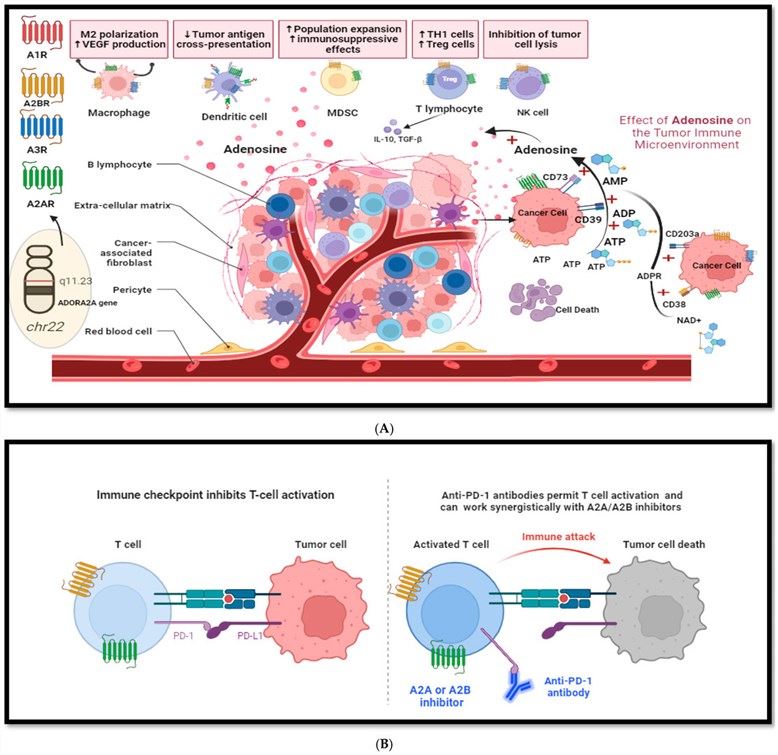 Fig.1 Impact of adenosine on the tumor-immune microenvironment (A2AR = ADORA2A).1
ADORA2A coordinates diverse physiological programs simultaneously, complicating its classical classification as an adenosine sensor:
We develop a customized suite of ADORA2A membrane protein products to support structural, ligand-binding, biochemical, and functional studies of this purinergic GPCR. Because appropriate receptor folding and membrane-associated conformation are important for preserving ligand-binding and signaling-related properties, available preparations and construct formats are designed to meet different experimental requirements. These products may be suitable for studies of orthosteric and allosteric ligand interactions, receptor structure, pharmacological modulation, and related functional mechanisms. Appropriate quality assessment is applied according to the intended research use and specific product format.
Not finding the membrane protein product you need? Contact us to start your one-stop custom service!
Physiologically representative cellular platforms are critical for elucidating ADORA2A-mediated purinergic signaling and benchmarking therapeutic discovery pipelines. We provide to the scientific community High-quality ADORA2A stable cell lines that maintain true plasma membrane localization, native glycosylation signatures, and functional response patterns upon exposure to drugs, including adenosine. In addition to those of wild-type ADORA2A, our platforms include constitutively active mutants; naturally occurring coding variants associated with neuropsychiatric phenotypes; and polymorphisms that enhance or reduce G protein coupling efficiency. We next created reporter-coupled lines for mechanistic dissection of ADORA2A-driven biology, which include cAMP response element-driven luciferase as well as assays to measure β-arrestin recruitment and calcium mobilization in real time upon agonist stimulation or antibody blockade. We also provide co-expression systems to reconstitute heteromeric receptor complexes of ADORA2A with either the dopamine D2 receptor or adenosine A1 receptors in one cell background, allowing for studies on allosteric crosstalk without transgenically expressing a second subunit.
Not finding the stable cell line product you need? Contact us to start your one-stop custom service!
We offer a range of sequence-defined recombinant antibodies against ADORA2A for diverse research applications. These reagents are designed to support the detection, localization, and analysis of ADORA2A in appropriate research samples and model systems. Depending on the specific product, ADORA2A antibodies may be suitable or available for selected applications such as Western Blotting, ELISA, Flow Cytometry, Immunofluorescence, and related antibody-based assays. Product-specific application suitability and performance should be determined based on the corresponding antibody data and experimental conditions.
Not finding the recombinant antibody product you need? Contact us to start your one-stop custom service!
In addition to our catalog products, we offer a suite of comprehensive end-to-end protein design and engineering services for complex purinergic GPCRs such as ADORA2A:
We produce ADORA2A membrane proteins in complex with heterotrimeric Gs protein for optimal coupling and ligand-binding kinetics. The receptor-G protein complex are available pre-assembled and can be supplied co-reconstituted with β-arrestin upon request.
Our products include the essentials for glycosylation and proper disulfide bond formation to maintain correct folding, membrane insertion and recognition by conformational dependent antibodies. Quality control explicitly approves these changes before release.
Specific deletions in the N-terminal extracellular domain, individual loops and/or C-terminus that contains serine phosphorylation sites. These have the advantage of allowing for large structure-function studies and creating dominant-negative mutants.
No—our ADORA2A products including recombinant proteins, stable cell lines and antibody reagents are only used for preclinical research purpose. None of them have passed the safety, sterility or regulatory hurdles requisite for use in human subjects.








