Creative Biolabs is offering the most comprehensive services for antibody development projects. With strict regulation and effective execution, we are dedicated to providing the most valuable solutions to complete your projects.
HighlightsCreative Biolabs is offering the most comprehensive services for antibody development projects. With strict regulation and effective execution, we are dedicated to providing the most valuable solutions to complete your projects.
HighlightsCreative Biolabs has established a broad range of platforms for developing novel antibodies or equivalents. These cutting-edge technologies enable our scientists to meet your demands from different aspects and tailor the most appropriate solution that contributes to the success of your projects.
HighlightsWith deep understanding in antibody-related realms and extensive project experience, Creative Biolabs offers a variety of references to help you learn more about our capacities and achievements, including infographic, flyer, case study, peer-reviewed publications, and all kinds of knowledge that can assist your projects. You are also welcome to contact us directly for more specific solutions.
HighlightsGet a real taste of Creative Biolabs, one of the most professional custom service providers in the world. We are committed to providing highly customized comprehensive solutions with the best quality to advance your projects.
HighlightsPreclinical drug development often faces critical challenges: low biological relevance of traditional models, difficulty in elucidating mechanisms of action (MOA), and inefficient screening workflows. Creative Biolabs' Cellular Mechanism & Functional Characterization Services directly address these hurdles by providing an integrated in vitro analysis platform. We provide an integrated platform that merges predictive biological models, multiparametric cellular imaging, and scalable automated screening technologies. This enables us to deliver data with enhanced translational predictiveness, deep mechanistic insights, and accelerated timelines, empowering you to de-risk and streamline your therapeutic development.
In the rapidly evolving landscape of cell-based therapeutics, the functional potency of therapeutic cells, such as CAR-T cells, stem cells, and other immune effectors, is increasingly recognized as a critical determinant of clinical success. Unlike molecular drugs, where structure-function relationships are well-defined, cellular therapeutics exhibit profound functional heterogeneity even among genetically identical populations. This variability stems from differences in secretion profiles, metabolic states, epigenetic modifications, and dynamic interactions with the microenvironment, all of which influence therapeutic outcomes but are poorly captured by conventional genomic or surface-marker-based assays. Consequently, there is a pressing need for advanced cellular mechanism and functional characterization services that move beyond static genotypic analysis to dynamically profile and quantify functional phenotypes at the individual cell level.
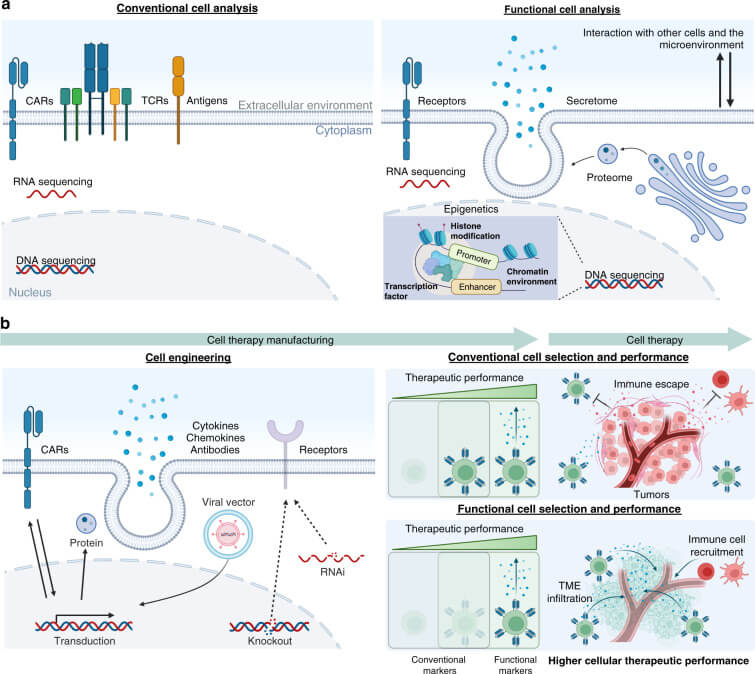 Fig.1 Innovative discovery and biomanufacturing of cellular therapeutics. 1
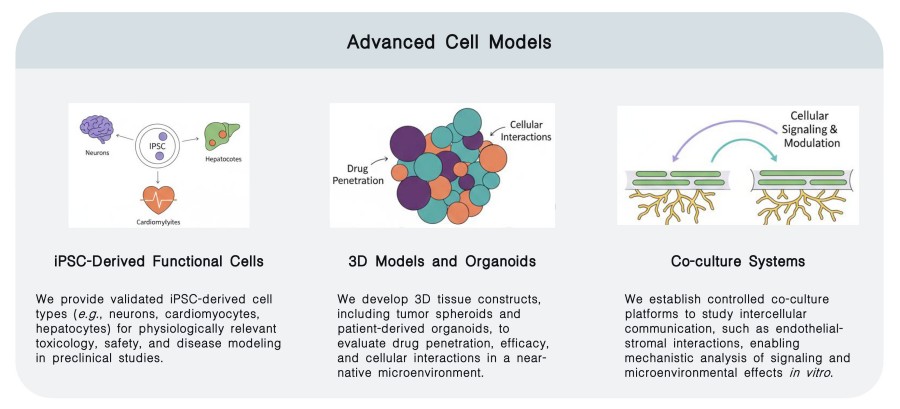
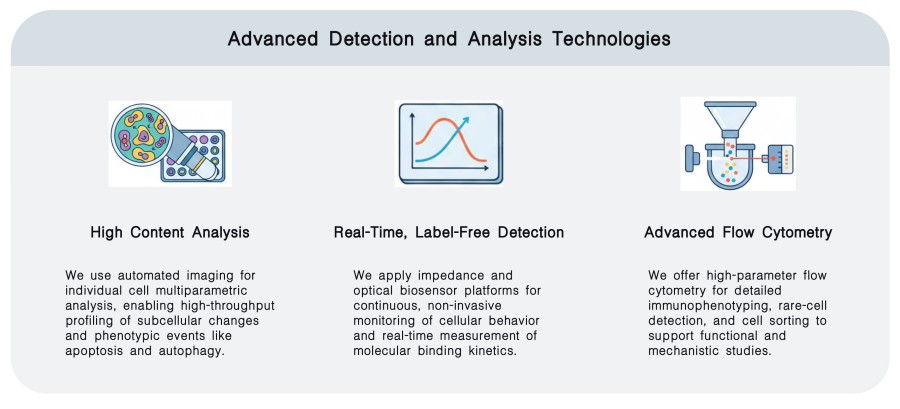
Creative Biolabs' Cellular Mechanism & Functional Characterization Services deliver advanced, physiologically reflective in vitro systems for the systematic evaluation of drug activity and biological mechanisms. We deliver predictive human-relevant models, including iPSC-derived cells, 3D organoids, and co-culture systems, combined with advanced analytical technologies like High Content Analysis, real-time label-free detection, and high-parameter flow cytometry. This integrated approach enables detailed investigation of drug activity, safety, and efficacy, accelerating preclinical development and de-risking translational pathways.
Our Advanced Cell Models service offers physiologically relevant human cellular platforms, including iPSC-derived functional cells, 3D organoids, and co-culture systems, to enable predictive in vitro analysis for toxicology, disease modeling, and therapeutic evaluation.
Our Advanced Detection and Analysis Technologies deliver multidimensional, real-time insights into cellular and molecular behavior through integrated high-content imaging, label-free kinetic monitoring, and high-parameter flow cytometry.
Our platform delivers integrated in vitro functional analyses to illuminate compound interactions with core biological pathways, facilitating drug development from mechanistic verification to therapeutic optimization.
We provide quantitative assessment of compound effects on cell growth and division using high-throughput methodologies such as BrdU incorporation, CFSE dilution, MTT/CCK-8 assays, and high-content imaging. This service supports oncology drug discovery, toxicology profiling, and cell cycle research by delivering precise dose- and time-dependent proliferation data.
We conduct comprehensive detection and mechanistic analysis of regulated cell death, including apoptosis, necrosis, pyroptosis, and autophagy, via Annexin V/PI flow cytometry, caspase activity assays, mitochondrial membrane potential measurement, and key pathway protein immunoblotting. These assays are essential for evaluating drug-induced cytotoxicity, neuroprotective mechanisms, and cellular injury pathways.
We analyze the uptake kinetics and intracellular trafficking of biologics, ADCs, nanoparticles, and gene delivery vectors using fluorescence labeling and confocal microscopy. This enables optimization of intracellular targeting, payload release, and pharmacokinetic properties for ADC development, novel biologics, and gene therapy platforms.
We assess compound effects on cell motility, invasion, and vascular formation through in vitro models including scratch assays, Transwell migration/invasion assays, and tube formation assays. These analyses are critical for screening anti-metastatic and anti-angiogenic therapies, as well as evaluating drugs for inflammatory and fibrotic diseases.
We perform detailed investigation of drug-modulated signaling networks via cytokine/chemokine release profiling (ELISA), phosphoprotein analysis (Western blot), gene expression quantification (qPCR), and pathway-specific reporter cell assays. This integrated approach supports mechanism-of-action validation for immunomodulators, anti-inflammatory agents, and receptor-targeted therapeutics.
Creative Biolabs provides in vitro mitochondrial function analysis toassess respiration, membrane potential, ATP production, and bioenergetics,enabling evaluation of mitochondrial health, dysfunction, and therapeuticresponses in cellular models.
Choose us to transform your preclinical research with predictive human-relevant models, deep mechanistic insights, and scalable efficiency. We overcome low biological relevance using iPSC-derived cells, 3D organoids, and co-culture systems. High-content multiparametric analysis clarifies MOA, while automated high-throughput platforms accelerate screening. De-risk development with data that bridges in vitro results to clinical translation.
Ready to transform your preclinical research with human-relevant data? today for a customized proposal and technical consultation to advance your in vitro cellular studies and accelerate your path to breakthroughs.
All listed services and products are For Research Use Only. Do Not use in any diagnostic or therapeutic applications.