Creative Biolabs is offering the most comprehensive services for antibody development projects. With strict regulation and effective execution, we are dedicated to providing the most valuable solutions to complete your projects.
HighlightsCreative Biolabs is offering the most comprehensive services for antibody development projects. With strict regulation and effective execution, we are dedicated to providing the most valuable solutions to complete your projects.
HighlightsCreative Biolabs has established a broad range of platforms for developing novel antibodies or equivalents. These cutting-edge technologies enable our scientists to meet your demands from different aspects and tailor the most appropriate solution that contributes to the success of your projects.
HighlightsWith deep understanding in antibody-related realms and extensive project experience, Creative Biolabs offers a variety of references to help you learn more about our capacities and achievements, including infographic, flyer, case study, peer-reviewed publications, and all kinds of knowledge that can assist your projects. You are also welcome to contact us directly for more specific solutions.
HighlightsGet a real taste of Creative Biolabs, one of the most professional custom service providers in the world. We are committed to providing highly customized comprehensive solutions with the best quality to advance your projects.
Highlights Loading...
All listed services and products are For Research Use Only. Do Not use in any diagnostic or therapeutic applications.
ATPase Na+/K+ transporting subunit alpha 2 (ATP1A2) is the catalytic alpha subunit of neuronal Na+/K+-ATPase encoded by ATP1A2 gene, belonging to P-type ATPase superfamily and acting as core ATP-dependent ion pump effector in central nervous system glial and neuronal populations. ATP1A2 is highly enriched in cerebral tissue cell membranes, carrying evolutionarily conserved ATP-binding cytoplasmic domains and Na+/K+ ion translocation transmembrane segments across species, serving as an essential modulator for ATP-fueled sodium-potassium counter-transport to maintain resting membrane potential. Beyond baseline neuronal electrical stabilization, ATP1A2 also undertakes interstitial potassium clearance after repetitive nerve firing, participates in blood-brain barrier ion balance maintenance and coordinates glial-neuron ion signal exchange in brain tissue microenvironment. ATP1A2-mediated ion pumping exerts decisive effects on stabilizing neuronal electrical baseline and sustaining cerebral interstitial ion balance under physiological brain conditions. Furthermore, ATP1A2 coordinates extracellular potassium clearance following neuronal firing to prevent hyperexcitability. Distinct from ubiquitously expressed ATP1A1, ATP1A2 exhibits central nervous system-restricted expression with unique brain ion regulatory functions.
ATP1A2 executes biological functions via ATP hydrolysis-driven conformational cycling, extruding cytoplasmic sodium and importing extracellular potassium against concentration gradients to establish transmembrane ion gradients critical for neuronal action potential recovery. Its conserved nucleotide and cation binding pockets enable efficient energy-coupled ion translocation to stabilize neural excitability thresholds. ATP1A2 participates in post-spike potassium buffering and cerebral tissue ion homeostasis. Missense ATP1A2 mutations impair pump catalytic activity and trigger familial hemiplegic migraine syndromes. Therefore, ATP1A2 constitutes a pivotal research target for neuronal ion pump physiology and migraine disorder mechanisms.
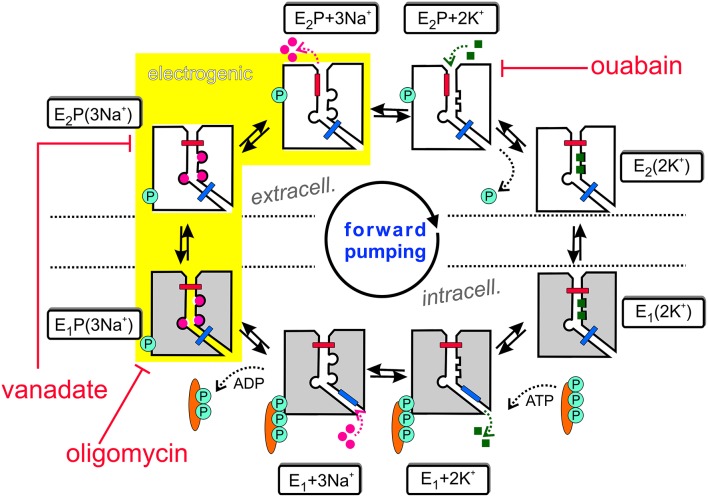 Fig. 1 E1-E2 conformational cycle of Na⁺/K⁺-ATPase (ATP1A2), ATP hydrolysis drives outward Na⁺ extrusion and inward K⁺ uptake; ouabain, vanadate and oligomycin inhibit distinct pumping steps.1
The biological functions of ATP1A2 are focused on P-type ATPase catalytic hydrolysis and coupled Na+/K+ transmembrane translocation:
Creative Biolabs offers high-quality ATP1A2 proteins via optimized expression systems, covering full-length ATP1A2 and ATP-binding catalytic domain variants. These products retain native pump folding and ATP-dependent ion transport activity, suitable for neuronal ion pump and migraine compound screening. Multi-step chromatography removes inactive truncated fragments, and low-ionic-strength storage buffer protects ATP binding pocket integrity during repeated freeze-thaw cycles. All ATP1A2 proteins undergo rigorous quality control to guarantee consistent functional performance and reliable application across diverse research platforms.
Not finding the membrane protein product you need? Contact us to start your one-stop custom service!
Creative Biolabs provides custom engineered ATP1A2 stable cell lines, including overexpression and gene silencing models. These cell lines are optimized for neuronal ion pump physiology and cerebral disorder research. Multiple rounds of clonal screening filter out cells with fluctuating pump expression, each clone supplied with continuous culture stability testing data for long-term experimental use. Each cell line undergoes strict validation procedures to ensure steady target expression levels and uniform functional performance across multiple experimental scenarios.
Not finding the stable cell line product you need? Contact us to start your one-stop custom service!
High-specificity recombinant antibodies targeting ATP1A2 are developed with advanced antibody engineering workflows, without cross-reactivity against other Na+/K+-ATPase alpha isoforms. These antibodies pass membrane localization and western blot functional verification, formulated with mild buffer suitable for brain tissue slice immunostaining. Parallel cross-reactivity screening eliminates signals binding ATP1A1/ATP1A3.
Not finding the recombinant antibody product you need? Contact us to start your one-stop custom service!
Beyond catalog products, Creative Biolabs offers specialized custom services for ATP1A2 research:
ATP1A2 is a neuronal P-type ATPase catalytic subunit that hydrolyzes ATP to drive Na+/K+ countertransport and stabilize neural resting membrane potential.
Pathogenic ATP1A2 variants disrupt brain ion balance and trigger hemiplegic migraine; it maintains core cerebral ion homeostasis, establishing it as a vital research target.
No, all ATP1A2 products and services are strictly for research use only, not intended for clinical diagnosis or treatment.
Offerings include ATP1A2 proteins, high-specificity recombinant antibodies and custom stable cell lines for neuronal ion pump and migraine research.
ATP1A2 proteins undergo functional verification via ATP hydrolysis and coupled sodium-potassium transport capacity evaluation.