Creative Biolabs is offering the most comprehensive services for antibody development projects. With strict regulation and effective execution, we are dedicated to providing the most valuable solutions to complete your projects.
HighlightsCreative Biolabs is offering the most comprehensive services for antibody development projects. With strict regulation and effective execution, we are dedicated to providing the most valuable solutions to complete your projects.
HighlightsCreative Biolabs has established a broad range of platforms for developing novel antibodies or equivalents. These cutting-edge technologies enable our scientists to meet your demands from different aspects and tailor the most appropriate solution that contributes to the success of your projects.
HighlightsWith deep understanding in antibody-related realms and extensive project experience, Creative Biolabs offers a variety of references to help you learn more about our capacities and achievements, including infographic, flyer, case study, peer-reviewed publications, and all kinds of knowledge that can assist your projects. You are also welcome to contact us directly for more specific solutions.
HighlightsGet a real taste of Creative Biolabs, one of the most professional custom service providers in the world. We are committed to providing highly customized comprehensive solutions with the best quality to advance your projects.
Highlights Loading...
All listed services and products are For Research Use Only. Do Not use in any diagnostic or therapeutic applications.
The CX3CR1 gene at 3p22.2 encodes the fractalkine receptor, a seven-transmembrane G-protein-coupled receptor of the rhodopsin-like class A family and the sole receptor for the CX3C chemokine fractalkine (CX3CL1). CX3CR1 is a 355-amino-acid multi-pass membrane protein of approximately 40 kDa. It is expressed on monocytes, natural killer cells, dendritic cells, and tissue-resident macrophages, with particularly high expression in nonclassical monocytes and central nervous system microglia. As the receptor for fractalkine, CX3CR1 mediates both adhesive and chemotactic functions: it captures leukocytes under physiologic flow through G-protein-independent adhesion and directs migration via Gαi-coupled signaling including PI3K/AKT and MAPK pathways. The CX3CL1-CX3CR1 axis is the primary communication pathway between neurons and microglia in the brain, maintaining microglial quiescence and regulating neuroinflammation, synaptic plasticity, and neuroprotection. Two common polymorphisms, V249I and T280M, are present in approximately 25% of the population and produce a receptor with reduced fractalkine binding affinity. These variants have been associated with HIV-1 disease progression, age-related macular degeneration, and coronary artery disease. CX3CR1 is therefore an important target for studying leukocyte trafficking, neuroimmune interactions, and microglia-mediated pathology, providing tools for understanding chemokine receptor biology and the role of neuroinflammation in neurodegenerative disease.
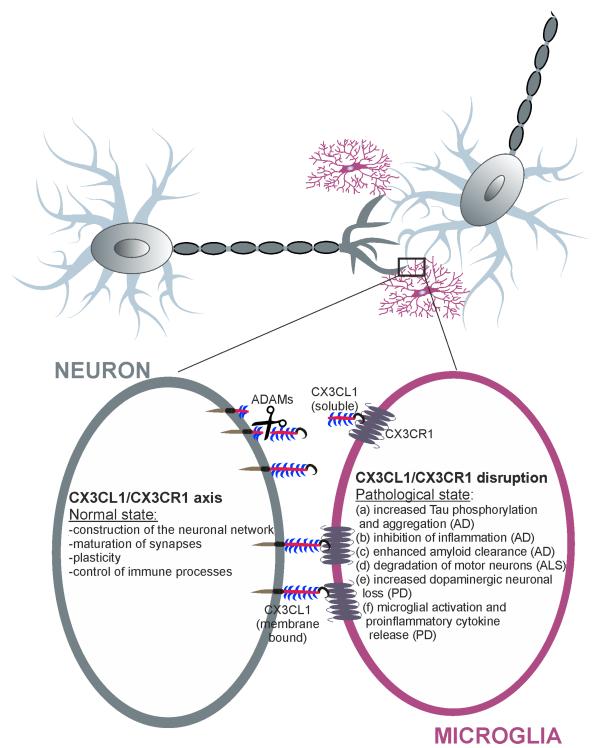 Fig. 1 CX3CL1-CX3CR1 signaling between microglia and neurons in physiological and neuropathological conditions.1
The functional spectrum of CX3CR1 spans leukocyte trafficking and neuroimmune biology:
Creative Biolabs offers a series of high-quality CX3CR1 membrane protein products, suitable for structural and functional studies of chemokine receptor biology and leukocyte trafficking. Built on the independently developed MemDX™ recombinant membrane protein technology platform, CX3CR1 proteins can be generated through various expression systems, including virus-like particles (VLP) and in vitro prokaryotic expression systems. These thoroughly characterized protein products, such as MemDX™ recombinant human CX3CR1 membrane protein as virus-like particles and human CX3CR1 proteins from diverse expression systems, can be used in ELISA, antibody screening, ligand binding assays, and functional investigations, providing reliable tools for analyzing the fractalkine binding mechanism and signaling properties of CX3CR1.
Not finding the membrane protein product you need? Contact us to start your one-stop custom service!
Constructing a robust cell model is essential for investigating the molecular mechanisms of fractalkine-mediated adhesion and chemotaxis. As the sole receptor for CX3CL1 mediating both adhesive capture and directed migration, CX3CR1 expression level and signaling capacity directly determine leukocyte trafficking behavior and microglial function. Genetic variants or altered expression may lead to substantial differences in ligand binding, signaling output, and neuroimmune regulation. Creative Biolabs offers customized CX3CR1 membrane protein stable transfection cell models, encompassing wild-type and disease-associated variant forms including V249I and T280M. These models express the target protein on the plasma membrane, and are suitable for studies on fractalkine binding kinetics, chemotaxis assays, signaling pathway analysis, and evaluation of variant-dependent functional differences, providing a reliable platform for exploring CX3CR1 structure-function relationships, the consequences of common polymorphisms, and the regulatory mechanisms of leukocyte migration. Our technology ensures cell membrane integrity and correct protein localization, facilitating your research.
Not finding the stable cell line product you need? Contact us to start your one-stop custom service!
Creative Biolabs offers highly specific recombinant antibodies targeting CX3CR1, manufactured using advanced recombinant antibody technology. Compared to traditional antibodies, these recombinant antibodies deliver improved performance in specificity, sensitivity, and batch-to-batch consistency. They also support various modifications and labeling strategies. Our CX3CR1 recombinant antibodies are suitable for a broad range of applications, including Western Blot, ELISA, flow cytometry, immunofluorescence, immunocytochemistry, immunohistochemistry, and immunoprecipitation, and can be used to examine CX3CR1 expression levels on leukocyte subsets and microglia, analyze its subcellular localization at the plasma membrane, and conduct related investigations such as ligand binding studies and chemotactic signaling analysis. These antibodies provide dependable detection reagents for the structural characterization, functional investigation of CX3CR1, and the analysis of its role in leukocyte trafficking and neuroimmune signaling.
Not finding the recombinant antibody product you need? Contact us to start your one-stop custom service!
In addition to the standard products, Creative Biolabs also offers professional customized services for CX3CR1. CX3CR1 has common polymorphisms with functional differences, including V249I and T280M variants that alter fractalkine binding and are associated with disease susceptibility. These variants present specific requirements in protein expression, ligand binding analysis, and functional characterization. Leveraging our technology platform, we can assist you in completing the following customized projects:
CX3CR1 encodes the fractalkine receptor, the sole receptor for the CX3C chemokine CX3CL1 (fractalkine). It mediates both adhesive capture of leukocytes under physiologic flow and chemotactic migration in response to soluble fractalkine gradients. In the central nervous system, the CX3CL1-CX3CR1 axis is the primary communication pathway between neurons and microglia, maintaining microglial quiescence and regulating neuroinflammation.
CX3CR1 is a critical regulator of leukocyte trafficking and neuroimmune homeostasis. Common polymorphisms (V249I, T280M) affect fractalkine binding affinity and are present in approximately 25% of the population, with associations to HIV-1 progression, age-related macular degeneration, and cardiovascular disease. CX3CR1 is also implicated in neurodegenerative diseases including Alzheimer and Parkinson diseases, making it a target of interest across immunology, neuroscience, and vascular biology.
Not applicable. All CX3CR1 products and services provided by Creative Biolabs are for research purposes only and cannot be used for any clinical diagnosis, prevention, treatment or cure of any disease.
We offer a variety of product types, including recombinant CX3CR1 membrane proteins, stable cell models expressing CX3CR1, high-quality recombinant CX3CR1 antibodies, as well as comprehensive customized services.