Creative Biolabs is offering the most comprehensive services for antibody development projects. With strict regulation and effective execution, we are dedicated to providing the most valuable solutions to complete your projects.
HighlightsCreative Biolabs is offering the most comprehensive services for antibody development projects. With strict regulation and effective execution, we are dedicated to providing the most valuable solutions to complete your projects.
HighlightsCreative Biolabs has established a broad range of platforms for developing novel antibodies or equivalents. These cutting-edge technologies enable our scientists to meet your demands from different aspects and tailor the most appropriate solution that contributes to the success of your projects.
HighlightsWith deep understanding in antibody-related realms and extensive project experience, Creative Biolabs offers a variety of references to help you learn more about our capacities and achievements, including infographic, flyer, case study, peer-reviewed publications, and all kinds of knowledge that can assist your projects. You are also welcome to contact us directly for more specific solutions.
HighlightsGet a real taste of Creative Biolabs, one of the most professional custom service providers in the world. We are committed to providing highly customized comprehensive solutions with the best quality to advance your projects.
Highlights Loading...
All listed services and products are For Research Use Only. Do Not use in any diagnostic or therapeutic applications.
Eph receptor B4(EPHB4) is a class B Eph transmembrane tyrosine kinase encoded by EphB4 gene, which is selectively expressed on the surfaces of venous endothelial cells and various epithelial tumor cells, and its only membrane ligand is EFNB2. Unlike EphA and other EphB family members who prefer arterial expression, EphB4-EFNB2 signal axis can mediate forward and reverse bidirectional signal conduction, and dominate the differentiation and construction of arterial and venous vascular boundaries during embryonic vascular development. In the vascular homeostasis of adult body, EphB4 maintains a low level of basic expression, which can stabilize the monolayer structure of venous endothelium and avoid abnormal germination and proliferation of blood vessels. However, in the microenvironment of hypoxic solid tumor, the expression of EphB4 in tumor cells and endothelial cells of neovascularization was significantly up-regulated, which activated the two-way kinase cascade reaction: the positive signal of EphB4 promoted the proliferation and migration of tumor cells, while the negative signal of endothelial cells EFNB2 drove pathological venous angiogenesis. Other Eph family kinases can't compensate EphB4' unique vein-specific angiogenic function. Specific blocking EphB4 can effectively inhibit tumor angiogenesis and hinder tumor distant metastasis, which is an irreplaceable core target for the study of vascular development mechanism and the screening of anti-angiogenic ADC drugs.
EphB4 is anchored on the lipid bilayer of endothelial cells and tumor cell membranes, which plays a role in bidirectional regulation of Eph kinase signals, recognizes membrane-anchored EFNB2 ligands through extracellular spherical ligand binding regions, and activates downstream RAS/FAK signaling cascade with intracellular tyrosine kinase domains. Its strict selective expression characteristics of venous endothelium form a clear functional differentiation with arterial Eph receptor, which constitutes the exclusive regulatory axis of arteriovenous identity differentiation. The cross signal of EphB4-EFNB2 can dynamically balance physiological vascular maturation and tumor pathological vascular hyperplasia according to the change of tissue oxygen partial pressure. This molecule is widely involved in physiological and pathological processes such as embryonic angiogenesis, wound repair and advanced tumor metastasis. The dysfunction of EphB4 can significantly inhibit the germination of pathological neovascularization and effectively limit the ability of tumor invasion and metastasis. To sum up, EphB4 is the key target for the study of Eph kinase mechanism and the exploration of tumor anti-angiogenesis targeted therapy.
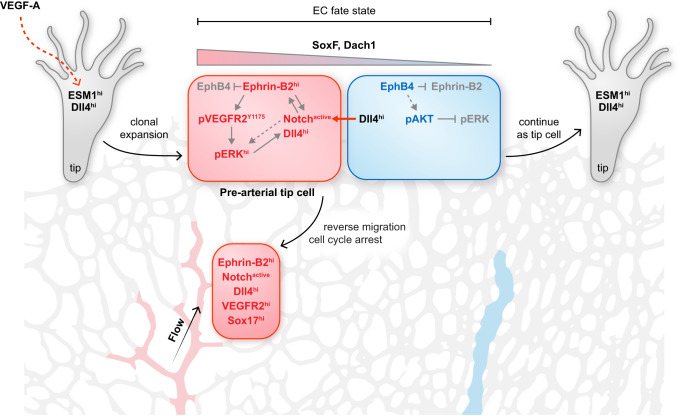 Fig. 1 Endothelial tip cell fate specification schematic showing EphB4-Ephrin-B2 reciprocal signaling bifurcating VEGF-triggered endothelium into pre-arterial and venous tip cell subpopulations via coordinated Notch, ERK and AKT kinase cascades.1
The biological functions of venous EphB4 tyrosine kinase receptor are fully focused on EFNB2 bidirectional binding and angiogenic signal amplification:
Creative Biolabs offers high-quality EphB4 proteins through optimized endothelial eukaryotic expression systems, including full-length kinase receptor and isolated EFNB2 ligand-binding domain variants. These products retain native bidirectional Eph-Ephrin signaling activity, suitable for anti-angiogenic ADC screening assays. All EphB4 proteins undergo strict quality control to ensure consistent performance and reliable application across vascular oncology research platforms.
Not finding the membrane protein product you need? Contact us to start your one-stop custom service!
Creative Biolabs provides custom-engineered EphB4 stable cell lines, including carcinoma overexpression and blank empty vector control models. These cell lines are optimized for Eph kinase profiling and angiogenic signal functional analysis. Each cell line undergoes stringent validation to ensure stable expression profiles during long-term hypoxic co-culture, and can be widely deployed for large-scale anti-vascular tumor compound screening experiments.
Not finding the stable cell line product you need? Contact us to start your one-stop custom service!
High-specificity recombinant antibodies targeting EphB4 are developed via advanced antibody engineering technologies. These antibodies are validated for venous endothelial and tumor membrane localization detection and lung/gastric tissue expression profiling, and can be combined with EFNB2 detection reagents to analyze complete EphB4 angiogenic complexes in endothelial models.
Not finding the recombinant antibody product you need? Contact us to start your one-stop custom service!
Beyond catalog products, Creative Biolabs offers specialized custom services for EphB4 research:
EphB4 is venous Eph kinase that binds EFNB2 bidirectionally to control embryonic vessel identity and tumor angiogenesis.
Tumor-expressed EphB4 drives pathological vasculature, a validated candidate for anti-angiogenic ADC therapy.
No, all EphB4 products and services are strictly for research use only, not intended for clinical oncology trials.
Offerings include full-length EphB4 kinase receptors, isoform-specific detection antibodies and custom stable cell lines for vascular research.
EphB4 proteins are validated via EFNB2 ligand binding and kinase autophosphorylation functional testing.