Creative Biolabs is offering the most comprehensive services for antibody development projects. With strict regulation and effective execution, we are dedicated to providing the most valuable solutions to complete your projects.
HighlightsCreative Biolabs is offering the most comprehensive services for antibody development projects. With strict regulation and effective execution, we are dedicated to providing the most valuable solutions to complete your projects.
HighlightsCreative Biolabs has established a broad range of platforms for developing novel antibodies or equivalents. These cutting-edge technologies enable our scientists to meet your demands from different aspects and tailor the most appropriate solution that contributes to the success of your projects.
HighlightsWith deep understanding in antibody-related realms and extensive project experience, Creative Biolabs offers a variety of references to help you learn more about our capacities and achievements, including infographic, flyer, case study, peer-reviewed publications, and all kinds of knowledge that can assist your projects. You are also welcome to contact us directly for more specific solutions.
HighlightsGet a real taste of Creative Biolabs, one of the most professional custom service providers in the world. We are committed to providing highly customized comprehensive solutions with the best quality to advance your projects.
Highlights Loading...
All listed services and products are For Research Use Only. Do Not use in any diagnostic or therapeutic applications.
Fms related receptor tyrosine kinase 1 (FLT1), also known as vascular endothelial growth factor receptor 1 (VEGFR1), is a receptor tyrosine kinase of approximately 1,338 amino acids encoded by the FLT1 gene. FLT1 contains an extracellular ligand-binding region, a single transmembrane domain, and an intracellular tyrosine kinase domain. It binds vascular endothelial growth factor A (VEGF-A), VEGF-B, and placental growth factor (PlGF) and participates in the regulation of vascular development, angiogenic signaling, vascular permeability, and inflammatory cell responses. FLT1 is expressed in vascular endothelial cells as well as several myeloid cell populations, including monocytes, macrophages, and dendritic cells, with expression also reported in other cell types depending on tissue and biological context. Through ligand-dependent signaling and regulation of VEGF availability, FLT1 contributes to endothelial and vascular responses and provides an important target for research into angiogenesis, vascular biology, and inflammation.
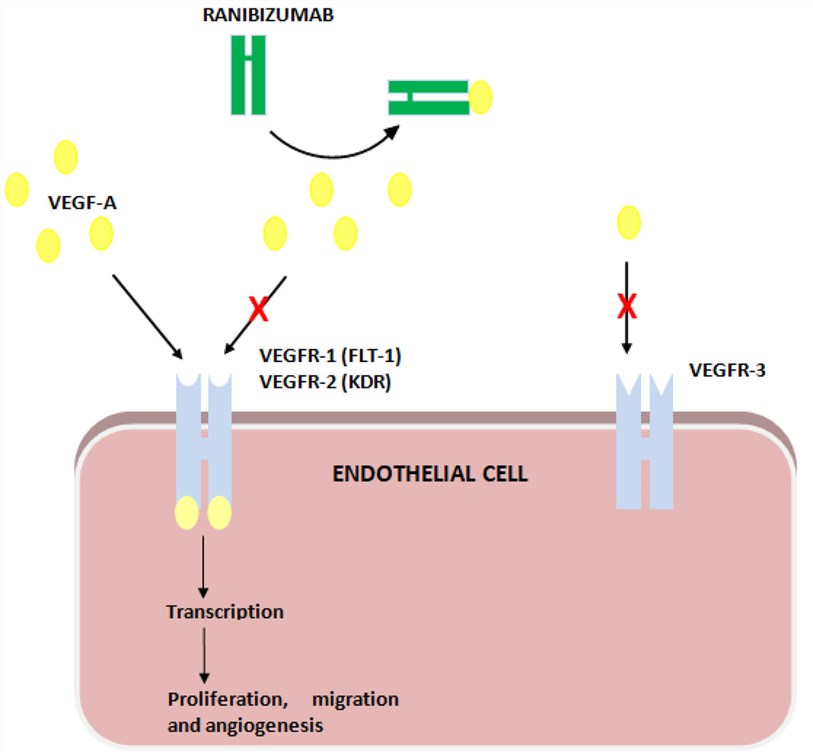 Fig.1 Ranibizumab's action on VEGF receptors (VEGFR).1
The functional scope of FLT1 spans multiple physiological and pathological domains, as it represents a unique entity acting simultaneously both as a ligand sink and receptor for signaling:
The investigations of the structural and pharmacological properties of FLT1 are further complicated by aspects nominee to the large extracellular domain, comparatively weak intrinsic kinase activity, dual output (membrane versus soluble), and epigenetic silencing susceptibility receptor. To overcome these challenges, Creative Biolabs has developed FLT1 protein design platform that provides conformationally intact preparations of this receptor for structural biology, ligand-binding studies and therapeutic antibody development. Utilizing cryo-EM–guided structural insights, codon-optimized gene synthesis, and proprietary expression protocols, our engineering team isolates constructs that maximize yield while maintaining the VEGF-A/PlGF binding interface (the "hot spot"), kinase domain, and juxtamembrane inhibitory region. Every engagement starts with an in-depth technical consultation to design the protein format to fit your specific downstream application, be it crystallography, small molecule–kinase/cell-free assay development or high-throughput inhibitor screening.
Not finding the membrane protein product you need? Contact us to start your one-stop custom service!
Cellular models expressing FLT1 are valuable for ligand-binding assays, signaling studies, compound screening, and cell migration research. Creative Biolabs provides customized FLT1 stable cell models with target expression or regulation tailored to specific experimental requirements. These models can support studies of FLT1 receptor biology, VEGF/PlGF-related signaling, cellular responses, and pathway modulation. Appropriate expression and functional characterization strategies can be selected according to the intended research application.
Not finding the stable cell line product you need? Contact us to start your one-stop custom service!
Exploiting high-affinity, sequence-defined antibodies against FLT1 are critical for detection of the receptor in tumor vasculature, mapping expression on macrophages and endothelial cells, neutralization respectively of VEGF-A binding to FLT1 to selectively block kinase activivity without affecting function of VEGFR-2. We are developing comprehensive recombinant antibody discovery programs for extracellular and conformational FLT1 epitopes (End-to-End). Antibody Development Pipeline Our antibody development pipeline combines immunogen design, multi-platform selection and downstream engineering to deliver binders with specificity, affinity and developability profiles required for research, diagnostic and therapeutic applications. Use of recombinant expression and clonal sequencing removes batch variation, common to polyclonal sera, leaving you with a renewable fully characterized reagent.
Not finding the recombinant antibody product you need? Contact us to start your one-stop custom service!
Beyond the standard catalog, Creative Biolabs provides advanced discovery services to meet end-to-end FLT1 research needs. These capabilities are customized for the needs of investigators exploring mechanistic detail that require specialty reagents, sophisticated assay architectures or integrated workflows across multiple components:
Yes, the immunogen corresponds to a conservation region within a mammalian species which allows consistency where detection can be done using multiple human, mouse and rat vascular preparations or cell lysate reagent types without needing these reagents for each individual species.
Yes, the protein is in a defined buffer devoid of any amines and at physiological pH to maintain native Ig-like domain fold wherein endotoxin is subject to monitoring. This allows for subsequent direct application into immobilization or capture-based displacement workflows for surface plasmon resonance (SPR) studies without requiring dialysis or intermediate buffer exchange.
Yes, we provide recombinant proteins, stable cell lines that express well-characterized substitutions which are known to disable tyrosine kinase functionality but allow for ligand-binding activity in the extracellular domain. They represent essential specificity controls for differentiating kinases from scaffolding functions in VEGF-mediated vascular biology.
Yes, certain clones have been confirmed on archival specimens post-antigen retrieval with specific membranous staining patterns along vascular endothelium in concordance with FLT1-enriched vascular beds. To confirm epitope specificity across heterogeneous tissue contexts, validation consists of peptide competition and recombinant antigen controls as a TCR control.