
Creative Biolabs is offering the most comprehensive services for antibody development projects. With strict regulation and effective execution, we are dedicated to providing the most valuable solutions to complete your projects.
HighlightsCreative Biolabs is offering the most comprehensive services for antibody development projects. With strict regulation and effective execution, we are dedicated to providing the most valuable solutions to complete your projects.
HighlightsCreative Biolabs has established a broad range of platforms for developing novel antibodies or equivalents. These cutting-edge technologies enable our scientists to meet your demands from different aspects and tailor the most appropriate solution that contributes to the success of your projects.
HighlightsWith deep understanding in antibody-related realms and extensive project experience, Creative Biolabs offers a variety of references to help you learn more about our capacities and achievements, including infographic, flyer, case study, peer-reviewed publications, and all kinds of knowledge that can assist your projects. You are also welcome to contact us directly for more specific solutions.
HighlightsGet a real taste of Creative Biolabs, one of the most professional custom service providers in the world. We are committed to providing highly customized comprehensive solutions with the best quality to advance your projects.
Highlights Loading...
All listed services and products are For Research Use Only. Do Not use in any diagnostic or therapeutic applications.
Sphingosine-1-phosphate receptor 1 (S1PR1) is a seven-transmembrane class A G protein-coupled receptor consisting of 382 amino acids and also known as endothelial differentiation gene 1 (EDG1) or S1P1. As the first member of the five-membered S1P receptor family (S1PR 1-5), it signals mainly through G i/o protein–coupled endothelial cell membranes, leading to adenylyl cyclase inhibition as well as downstream PI3K/AKT and ERK1/2 activation or Rac signaling. Receptor architecture adopts canonical class A GPCR topology comprising seven transmembrane α-helices, an extracellular N-terminal domain and three (ECL1–3) and intracellular loops (ICL1-3); additionally each receptor has a fully extended cytosolic C-terminal tail. A Cryo-EM structural analysis of S1PR has elucidated the molecular basis for ligand recognition: its zwitterionic phosphoamine headgroup pocks a polar pocket of residues from TM3, TM5, and TM6 and 7 (leading to selective high affinity binding), while its hydrophobic acyl tail reaches into a central groove buried deep in the membrane plane — consistent with receptor preference for lipid-type ligands. S1PR1 is expressed on nearly all the hematopoietic and vascular compartments with very high expression levels on T cells, B-cells as well as endothelial progenitors/dendritic-cell/neural-progenitor. The key physiological function of S1P is to sense the steep influx gradient between lymphoid tissues (low S1P) and blood/lymphatic circulation (high S1P), thereby guiding egress from thymusilator sites that are either newly made or already widely used. Immune surveillance and adaptive immunity rely on such a gradient-driven navigation. When activated by S1P or synthetic agonists, S1PR1 is phosphorylated rapidly on multiple serine residues (highlighted in red) following G protein-coupled receptor kinase 2-mediated phosphorylation and recruitment of β-arrestin, followed by clathrin-mediated endocytosis. In contrast to many GPCRs that recycle back to the surface on minute time scales, internalized S1PR1 is directed away from recycling pathways towards lysosomal degradation and temporarily renders cells insensitive to egress signals—a feature that functional antagonists exploit for therapeutic benefit.
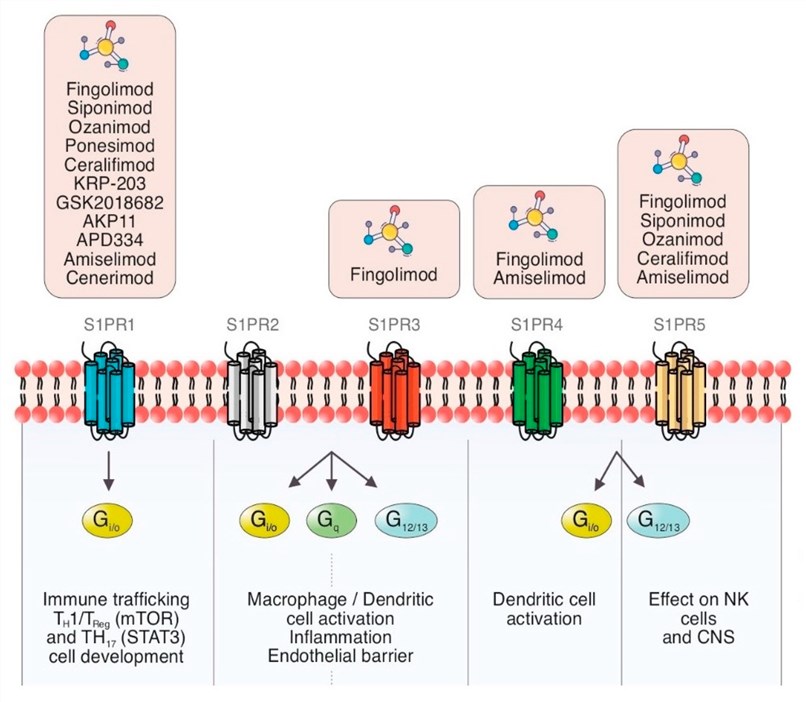 Fig.1 Schematic summary of the current view of S1PR modulators and S1P signaling pathways with cellular therapeutic targets in inflammation and immune processes through different G proteins.1
The range of S1PR1 functionality covers a variety of physiological and therapeutic areas:
The lipid-mediated activation mechanism of S1PR1, and its conformational flexibility throughout the Gi-coupling cycle, further complicate structural and pharmacological studies aimed at understanding receptor biology since such systems are quickly biased toward a single active conformation by subsequent agonist binding-driven internalization. Creative Biolabs has developed a customized S1PR1 protein design platform that supplies conformationally intact receptor preparations for structural biology and ligand-binding studies as well therapeutic antibody development. Our engineering team utilizes structural insights from the most recent active-state structural studies and ligand-binding research, in conjunction with codon optimized gene synthesis as well as proprietary detergent-screening protocols for identifying constructs that balance yield-maximizing considerations while rigorously preserving both the S1P-binding pocket and Gi-protein coupling interface. For every engagement, a technical consultation is conducted to ensure the architecture of the protein will suit your downstream target use case: crystallography, or high-throughput modulator screening.
Not finding the membrane protein product you need? Contact us to start your one-stop custom service!
Functional S1PR1 is expressed at the plasma membrane and mediates strong Gi-coupled signaling in essential cellular models, which are required for agonist/antagonist screening, antibody validation, and studies of lymphocyte egress mechanisms. Engineered S1PR1 stable cell lines at Creative Biolabs have optimized transduction and selection protocols to achieve homogeneous, long-term receptor expression. We utilize lentiviral delivery, transposon-mediated integration, and targeted knock-in methodologies enabling precise genetic control with our proprietary cell engineering platform. Each line is subjected to rigorous monoclonal selection for clonal purity with detailed phenotypic validation that confirms not only surface receptor density but functional responsiveness toward known agonists, antagonists and modulators.
Not finding the stable cell line product you need? Contact us to start your one-stop custom service!
High affinity, sequence-defined antibodies to S1PR extracellular epitopes are a necessity for detecting the receptor on lymphocyte and endothelial cell surfaces (notably in people), mapping its subcellular distribution during internalization, or blocking S1P-mediated signaling in research studies. Creative Biolabs provides fully comprehensive recombinant antibody discovery programs targeted against both extracellular and conformational S1PR1 epitopes. Our antibody development pipeline combines immunogen design, multi-platform selection, and downstream engineering to produce binders with the specificity, affinity, and developability profiles required for research applications. Using recombinant expression and clonal sequencing allows us to create a renewable, fully characterized reagent devoid of batch-to-batch variability inherent in traditional polyclonal sera.
Not finding the recombinant antibody product you need? Contact us to start your one-stop custom service!
Creative Biolabs goes beyond traditional catalog products by providing complex discovery services tailored to all S1PR1 research needs:
No. All the S1PR1 proteins, Cell lines, Antibodies and custom services from Creative Biolabs are for research use only.
Yes, we created dual-stable lines which constitutively express full-length S1PR1 and Gαi from independent loci. Each batch is accompanied by documentation of forskolin-stimulated cAMP inhibition upon agonist stimulation, allowing an unbroken cell-based platform for pharmacological profiling without the need to perform transient transfections on a repeat basis.
Yes, certain clones recognize epitopes within the third extracellular loop that are accessible to surface-resident population yet sterically shielded when clathrin-mediated internalized. These reagents allow for differential flow cytometric and immunofluorescence detection of surface versus endosomal S1PR1 populations in the absence of subcellular fractionation.
Yes, all immunogen are from higher conserved protein region (non non-specific sequence) among mammal forms so it is guaranteed reliable detection in mouse and rat tissue preparations and cell lysates without multiple species specific reagent to detect.








