Creative Biolabs is offering the most comprehensive services for antibody development projects. With strict regulation and effective execution, we are dedicated to providing the most valuable solutions to complete your projects.
HighlightsCreative Biolabs is offering the most comprehensive services for antibody development projects. With strict regulation and effective execution, we are dedicated to providing the most valuable solutions to complete your projects.
HighlightsCreative Biolabs has established a broad range of platforms for developing novel antibodies or equivalents. These cutting-edge technologies enable our scientists to meet your demands from different aspects and tailor the most appropriate solution that contributes to the success of your projects.
HighlightsWith deep understanding in antibody-related realms and extensive project experience, Creative Biolabs offers a variety of references to help you learn more about our capacities and achievements, including infographic, flyer, case study, peer-reviewed publications, and all kinds of knowledge that can assist your projects. You are also welcome to contact us directly for more specific solutions.
HighlightsGet a real taste of Creative Biolabs, one of the most professional custom service providers in the world. We are committed to providing highly customized comprehensive solutions with the best quality to advance your projects.
Highlights Loading...
All listed services and products are For Research Use Only. Do Not use in any diagnostic or therapeutic applications.
Solute carrier family 1 member 5 (SLC1A5), also referred to as alanine-serine-cysteine transporter 2 (ASCT2), is an integral membrane protein composed of 541 amino acids. As a member of the SLC1 superfamily, SLC1A5 possesses the characteristic elevator-type architecture seen for its paralogs: a homotrimeric assembly where each protomer consists of a relatively rigid scaffold domain and a more mobile transport domain. The substrate-binding pocket, comprising transmembrane segments TM3, TM6–TM8, and helix hairpins HP1 and HP2, is found within the transport domain (blue), whereas the scaffold domain contains the trimerization interface and membrane anchoring features. ECL2 is the bridge between the two domains linking TM3 and TM5 through TM4, facilitating a vertical elevator movement and shuttle of amino acids across the lipid bilayer. The expression of SLC1A5 is significantly elevated in a wide range of cancers. SLC1A5 promotes glutamine uptake in these settings to support the TCA cycle, sustain redox balance via glutathione production, and stimulate mTORC1 signaling. Also, the transporter has been associated with regulation of ferroptosis, wound healing through the MEK/ERK/SLC1A5 network, and glutamine-dependent antioxidant defense.
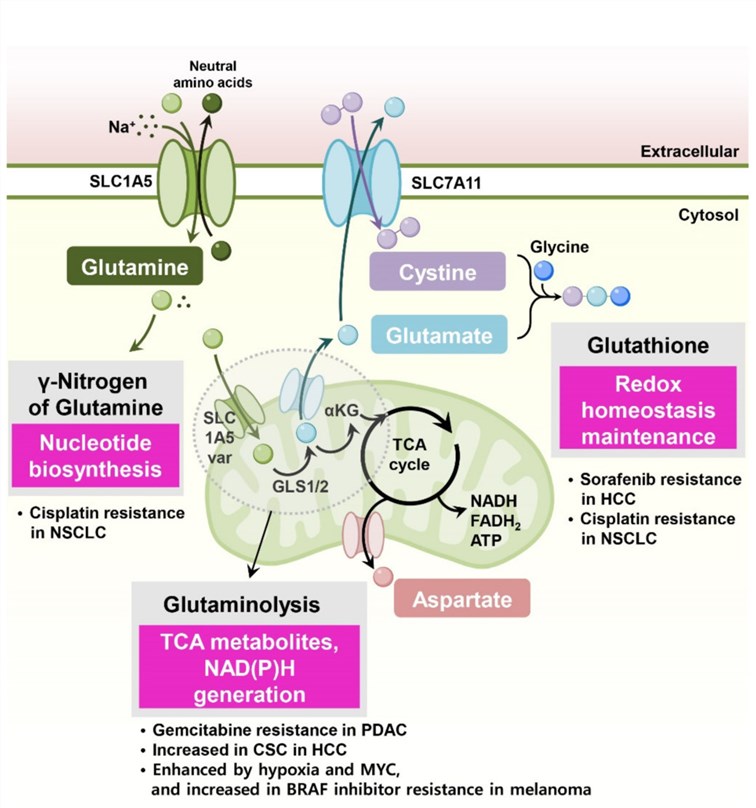 Fig.1 Glutamine metabolism is involved in drug resistance in cancer cells.1
SLC1A5 activity spans diverse cancer biological, immunological and tissue maintenance domains:
The trimeric architecture of SLC1A5, reliance on an appropriate lipid environment, and dynamic elevator mechanism complicate structural and pharmacological investigations. Creative Biolabs has developed a dedicated custom SLC1A5 protein design platform to generate transporter constructs for structural biology, ligand-binding, and transport research. Our engineering effort employs structure-function analysis and codon-optimized gene synthesis to develop constructs tailored to specific research requirements while considering the trimerization interface and characteristic scaffold- and transport-domain architecture of SLC1A5. All engagements start with an in-depth technical consultation to ensure that the protein design is aligned with your selected application. Specific protein formats, preparation conditions, and quality-control strategies are confirmed according to individual project requirements.
Not finding the membrane protein product you need? Contact us to start your one-stop custom service!
Cellular systems expressing functional SLC1A5 at the plasma membrane are essential for glutamine uptake assays, analysis of inhibitors and immuno-metabolism studies. Creative Biolabs has engineers SLC1A5 stable cell lines using optimized transduction and selection protocols that ensure homogeneous and sustained transporter expression. Combined with lentiviral delivery, transposon-mediated integration and targeted knock-in (TCG products), our cell engineering platform provides genetic control at a high grade. All lines are subjected to stringent monoclonal selection and validated phenotypically for both surface transporter density and functional sodium-dependent glutamine uptake activity.
Not finding the stable cell line product you need? Contact us to start your one-stop custom service!
Antibodies that are both high affinity and sequence defined to SLC1A5 represent powerful reagents for detecting the transporter in tumor tissue, mapping its plasma membrane localization, and blocking glutamine uptake in cancer- and immune cells. Creative Biolabs: End-to end Recombinant Antibody Discovery Programs Against Extracellular and Intracellular SLC1A5 Epitopes Our pipeline of antibody development combines immunogen design, multi-platform selection and downstream engineering to produce binders with the specificity, affinity and developability profiles needed for research applications. Traditional polyclonal sera provide a batch-to-batch variability; by using recombinant expression and clonal sequencing you now have a renewable, fully characterized reagent.
Not finding the recombinant antibody product you need? Contact us to start your one-stop custom service!
In addition to providing standard catalog products, Creative Biolabs also offers state-of-the-art discovery services across the entire spectrum of SLC1A5 research needs:
No. Creative Biolabs designates all SLC1A5 proteins, cell lines, antibodies and custom services as research use only. These have not been validated, cleared, or approved for human diagnostic, therapeutic, and/or prophylactic use.
Yes, we offer conformation-selective antibodies which target an extracellular epitope surface that is exposed on sodium-induced transition to the outward-open state. These reagents allow for indirect visualization of the transport-competent conformation in fixed cells or permeabilized membranes by immunofluorescence and flow cytometry, avoiding radioactive measurements glutamine uptake.
Yes, we have validated selected clones on archival material after antigen retrieval showing specific membranous staining patterns corresponding to the distribution of epithelial cells and neoplastic cells. Validation consists of peptide competition and recombinant antigen controls to confirm the epitope specificity.
Yes the protein is concentrated in a buffer with non-ionic detergent and buffer-exchanged into a lipid-compatible system. This allows to proceed directly with synthetic membranes for cryo-electron microscopy or stopped-flow transport assays, so no further dialysis steps are required.