Creative Biolabs is offering the most comprehensive services for antibody development projects. With strict regulation and effective execution, we are dedicated to providing the most valuable solutions to complete your projects.
HighlightsCreative Biolabs is offering the most comprehensive services for antibody development projects. With strict regulation and effective execution, we are dedicated to providing the most valuable solutions to complete your projects.
HighlightsCreative Biolabs has established a broad range of platforms for developing novel antibodies or equivalents. These cutting-edge technologies enable our scientists to meet your demands from different aspects and tailor the most appropriate solution that contributes to the success of your projects.
HighlightsWith deep understanding in antibody-related realms and extensive project experience, Creative Biolabs offers a variety of references to help you learn more about our capacities and achievements, including infographic, flyer, case study, peer-reviewed publications, and all kinds of knowledge that can assist your projects. You are also welcome to contact us directly for more specific solutions.
HighlightsGet a real taste of Creative Biolabs, one of the most professional custom service providers in the world. We are committed to providing highly customized comprehensive solutions with the best quality to advance your projects.
Highlights Loading...
All listed services and products are For Research Use Only. Do Not use in any diagnostic or therapeutic applications.
Solute carrier family 17 member 6 (SLC17A6), also known as vesicular glutamate transporter 2 (VGLUT2) is an encoded polytopic membrane protein comprising of cytoplasmic amino-terminal, trans-membrane domains, and a large hydrophilic loop between TM8 and TM9 on the intracellular side. SLC17A6 expression is primarily restricted to subcortical and brainstem glutamatergic neurons with the highest transcription and protein levels found in thalamus, hypothalamus, amygdala and various brain stem nuclei, spinal cord and cerebellar deep nuclei. This distribution is mainly antagonistic to VGLUT1, which predominates in the cerebral cortex as well as hippocampus and cerebellar cortex. SLC17A6 dysregulation has been implicated pathologically in schizophrenia, major depressive disorder, epilepsy, chronic pain and neurodegenerative diseases. Knockout of the gene coding for SLC17A6 in various regions such as subthalamic nucleus causes cell loss, structural disorganization, hyperlocomotion, and disrupted reward processing mouse models.
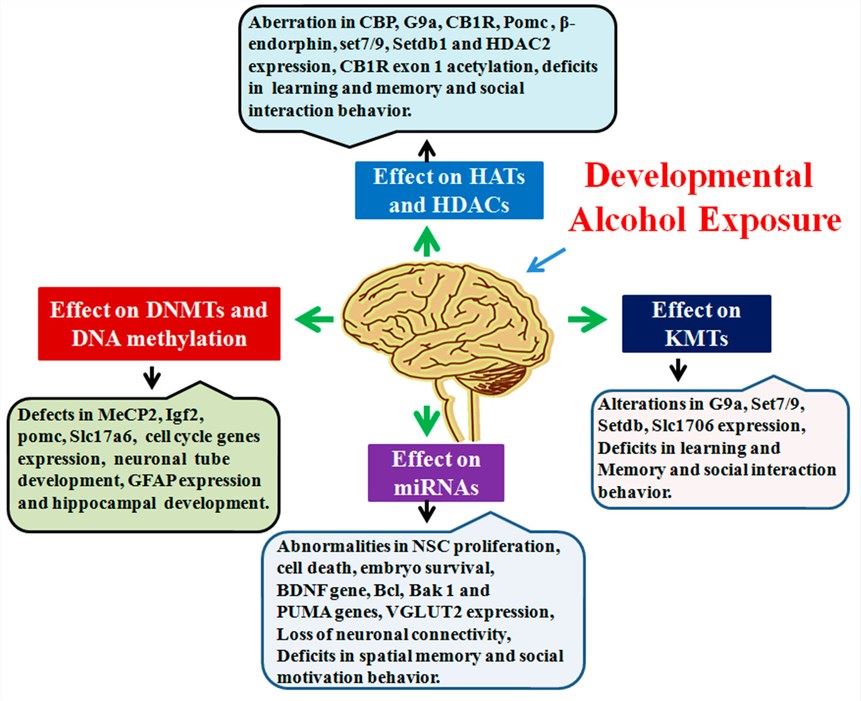 Fig. 1 Graphical summary of developmental alcohol-induced epigenetic defect.1
The roles of SLC17A6 are really multifunctional and involve a variety of domains in neurobiology and neuropathology:
The membrane-embedded topology of the transporter, its dependence upon an appropriate lipid environment for proper folding, and regulation by chloride and the proton electrochemical gradient complicate structural and functional investigations of SLC17A6. To overcome these difficulties, Creative Biolabs developed a custom SLC17A6 design platform for membrane protein research constructs, enabling structural biology, ligand-binding studies, transport research, and monoclonal antibody development for research applications. We use structural insights and codon-optimized gene synthesis in our engineering efforts to develop constructs suited to studies of VGLUT2-mediated vesicular glutamate transport and its regulatory mechanisms. The first step in every engagement is a technical consultation to design the protein construct based upon its intended research application. Specific construct formats, preparation conditions, and structural or functional validation strategies are determined according to individual project requirements.
Not finding the membrane protein product you need? Contact us to start your one-stop custom service!
For reliable vesicular uptake assays, we require cellular models that present functional SLC17A6 at the plasma membrane or synaptic vesicle–like compartments for monoclonal antibody screening and compound modulation. Engineered SLC17A6 stable cell lines can be generated by Creative Biolabs using proprietary transduction and selection methods for more homogeneous, persistent transporter expression. We harness lentiviral delivery, transposon-mediated integration and targeted knock-in to provide a streamlined cell engineering platform facilitating accurate genetic control. Rigorous monoclonal selection followed by detailed phenotypic validation confirms clonal purity, surface and intracellular transporter density, as well as functional glutamate uptake activity for each line.
Not finding the stable cell line product you need? Contact us to start your one-stop custom service!
We have End-to-End recombinant antibody discovery programs against cytosolic and conformational SLC17A6 epitopes. In addition to immunogen design, multi-platform selection and downstream engineering are all integral components of our antibody development pipeline, enabling us to provide binders with the specificity, affinity and developability profiles suited for research use. We use recombinant expression and clonal sequencing to remove the batch-to-batch variability present in classical polyclonal sera, giving you a renewable, fully characterized reagent.
Not finding the recombinant antibody product you need? Contact us to start your one-stop custom service!
Creative Biolabs goes beyond catalog products and provides comprehensive discovery services in support of all SLC17A6 research needs:
No, our SLC17A6 portfolio is manufactured solely for research use only.
Yes, we developed stable lines with high cell surface SLC17A6 expression and localization in intracellular vesicular compartments confirmed by immunofluorescence assays (IF) and functional glutamate accumulate assays.
Yes, we validated some of the selected clones in paraformaldehyde-fixed brain cryosections as well as on archival paraffin-embedded specimens following antigen retrieval that showed a specific punctate staining which coincided with distributions previously described for synaptic boutons and axonal varicosities.
Yes, the immunogen consists of a conserved region across mammalian species which enables reproducibly detectable levels in human, mouse and rat brain preparations or neuronal cell lysates without requiring different species-specific reagents; in all formats.