Creative Biolabs is offering the most comprehensive services for antibody development projects. With strict regulation and effective execution, we are dedicated to providing the most valuable solutions to complete your projects.
HighlightsCreative Biolabs is offering the most comprehensive services for antibody development projects. With strict regulation and effective execution, we are dedicated to providing the most valuable solutions to complete your projects.
HighlightsCreative Biolabs has established a broad range of platforms for developing novel antibodies or equivalents. These cutting-edge technologies enable our scientists to meet your demands from different aspects and tailor the most appropriate solution that contributes to the success of your projects.
HighlightsWith deep understanding in antibody-related realms and extensive project experience, Creative Biolabs offers a variety of references to help you learn more about our capacities and achievements, including infographic, flyer, case study, peer-reviewed publications, and all kinds of knowledge that can assist your projects. You are also welcome to contact us directly for more specific solutions.
HighlightsGet a real taste of Creative Biolabs, one of the most professional custom service providers in the world. We are committed to providing highly customized comprehensive solutions with the best quality to advance your projects.
Highlights Loading...
All listed services and products are For Research Use Only. Do Not use in any diagnostic or therapeutic applications.
Transmembrane protein 106B (TMEM106B) is a highly conserved single-pass type II integral membrane protein encoded by the TMEM106B gene, predominantly localized to late endosomal and lysosomal limiting membranes across central nervous system neurons and microglial populations, serving as a master modulator of lysosomal organelle morphology, acidification and degradative cargo sorting. The polypeptide contains a single hydrophobic transmembrane helix, a short cytosolic N-terminal domain and a large luminal C-terminal domain, and interacts with lysosomal lipid bilayers and other lysosomal scaffold proteins to control vesicle fusion, lysosome size and perinuclear organelle positioning within neural cells. Under physiological central nervous system homeostasis, basal TMEM106B expression maintains intact lysosomal degradative capacity to clear aggregated protein cargo and sustain microglial phagocytic function for neuronal debris clearance. Genetic TMEM106B variant alleles alter protein stability and lysosomal membrane trafficking, shifting organelle acidification efficiency and impairing toxic protein aggregate turnover in aging brain tissue. Distinct from housekeeping lysosomal transporters with nutrient recycling functions, TMEM106B specializes in structural and morphological regulation of degradative compartments without direct substrate transport activity, representing a unique lysosomal scaffold with no functionally redundant paralogs in mammalian neural tissue. Reduced functional TMEM106B disrupts lysosomal acidification, accumulates toxic neuronal protein aggregates and elevates risk of frontotemporal lobar degeneration, while abnormal TMEM106B overexpression triggers excessive lysosomal vesicle enlargement and impaired microglial clearance activity, establishing TMEM106B as a core research target for lysosomal neurobiology and age-related neurodegenerative disorder mechanism exploration.
TMEM106B executes core lysosomal structural regulatory function embedded within late endosome-lysosome lipid bilayers, utilizing luminal and transmembrane domain interactions to coordinate organelle membrane shaping, vesicle fusion events and proton pump complex retention to sustain proper lysosomal luminal pH. Conserved intraluminal structural motifs mediate homotypic TMEM106B oligomerization to form membrane scaffold networks that constrain lysosomal organelle dimensions and control perinuclear lysosome clustering critical for efficient autophagic cargo degradation. TMEM106B-dependent lysosomal structural integrity sustains balanced neural tissue proteostasis, covering controlled clearance of misfolded neuronal proteins and sustained microglial phagocytic degradative capacity. TMEM106B participates in a broad spectrum of neurophysiological processes including lysosomal biogenesis, autophagic aggregate clearance, microglial debris turnover and age-dependent brain tissue proteostasis maintenance. Dysregulated TMEM106B expression disrupts lysosomal acidification and aggregate clearance, accelerating toxic protein deposition linked to neurodegenerative pathology. Therefore, TMEM106B represents a pivotal research target for multi-pass lysosomal scaffold protein study and neuroprotective lysosomal modulator screening.
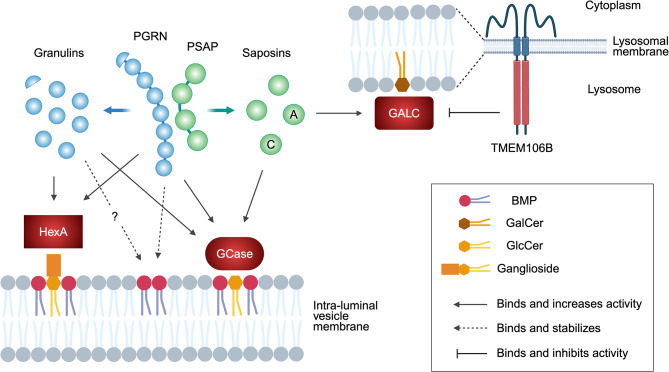 Fig. 1 PGRN generates granulins to assist lysosomal hydrolase function; TMEM106B restrains GALC catalytic activity, jointly governing the lysosomal sphingolipid catabolic network composed of GCase and HexA.1
The biological functions of TMEM106B are focused on endolysosomal membrane scaffolding, organelle pH maintenance and microglial degradative function tuning:
Creative Biolabs offers high-quality TMEM106B proteins through optimized expression systems, including full-length multi-pass lysosomal scaffold and isolated luminal N-terminal domain variants. These products retain native conformational characteristics and lysosomal membrane oligomerization biological activity, suitable for endolysosomal scaffold interaction assays and neuroprotective lysosomal modulator screening. All TMEM106B proteins undergo strict quality control to ensure consistent performance and reliable application across diverse research platforms.
Not finding the membrane protein product you need? Contact us to start your one-stop custom service!
Creative Biolabs provides custom-engineered TMEM106B stable cell lines, including wild-type and neurodegeneration risk variant control models. These cell lines are optimized for lysosomal morphology profiling and autophagic aggregate clearance functional analysis. Each cell line undergoes stringent validation to ensure stable expression profiles and consistent functional performance in diverse experimental contexts.
Not finding the stable cell line product you need? Contact us to start your one-stop custom service!
High-specificity recombinant antibodies targeting TMEM106B are developed via advanced antibody engineering technologies, with no cross-reactivity with other multi-pass lysosomal transmembrane proteins. These antibodies are validated for late endosome/lysosome subcellular localization detection and central nervous system microglial/neuronal tissue profiling, and can be paired with LAMP1 detection reagents to quantify complete lysosomal scaffold membrane complexes in neurodegenerative cell models.
Not finding the recombinant antibody product you need? Contact us to start your one-stop custom service!
Beyond catalog products, Creative Biolabs offers specialized custom services for TMEM106B research:
TMEM106B is a multi-pass lysosomal scaffold protein that controls organelle morphology, stabilizes lysosomal proton pumps and sustains neuronal and microglial protein aggregate clearance.
Common TMEM106B genetic variants modify lysosomal function and confer altered risk of frontotemporal neurodegeneration, making it a core brain lysosomal disease marker.
No, all TMEM106B products and services are strictly for research use only, not intended for clinical diagnosis or treatment.
Offerings include full-length TMEM106B lysosomal scaffold proteins, variant-specific detection antibodies and custom stable cell lines for neural lysosomal proteostasis research.
TMEM106B proteins are validated via lysosomal membrane homotypic oligomerization interaction testing.