Are you currently facing long development cycles due to product heterogeneity, toxicity from random conjugation, or poor batch-to-batch reproducibility? Our Bispecific Antibody (BsAb) Conjugates Generation Services: Antibody-Antibody Conjugates Generation Service helps you obtain defined, high-purity BsAb conjugates for enhanced therapeutic potential through advanced site-specific chemical conjugation platforms.
Contact our team to get an inquiry now!
Bispecific antibodies (BsAbs) have established themselves as a versatile therapeutic platform by simultaneously engaging two distinct antigens, enabling precise immune cell targeting and enhanced cytotoxicity. Building upon this concept, Antibody-Antibody Conjugates (AACs) represent an evolution of bispecific engineering, wherein two full-length antibody molecules-or antibody fragments-are covalently or genetically linked to form a single, multifunctional construct. This design aims to combine the antigen-binding specificity and effector functions of both antibodies within one molecular entity, thereby enabling simultaneous modulation of multiple biological pathways, enhanced avidity, and improved therapeutic efficacy. Moreover, the structural flexibility of AACs allows for incorporation of diverse antibody formats-including IgG, Fab, scFv, or hybrid IgG-Fab structures-permitting tailored optimization of molecular size, half-life, and tissue penetration.
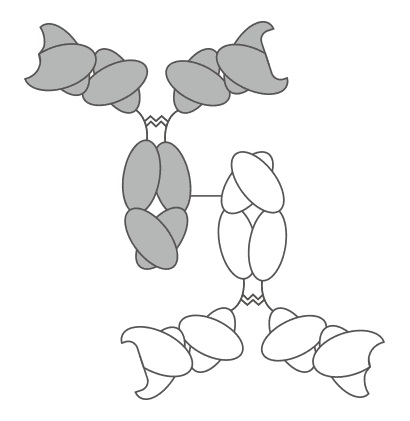 Fig. 1 Diagram of IgG-IgG BsAb.
As a common class of BsAb conjugates, IgG-IgG Bispecific Antibodies (BsAbs) are created by chemically linking two individual, intact antibodies, resulting in a 300 kDa bispecific molecule capable of bivalent recognition for two unique antigens. This crosslinking technique involving complete IgGs is a straightforward and widely utilized pathway for BsAb synthesis. The assembly of these BsAbs fundamentally depends on amino-reactive chemicals that specifically engage the lysine side-chains; in most cases, the employed crosslinkers are categorized as hetero-bifunctional.
Within the framework of Antibody-Antibody Conjugates (AACs), F(ab')₂ and F(ab')₃ bispecific antibodies represent a well-defined structural subclass that leverages multivalent antigen recognition while omitting the Fc region. F(ab')₂ BsAbs are composed of two antigen-binding fragments linked in a dimeric format, providing dual specificity and moderate molecular size. F(ab')₃ BsAbs, by contrast, integrate three Fab fragments into a trimeric architecture, enhancing valency and avidity, which can improve target cell binding and crosslinking efficiency. By eliminating the Fc domain, these constructs reduce Fc-mediated effector functions and interactions with Fc gamma receptors, thereby minimizing undesired immune activation and potential off-target cytotoxicity.
Functionally, F(ab')₂ and F(ab')₃ bispecific antibodies as AACs combine the modularity and multivalency of antibody fusions with reduced immunogenicity and improved tissue penetration relative to full-length IgG-based bispecifics. They are particularly advantageous for applications where precise targeting and crosslinking are required-such as bridging T cells to tumor cells-without eliciting Fc-dependent effects. Additionally, their smaller size relative to full-length antibodies allows better diffusion in solid tumor microenvironments, making them a versatile platform within the broader AAC landscape.
Creative Biolabs is committed to delivering highly defined biotherapeutics that mitigate the clinical risks associated with heterogeneity. Our key advantage lies in transitioning clients from random conjugation technologies—which often result in mixed products suitable only for in vitro assays—to advanced, stoichiometrically-controlled methods.
Experience the Creative Biolabs Advantage - Get a Quote Today
A: Chemical conjugation allows for the rapid assembly of diverse bispecific constructs using two already optimized parent antibodies or fragments. While genetic engineering offers ultimate sequence control, chemical methods significantly accelerate the early design and screening phase by quickly generating various bispecific formats for functional testing.
A: Heterogeneity is managed through site-selective chemistry. This often involves generating reactive groups at specific locations, such as using fragment-based assembly or controlled partial reduction of IgG followed by conjugation via specific bifunctional linkers (like maleimide-thiol chemistry). This limits the conjugation sites, ensuring a defined final structure and high purity.
A: The full IgG-IgG bispecific format retains the native Fc region, which provides two critical advantages: Fc-mediated effector functions (such as ADCC or CDC) and a significantly longer serum half-life due to binding to the neonatal Fc receptor (FcRn). This extended half-life is essential for therapeutic applications requiring sustained in vivo exposure.
A: The efficiency and speed of the process rely heavily on the quality of the starting materials. The most crucial requirement is high-purity parent antibodies or antibody fragments with confirmed binding specificity. Detailed characterization data, particularly affinity measurements, are also essential to ensure the subsequent conjugation and purification steps are successful.
A: BsAACs serve as versatile bispecific scaffolds. By employing chemical linkers that are payload-ready, these scaffolds can be utilized to attach a cytotoxic drug moiety, effectively creating a bispecific ADC (BsADC). This enables simultaneous targeting of two distinct antigens, offering enhanced specificity and efficacy against heterogeneous tumors.
Welcome! For price inquiries, we will get back to you as soon as possible.
INQUIRY





SERVICES
PRODUCTS
PLATFORMS