Are you currently facing rapid clearance of therapeutic fragments, resulting in short in vivo half-lives and complex clinical dosing regimens? Our Bispecific Antibody (BsAb)-HSA Fusions Generation Service helps you convert potent, small-format fragments into long-acting biologics and streamline clinical trial processes through innovative fusion protein engineering and advanced FcRn-mediated recycling strategies.
Contact our team to get an inquiry now!
Bispecific antibodies (BsAbs) have emerged as a highly versatile class of immunotherapeutics, capable of simultaneously engaging tumor-associated antigens and immune effector cells such as T cells or natural killer (NK) cells. This dual-targeting capability enables precise immune synapse formation, potent cytotoxic activity, and the potential to overcome immune evasion mechanisms employed by tumors. Despite these advantages, many BsAb formats-particularly smaller constructs such as Tandem scFv, Diabody, and Tandem Fabs, suffer from rapid systemic clearance due to their low molecular weight and lack of Fc-mediated recycling, resulting in short plasma half-lives that often necessitate continuous infusion for sustained therapeutic effect.
To address these pharmacokinetic limitations, a strategy has been developed to fuse BsAbs with human serum albumin (HSA), generating BsAb-HSA fusion proteins. HSA, the most abundant plasma protein in humans, possesses a naturally long half-life (~19 days) primarily due to FcRn-mediated recycling and resistance to lysosomal degradation. By genetically fusing BsAbs to HSA, the resulting fusion proteins retain the high-affinity, MHC-independent antigen recognition of the bispecific antibody while simultaneously benefiting from the favorable pharmacokinetic and biodistribution properties of albumin. This design not only extends systemic exposure and reduces dosing frequency but also improves bioavailability and tumor accumulation.
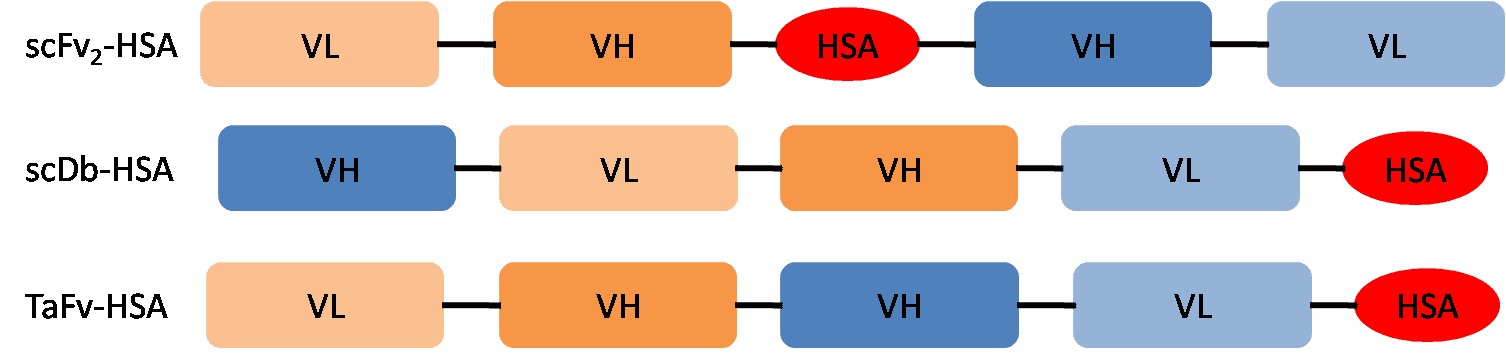 Fig.1 Schematic presentation of bispecific antibody-HSA fusion proteins.
BsAb-HSA fusions provide a strategic solution to the intrinsic pharmacokinetic limitations of conventional bispecific antibody formats, resulting in improved therapeutic performance and clinical feasibility.
| Extended Half-Life | Fusion with HSA significantly prolongs plasma circulation, transforming therapeutics with half-lives of hours into molecules with half-lives of days to weeks, reducing the need for continuous infusion. |
| Improved Pharmacokinetics and Biodistribution | HSA mediates FcRn-dependent recycling and enhances stability in the bloodstream, maintaining more consistent drug exposure and minimizing peak-trough fluctuations. |
| Low Immunogenicity and Clinical Safety | HSA is highly abundant and well-tolerated in humans, reducing the risk of immune reactions associated with engineered half-life extension strategies. |
| Compatibility with Multiple BsAb Formats | This fusion strategy can be applied to diverse bispecific architectures, including IgG-like BsAbs and Appended IgG BsAbs, providing flexibility for various therapeutic applications. |
Choosing Creative Biolabs means gaining a strategic partner dedicated to maximizing the 'developability' of your therapeutic candidate. Our 10-year history is built on overcoming the structural and PK challenges that commonly derail novel biologic programs. We have mastered the FcRn recycling mechanism engineering, ensuring the longevity of your drug is maximized without impairing its clinical efficacy.
Our platform ensures optimal construct performance through several critical, differentiating features:
Experience the Creative Biolabs Advantage - Get a Quote Today
A: The fusion of HSA, while critical for half-life, introduces risks of steric hindrance that could impair function. To mitigate this, rational engineering must be applied, involving screening various linker lengths and fusion orientations (N-terminal vs. C-terminal) to maintain optimal spatial access for both binding domains. Functional validation (e.g., using SPR or BLI) is essential to confirm that dual-target engagement and bioactivity are fully preserved.
A: The extension relies on the neonatal Fc receptor (FcRn) recycling pathway. HSA binds to FcRn in the endosome, protecting it from lysosomal degradation and recycling it back into the bloodstream. Quantification is achieved through pharmacokinetic (PK) studies in relevant animal models, where the terminal half-life (t1/2) and Area Under the Curve (AUC) are measured and compared against the unconjugated fragment.
A: The main difference lies in effector function and size. Fc fusions inherently contain the Fc region, which can potentially mediate unwanted ADCC or ADCP if not mutated, complicating therapeutic function. HSA fusions, conversely, are generally immunologically silent regarding effector function and often present superior stability, solubility, and lower aggregation risk compared to some complex multi-chain Fc formats.
A: Confirming the quality of these complex biologics requires rigorous analysis. Key methods include High-Performance Liquid Chromatography (HPLC) to assess overall purity and ensure the absence of aggregates, Mass Spectrometry for confirming the exact molecular weight and fusion site, and Circular Dichroism (CD) spectroscopy to verify the correct folding and secondary structure.
A: Development begins with rational construct design, including sequence verification and codon optimization for the chosen expression system (typically mammalian). Next, transient expression is performed to rapidly confirm protein expression levels and screen multiple candidate constructs for yield and preliminary quality before moving into large-scale purification and full characterization.
Welcome! For price inquiries, we will get back to you as soon as possible.
INQUIRY





SERVICES
PRODUCTS
PLATFORMS