Creative Biolabs is offering the most comprehensive services for antibody development projects. With strict regulation and effective execution, we are dedicated to providing the most valuable solutions to complete your projects.
HighlightsCreative Biolabs is offering the most comprehensive services for antibody development projects. With strict regulation and effective execution, we are dedicated to providing the most valuable solutions to complete your projects.
HighlightsCreative Biolabs has established a broad range of platforms for developing novel antibodies or equivalents. These cutting-edge technologies enable our scientists to meet your demands from different aspects and tailor the most appropriate solution that contributes to the success of your projects.
HighlightsWith deep understanding in antibody-related realms and extensive project experience, Creative Biolabs offers a variety of references to help you learn more about our capacities and achievements, including infographic, flyer, case study, peer-reviewed publications, and all kinds of knowledge that can assist your projects. You are also welcome to contact us directly for more specific solutions.
HighlightsGet a real taste of Creative Biolabs, one of the most professional custom service providers in the world. We are committed to providing highly customized comprehensive solutions with the best quality to advance your projects.
Highlights Loading...
All listed services and products are For Research Use Only. Do Not use in any diagnostic or therapeutic applications.
Solute carrier family 1 member 3 (SLC1A3), also known as excitatory amino acid transporter 1 (EAAT1) or glutamate-aspartate transporter 1 (GLAST-1), is a membrane protein of the solute carrier family consisting of 542 amino acids. The transport domain consists of two re-entrant hairpin loops (HP1 and HP2) and four transmembrane segments that create the substrate-binding pocket, while the scaffold domain contains the trimerization interface plus membrane anchorage. This bipartite structure permits the hallmark "elevator" mechanism by which this transport domain moves in a vertical motion with regard to the scaffold, and shuttles glutamate from the extracellular space into the cytoplasm. SLC1A3 is primarily expressed in astrocytes throughout the CNS, where its levels are particularly high in the cerebellum, retina and spinal cord. You are detected in the heart, placenta, skeletal muscle and skin stem cell niches as well which indicates it has a wider physiological scope possibly with abiding the functionality of tissue homeostasis. In the CNS, EAAT1 cooperates with the homologous transporter EAAT2 (SLC1A2) to clear around 90% of released glutamate from the synaptic cleft, thus terminating excitatory signalling and safeguarding neurons against calcium-mediated excitotoxicity.
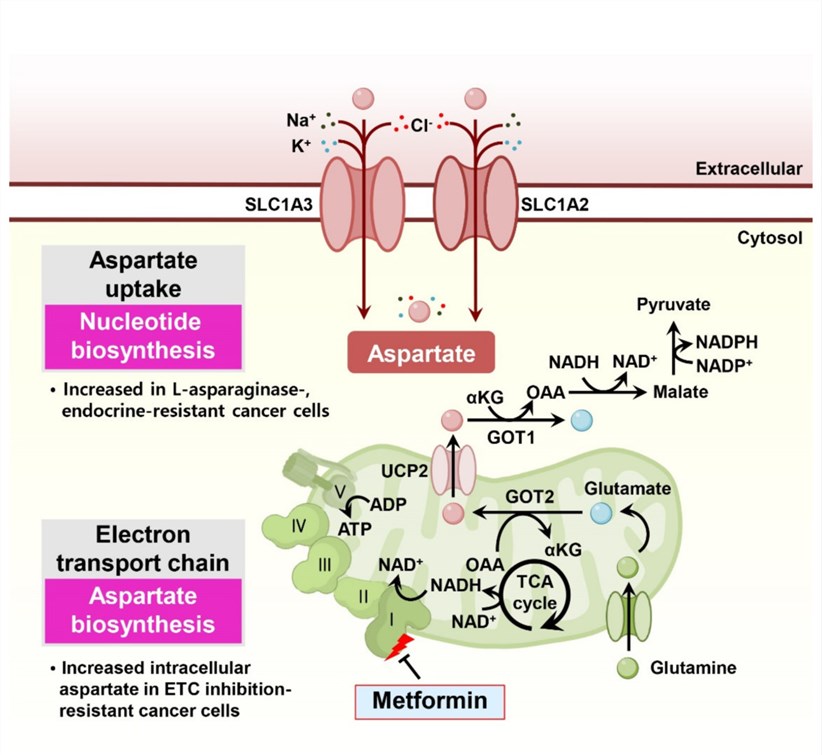 Fig.1 Aspartate metabolism is involved in drug resistance in cancer cells.1
SLC1A3 has functional relevance across multiple domains of neurobiology and neuropathology:
Structural and pharmacological studies of SLC1A3 have been hampered by its trimeric architecture, the need for an appropriate membrane environment for proper folding, and the dynamic nature of its elevator mechanism. Creative Biolabs addresses these challenges via a purpose-built custom SLC1A3 protein design platform that generates full-length and engineered SLC1A3 transporter preparations, including membrane-embedded constructs, for structural biology, ligand-binding studies, and transport research. Our engineering team leverages structural insights and codon-optimized gene synthesis to develop constructs tailored to specific experimental requirements while considering key structural and functional features of the transporter. Every engagement begins with a deep-dive technical conversation to confirm that the protein design and preparation strategy align with your research needs. Specific preparation conditions and conformational or functional characterization are determined according to the individual project.
Not finding the membrane protein product you need? Contact us to start your one-stop custom service!
Conveniently, high-yielding and reproducible mammalian cells constitutively expressing the functional SLC1A3 at the plasma membrane are essential for such assays of glutamate transport, antibody selection and compound modulation. CompanyA engineers unique SLC1A3 stable cell lines with our optimized transduction and selection protocols to ensure uniform, long term expression of transporter. We apply precision genomic control through the methods of lentiviral delivery, transposon-mediated integration and targeted knock-in from our cell engineering platform. After minimal monoclonal selection of each line for clonal purity, the resultant clones are subjected to extensive phenotypic validation including surface transporter density and sodium-dependent glutamate uptake activity.
Not finding the stable cell line product you need? Contact us to start your one-stop custom service!
Unique, high-affinity sequence-defined antibodies against SLC1A3 are necessary for both detection of the transporter in native brain tissue and mapping localization within astrocytes (with functionally irrelevant cross-reactivity from closely related isoforms EAAT2 / SLC1A2 and EAAT3 / SLC1A1). End-to-end recombinant antibody discovery programs at Creative Biolabs against SLC1A3 extracellular and intracellular epitopes. We deliver binders of the specificity, affinity and developability required for a range of research, diagnostic and therapeutic applications through our integrated antibody development pipeline that combines immunogen design / multi-platform selection / downstream engineering. Using recombinant expression and clonal sequencing, we eradicate the batch-to-batch variability associated with traditional polyclonal sera giving you a fully characterized, renewable reagent.
Not finding the recombinant antibody product you need? Contact us to start your one-stop custom service!
Going beyond typical catalog products, Creative Biolabs provides innovative exploratory services addressing each and every aspect of SLC1A3 studies:
We recommend full-length SLC1A3 carrying out in nanodisc or proteoliposome format both with glutamate uptake or radioligand displacement assays for biochemical screening. Furthermore, we also provide stable cell lines with an embraceable physiologic relevance and high through put compatible read-outs for cellular studies such as our glutamate uptake reporter.
No — our SLC1A3 products, which include recombinant proteins, stable cell lines and antibody reagents, are not intended for human use. None have been tested for safety, sterility or regulatory processes necessary to give to humans.
It is true, we have produced stable lines that express SLC1A3 full-length, as well as engagement with known cytoskeletal interactions from independent loci (dual-stable lines).
Yes, we provide recombinant proteins and stable cell lines containing disease-associated mutations in the substrate-binding pocket or through transmembrane helices. These enable direct comparison of sodium affinity, glutamate turnover and oligomeric stability against their wild-type counterparts in matched cellular backgrounds.