
Custom Peptide-Liposome Conjugation Service
Are you currently facing challenges with non-specific drug action, poor drug stability, or inefficient delivery to target tissues? At Creative Biolabs, our peptide-liposome conjugation service can help you achieve highly specific drug targeting and improve therapeutic efficacy through advanced bioconjugation chemistries and customized liposome formulation technologies.
Introduction
Peptide-liposome conjugation is a sophisticated strategy in nanomedicine, merging the versatile drug-carrying capacity of liposomes with the precise targeting capabilities of peptides. Liposomes, vesicles composed of lipid bilayers, can encapsulate a wide array of therapeutic and diagnostic agents. By functionalizing their surface with specific peptides—such as cell-targeting peptides, cell-penetrating peptides, or stimuli-responsive peptides—these nanocarriers can be directed to specific cells or tissues, enhancing therapeutic efficacy and minimizing off-target effects. This targeted approach is pivotal for advancing treatments in areas like oncology and for developing next-generation diagnostic tools.
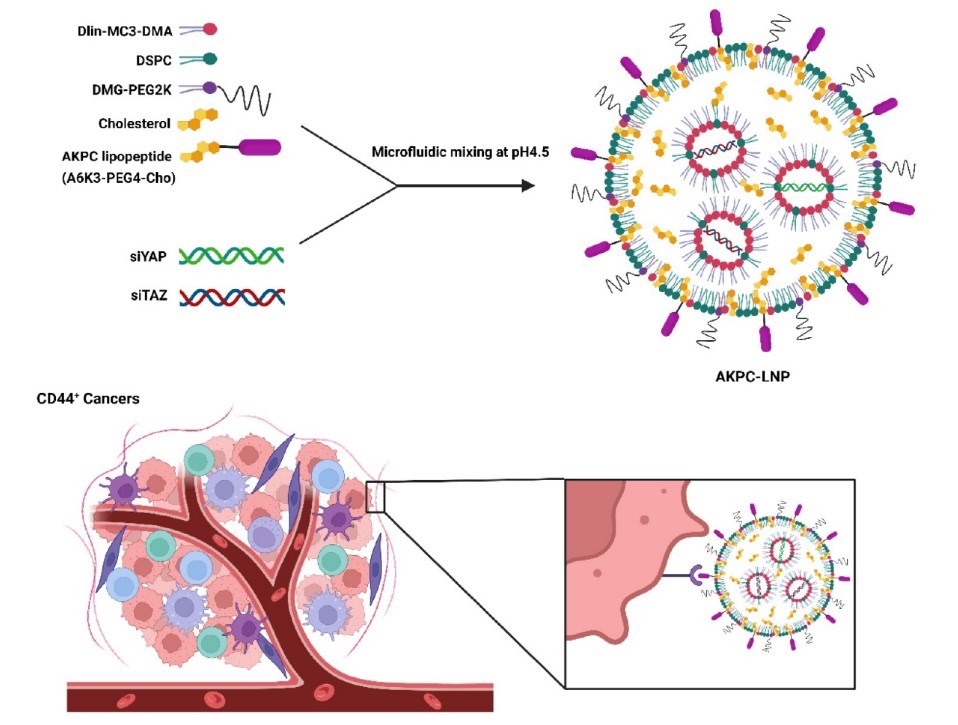 Fig.1 Delivery of therapeutic genes to CD44+ cancer cells using targeted peptide-modified Lipid Nanoparticles (LNPs).1
How Can We Assist Your Project?
Creative Biolabs provides comprehensive peptide-liposome conjugation services designed to enhance the specificity, stability, and efficacy of your therapeutic or diagnostic agents. Our expert team works closely with you to develop peptide-liposome conjugates that can selectively target specific cells or tissues, improve drug solubility, protect sensitive cargos from degradation, and facilitate controlled release, ultimately accelerating your research. Whether you are developing novel cancer therapies, advanced imaging agents, or targeted gene delivery systems, our conjugation solutions are built to overcome complex delivery challenges.
Types of our Service:
We provide high-quality custom peptide synthesis services, including peptides with specific modifications (e.g., terminal cysteine, lysine, azide, alkyne) suitable for various conjugation chemistries. Our capabilities cover a wide range of peptide lengths, complexities, and purification requirements.
- Liposome Formulation Customization and Synthesis:
Our team can design and prepare liposomes tailored to your specific application. This includes customization of lipid composition (e.g., phospholipids, cholesterol, PEGylated lipids), size (from nanometers to microns, achieved via extrusion or sonication), and surface charge (achieved by adding cationic or anionic phospholipids). We also offer encapsulation services for various cargo, including small molecule drugs, proteins, nucleic acids, and imaging agents.
- Peptide-Liposome Conjugation:
This core service involves the covalent attachment of your custom or pre-existing peptide to our custom liposomes. We employ a range of optimized conjugation chemistries (e.g., maleimide-thiol, NHS-ester, click chemistry, EDC/NHS coupling) to ensure efficient, stable, and site-specific linkage. The service includes purification of the conjugate and comprehensive characterization.
Why Choose Us?
- Integrated Expertise: We merge cutting-edge technology with profound scientific knowledge to deliver superior conjugation outcomes.
- Core Commitments: Our services are built upon an unwavering commitment to quality and close collaboration with our clients.
- Custom Strategies: Our conjugation platforms are designed with flexibility at their core, enabling us to meticulously tailor strategies to the unique chemical characteristics of your specific peptide and the detailed requirements of your liposomal formulation.
- Proven Chemical Methodologies: We utilize a diverse toolkit of well-established conjugation chemistries, including maleimide-thiol reactions, NHS-ester couplings, and click chemistry. This ensures the creation of optimal and stable linkages while preserving the full biological activity of your peptide and liposome components.
- Comprehensive Characterization & Deliverables: Our thorough characterization services provide you with high-quality peptide-liposome conjugates that are ready for immediate use in your downstream applications.
Customer Reviews

A***a:
"Using Creative Biolabs's peptide-liposome conjugation service in our research has significantly improved the specific delivery of our cytotoxic payload to cancer cells. The conjugation was efficient, and the characterization data provided was thorough, allowing us to confidently proceed with our in vitro efficacy studies. We observed a >10-fold increase in potency against target cells compared to non-targeted liposomes."
[August 2024]
S***d:
"Creative Biolabs's expertise in conjugating our custom cell-penetrating peptide to stealth liposomes was instrumental for our in vivo studies. The conjugates exhibited prolonged circulation and significantly better tumor accumulation compared to the free peptide or unconjugated liposomes. This directly translated to improved anti-tumor efficacy in our xenograft model. We particularly appreciated their guidance on linker selection."
[May 2024]
Ji** H. K**:
"Creative Biolabs provided a highly customized service, from liposome formulation to the final characterized conjugate. The process was transparent, and the team was responsive to our specific analytical requests. The resulting peptide-liposome probe showed excellent stability and target engagement in our preclinical imaging experiments."
[January 2025]
FAQs
1. Q: What types of peptides can be conjugated to liposomes?
A: A wide variety of peptides can be conjugated, including cell-targeting peptides (e.g., RGD, NGR, specific receptor ligands), cell-penetrating peptides (CPPs like TAT), antimicrobial peptides, and stimuli-responsive peptides. The choice depends on your application. We can help you select an appropriate peptide. We encourage you to discuss your specific peptide with our team for feasibility.
2. Q: How does peptide conjugation improve drug delivery compared to plain liposomes?
A: Peptide conjugation adds a layer of "active targeting." While plain (often PEGylated) liposomes can passively accumulate in tumors via the EPR effect, peptide-conjugated liposomes can specifically bind to receptors overexpressed on target cells or tissues. This enhances cellular uptake, increases local drug concentration, and can reduce systemic exposure and side effects, leading to a better therapeutic window.
3. Q: What are the critical factors for successful peptide-liposome conjugation?
A: Key factors include the purity and reactivity of the peptide and liposome components, the choice of appropriate and stable conjugation chemistry (linker type and length), efficient purification methods to remove unconjugated species, and thorough characterization of the final conjugate to confirm identity, purity, and functionality. Our experts at Creative Biolabs manage all these aspects meticulously.
4. Q: Can peptide-liposome conjugates be used for applications other than cancer therapy?
A: Absolutely! While oncology is a major application, peptide-liposome conjugates are versatile. They are being explored for targeted delivery in inflammatory diseases, infectious diseases, gene therapy (delivering nucleic acids), vaccine development, and advanced diagnostic imaging agents. If you have a novel application in mind, we'd be excited to explore it with you.
5. Q: How stable are peptide-liposome conjugates, and what are the storage recommendations?
A: Generally, liposomal formulations require refrigerated storage (2-8°C) and should not be frozen, as ice crystal formation can disrupt the bilayer. We provide specific storage and handling recommendations with each batch. For more details on long-term stability for your specific construct, please inquire with our scientific team.
How to Contact Us?
Ready to enhance your drug delivery strategy? Our team of experts is available to discuss your project in detail and develop a tailored solution. Contact our team for more information. We look forward to partnering with you to advance your research.
Reference
- Zhao, Gangyin, et al. "Peptide-Modified Lipid Nanoparticles Boost the Antitumor Efficacy of RNA Therapeutics." ACS nano 19.14 (2025): 13685-13704. Under open access license CC BY 4.0, without modification.