
Lipid related Conjugation Services
What are Lipids?
Lipids are a diverse class of organic molecules that are fundamental to the structure and function of all living cells. Characterized by their amphipathic nature, most lipids possess a hydrophilic (water-attracting) "head" and a hydrophobic (water-repelling) "tail." This unique dual property drives their self-assembly in aqueous environments into highly organized structures, such as micelles and liposomes, that form the basis of cell membranes. Beyond their structural role, lipids are critical players in energy storage, cell signaling, and protecting cellular components. Their inherent ability to form barriers and encapsulate molecules makes them an ideal platform for advanced biological and therapeutic applications.
Lipid Conjugation
Lipid conjugation is the process of covalently or non-covalently attaching a lipid to another molecule, such as a protein, peptide, oligonucleotide, or small molecule drug. This powerful technique leverages the intrinsic properties of the lipid to fundamentally enhance the function, delivery, and stability of the attached molecule. By creating a lipid-molecule conjugate, it becomes possible to solve complex challenges in solubility, improve targeting to specific tissues, and protect therapeutic payloads from degradation in vivo.
- Covalent Conjugation: This involves the formation of a stable, direct chemical bond between the lipid and the target molecule. This method offers robust stability, ensuring the conjugate remains intact until it reaches its target. The bond is typically formed between specific reactive functional groups on each component, providing precise control over the final structure.
- Non-Covalent Conjugation: This strategy relies on hydrophobic or electrostatic interactions to associate a molecule with a lipid assembly, such as inserting a hydrophobically modified drug into the bilayer of a liposome. While less permanent than covalent bonding, this method is highly effective for drug loading and formulation.
Conjugation Methods
The successful creation of a lipid conjugate depends on selecting the optimal chemical strategy for the specific molecules involved. At Creative Biolabs, our expertise covers a wide array of proven and innovative conjugation methodologies to meet the demands of any project.
This is a widely used and robust method that forms a stable amide bond between an amine-functionalized lipid (like phosphatidylethanolamine, PE) and a carboxyl group on the target molecule, or vice versa. The reaction is often facilitated by activating agents such as EDC/NHS to ensure high efficiency and yield under mild conditions.
This highly specific and efficient reaction occurs between a thiol (sulfhydryl) group and a maleimide functional group. It proceeds rapidly at neutral pH, creating a stable thioether bond. This method is ideal for conjugating proteins and peptides with minimal side reactions.
Representing a class of modern, highly efficient reactions, click chemistry enables the rapid and specific joining of two molecules functionalized with complementary groups, such as azides and alkynes. These reactions can often proceed in complex biological media without catalysts, making them perfect for creating sophisticated bioconjugates with high purity.
Applications
Lipid conjugation is a cornerstone technology enabling significant advances across the life sciences. Its versatility allows for the development of novel tools for research, diagnostics, and next-generation therapeutics.
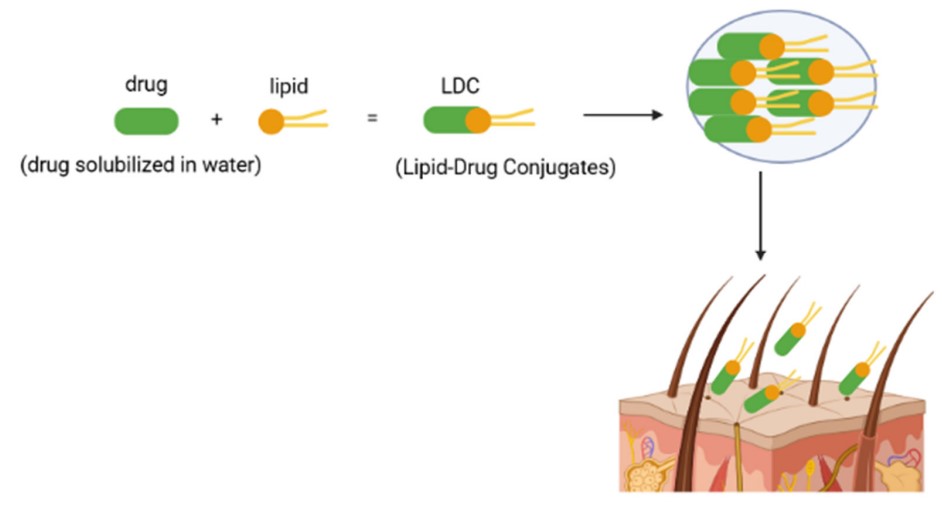 Fig.1 Schematic diagram of the mechanism of action of lipid-drug conjugates for skin delivery.1
-
Advanced Drug Delivery
Lipid conjugation is a key strategy for overcoming the poor water solubility and low bioavailability that hinder many small molecule drugs. Formulating these conjugates into nanocarriers like liposomes or micelles improves their physicochemical properties, leading to enhanced absorption and extended circulation half-life for greater accumulation in target tissues such as tumors. Crucially, covalent lipid conjugation secures a higher drug payload and prevents the premature leakage of polar drugs, offering a distinct advantage over simple encapsulation. -
Targeted Therapeutics and Gene Therapy
Lipid nanoparticles (LNPs) have become the leading platform for delivering nucleic acid-based therapies, including siRNA and mRNA vaccines. By conjugating lipids to targeting ligands (e.g., antibodies or peptides), these LNPs can be directed to specific cells or tissues, increasing therapeutic efficacy while minimizing off-target effects and systemic toxicity. -
High-Resolution Cellular Imaging
Conjugating lipids to fluorescent dyes creates powerful molecular probes for studying cellular biology. These lipid-dye conjugates can be integrated into cell membranes to visualize lipid rafts, track membrane dynamics, or act as sensors that report on local environmental changes, such as pH. These tools provide invaluable insights into the mechanisms of health and disease.
Our Services: Tailored Lipid Conjugation Solutions
Creative Biolabs provides comprehensive, custom lipid conjugation services designed to meet your precise specifications. We have the deep expertise and technological capacity to conjugate lipids to a wide array of molecules.
| Target Molecule Class | Description & Common Applications |
|---|---|
| Proteins & Peptides | Conjugation to enhance stability, facilitate membrane translocation, or create targeted delivery vehicles. Ideal for developing novel biotherapeutics and vaccines. |
| Oligonucleotides | Conjugation to increase delivery efficiency and targeting. Essential for the formulation of lipid nanoparticles (LNPs) for siRNA, ASO, and mRNA delivery. We provide conjugation to support gene therapy and vaccine development. |
| Small Molecules | Overcome challenges of poor solubility and pharmacokinetics. We create lipid-drug conjugates and prodrugs to improve efficacy and reduce toxicity for oncology and other fields. |
| Fluorescent Molecules | Design and synthesis of custom fluorescent lipid probes (e.g., using FITC, Rhodamine, Cy-dyes) for advanced cellular imaging, flow cytometry, and diagnostic assays. |
Workflow
We believe in a transparent and collaborative process, ensuring your project's objectives are met at every stage.

Consultation and Design: Our PhD-level scientists work directly with you to understand your goals and design the optimal conjugation strategy, selecting the ideal lipid, linker, and chemistry.
Synthesis and Purification: We perform the custom synthesis and conjugation using state-of-the-art equipment. The resulting conjugate is meticulously purified using advanced techniques like High-Performance Liquid Chromatography (HPLC) to ensure exceptional purity.

Characterization and Validation: We provide rigorous quality control and validation. The structure, purity, and conjugation efficiency are confirmed using sophisticated analytical methods, including Mass Spectrometry (MS), Nuclear Magnetic Resonance (NMR) spectroscopy, etc.

Final Report and Delivery: You receive the high-purity conjugate along with a comprehensive report detailing all characterization data, ready for your downstream applications.
Advantages: The Creative Biolabs Difference
- World-Class Expertise: Our team possesses deep scientific knowledge and an unwavering focus on quality, with a proven track record of solving complex bioconjugation challenges using innovative and robust solutions.
- Cutting-Edge Technology: We invest in state-of-the-art instrumentation that enables us to develop, optimize, and validate methods for even the most complex and novel lipid conjugates.
- Personalized Service Model: We recognize that every project is unique. We offer a deeply personalized and collaborative service, tailoring conjugation strategies and timelines to your specific research needs.
By harnessing the power of lipid chemistry, you can unlock new possibilities in drug delivery, diagnostics, and biological research. At Creative Biolabs, we provide the specialized expertise and end-to-end service required to create the high-performing, custom lipid conjugates your project demands. Contact us today to discuss your project with one of our conjugation experts and learn how we can help you achieve your scientific goals.
Reference
- Zielińska, Aleksandra et al. "Lipid-Drug Conjugates and Nanoparticles for the Cutaneous Delivery of Cannabidiol." International journal of molecular sciences vol. 23,11 6165. 31 May. 2022, doi:10.3390/ijms23116165. Under open access license CC BY 4.0, without modification.