
Custom Nanoparticle-Lectin Conjugation Service
Creative Biolabs is ready to be your trusted partner, providing the necessary expertise, technology platform, and rigorous quality control to transform complex scientific hypotheses into functional, high-performance conjugates.
What are Nanoparticles?
In the field of nanobiotechnology, nanoparticles (NPs) refer to colloidal particles typically ranging in size from 1 to 100 nanometers. Their practicality stems from their high specific surface area and size-dependent tunable physical properties.
Different materials offer different advantages:
 Gold Nanoparticles (AuNPs)
Favored for their superior plasmonic properties, they can be applied to colorimetric analysis, photothermal therapy, and surface-enhanced Raman spectroscopy (SERS). Their surfaces readily undergo thiol-gold chemical reactions, enabling stable coupling.
Quantum Dots (QDs)
Semiconductor nanocrystals with size-tunable fluorescence and high photostability, making them superior to traditional fluorescent dyes in long-term bioimaging and multiplexing.
Magnetic Nanoparticle
Manipulated by external magnetic fields, they can be used for targeted drug delivery, magnetothermal cancer treatment, and as contrast agents in magnetic resonance imaging (MRI).
Polymer Nanoparticles
Possessing excellent biocompatibility and biodegradability, they are ideal carriers for controlled drug release. Its surface chemistry is easily modified and can be used to covalently link biomolecules.
What is Lectin?
Lectins are a diverse class of proteins with the unique ability to specifically bind to carbohydrate molecules without altering their structure. This property underpins their crucial roles in various biological processes, including those in plants, animals, and microorganisms, highlighting their widespread presence and importance in nature.
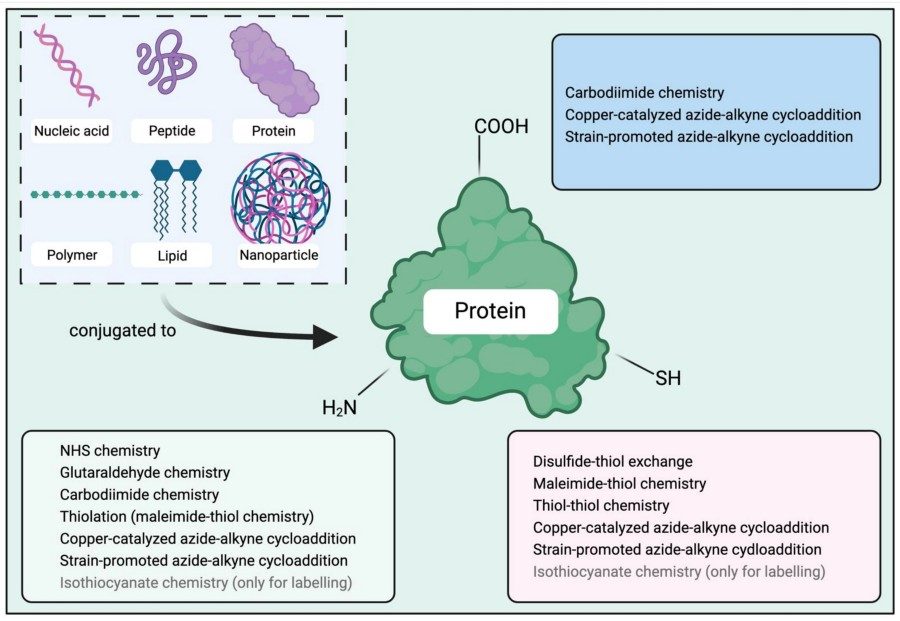 Figure 1. Conjugation strategies targeting different functional groups of proteins. Compounds, such as nucleic acids, peptides, proteins, polymers, lipids, and nanoparticles, can be conjugated to proteins via methods that target the amine, thiol, or carboxyl groups of proteins. NHS, N-hydroxysuccinimide.1
Furthermore, lectins are essential in numerous biochemical and medical applications. In cell biology, they promote cell aggregation by binding to specific carbohydrates on the cell surface and play a vital role in blood typing. In immunology, lectins influence immune responses by activating or inhibiting immune pathways. They are also crucial in diagnostic analysis for pathogen detection and are an integral part of targeted drug delivery systems, guiding therapeutic drugs to specific cells based on unique carbohydrate patterns.
Nanoparticle-Lectin Conjugation Application

Targeted Drug Delivery
Lectin-conjugated gold nanoparticles can deliver chemotherapy drugs directly to cancer cells, reducing systemic side effects and improving treatment precision.

Photothermal Therapy
Utilizing their photothermal properties, these nanoparticles can selectively heat and eliminate cancer cells under specific wavelengths of light, enabling precise therapeutic intervention.

Enhanced Imaging
Gold nanoparticles can enhance the imaging contrast of techniques such as computed tomography (CT) and magnetic resonance imaging (MRI). When bound to lectins, they can precisely target imaging agents to tumor sites, improving diagnostic accuracy.

Early Detection
The specificity of lectin binding facilitates the early detection of cancer cells and other diseased cells, enabling timely diagnosis and treatment.

Biosensing
Lectin-conjugated gold nanoparticles can serve as highly sensitive biosensors, detecting pathogens, glycoproteins, or biomarkers with extremely high specificity. This characteristic enhances their application value in clinical diagnostics and environmental monitoring.
Types of Nanoparticle-Lectin Conjugates
The following table catalogues the primary conjugate systems we engineer at Creative Biolabs, highlighting their core components and principal applications.
| Nanoparticle Core | Conjugated Lectin | Target Glycan | Primary Applications |
|---|---|---|---|
| Gold Nanoparticle (AuNP) | Wheat Germ Agglutinin (WGA) | N-Acetylglucosamine, Sialic Acid | Colorimetric Biosensing, Photothermal Therapy, SERS Imaging |
| Quantum Dot (QD) | Concanavalin A (ConA) | α-D-Mannose, α-D-Glucose | Long-term Cell Tracking, Multiplexed Glycan Profiling |
| Superparamagnetic Iron Oxide Nanoparticle (SPION) | Ulex Europaeus Agglutinin I (UEA-I) | L-Fucose | MRI Contrast Agent, Magnetic Separation of Cell Populations |
| Polymeric (PLGA) Nanoparticle | Peanut Agglutinin (PNA) | T-antigen (Gal-β(1-3)-GalNAc) | Targeted Chemotherapy, Controlled Drug Release |
| Mesoporous Silica Nanoparticle (MSN) | Lentil Lectin (LcH) | α-D-Mannose, Fucose | Stimuli-Responsive Drug Delivery, Intracellular Protein Delivery |
Conjugation Methods
The coupling method is crucial as it determines the stability, orientation, and bioactivity of the final construct. Our scientists employ a range of chemical approaches to ensure optimal performance.
Covalent Conjugation
- EDC/NHS Chemistry: The gold standard method for coupling lectin amine groups to nanoparticle carboxyl groups. We optimize reaction pH and stoichiometry to maximize yield and minimize lectin denaturation.
- Click Chemistry (e.g., azido-alkynyl cycloaddition reactions): Bioorthogonal, efficient, and specific. We can prefunctionalize nanoparticles and lectins separately with azido and alkynyl groups, enabling clean and controlled reactions even in complex environments.
- Maleimide-Thiol Chemistry: An ideal method for coupling with cysteine residues in lectins. This method offers excellent site specificity and stable thioether bonds, preserving the integrity of the carbohydrate-binding domain.
Non-Covalent Conjugation
- Avidin-Biotin Interaction: One of the strongest non-covalent bonds in nature (Kd ≈ 10⁻¹⁵ M). We can construct biotinylated nanoparticles and streptavidin-labeled lectins (and vice versa), enabling flexible and high-affinity complex formation. This is particularly important for the development of detection methods and modular systems.
- Electrostatic Adsorption: A simpler method where positively charged lectins (under neutral pH conditions) adsorb onto negatively charged nanoparticles. While simple to operate, the process still requires strict control to prevent aggregation and ensure consistent loading.
What Creative Biolabs Offers?
Creative Biolabs offers fully integrated, customized nanoparticle-lectin conjugation services that go beyond catalog products, providing tailored solutions for complex research and preclinical needs.
Custom Nanoparticle Synthesis
Fabrication of custom nanoparticles (gold, iron oxide, polymers, liposomes) with precise size control (PDI < 5%), specific surface chemistry, and encapsulation of customer payloads (drugs, nucleic acids, imaging agents).
Proprietary Lectin Sources and Modification
Possessing a rich, highly purified library of natural and recombinant lectins. We focus on site-selective modification of lectins to ensure 100% retention of the carbohydrate recognition domain (CRD).
Synthesis Process of Nanoparticle-Lectin Conjugates
Our synthesis is a meticulously controlled, multi-step process, strictly adhering to quality control (QC) procedures.
01 Synthesis and Functionalization of Nanoparticles
We synthesize or source high-purity nanoparticles with controllable size, shape, and dispersibility. The nanoparticle surface is then functionalized with specific reactive groups (e.g., -COOH, -NH₂, -maleimide) according to the chosen coupling chemistry.
Common methods include:
- Citrate reduction: Citrate ions act as both reducing agents and stabilizers, and are widely used in the preparation of monodisperse nanoparticles.
- Sodium borohydride reduction: This method provides controllable conditions, enabling precise control over the size and shape of nanoparticles, and is suitable for specific applications.
02 Preparation and Modification of Lectin
We obtain high-purity lectins and, where necessary, perform site-specific modifications (e.g., introducing unique cysteine residues, biotinylation) to achieve controllable orientation after coupling.
03 Conjugation Reaction
Activated nanoparticles and prepared lectins are mixed at optimal molar ratios, pH values, and temperatures. The reaction process is monitored in real time to prevent over-coupling and aggregation.
04 Purification and Characterization
After coupling, the nanoparticles are purified using techniques such as centrifugation, dialysis, or filtration to remove unbound lectins and reactants. Characterization methods included:
(a) Transmission electron microscopy (TEM): providing detailed images of the nanoparticle morphology and size distribution.
(b) Dynamic light scattering (DLS): measuring hydrodynamic dimensions and suspension stability.
(c) Ultraviolet-Vis spectroscopy: confirming the presence of gold nanoparticles and evaluating optical properties affected by surface plasmon resonance (SPR).
These steps ensured the preparation of stable, functionalized nanoparticle-lectin conjugates, crucial for biomedical applications such as targeted drug delivery, diagnostics, and cancer therapy.
Advantages of Choosing Creative Biolabs
Exceptional Knowledge Base
Our team possesses profound expertise and vast experience in nanoparticle conjugation, guaranteeing excellent service and outstanding outcomes.
Rigorous Quality Assurance
We employ comprehensive quality control measures to provide reliable and consistent products, perfectly aligned with your research requirements.
Cutting-Edge Solutions
We utilize the most recent breakthroughs in nanoparticle technology to deliver innovative and efficient solutions for your projects.
Unmatched Customer Care
Our committed team offers personalized support and exceptional service, catering to the unique needs of each client.
Frequently Asked Questions
Q: What is the lowest lectin loading density you can achieve?
A: Lectin loading density is highly dependent on the size of the nanoparticles and the lectin. We guarantee a specific loading range determined in the initial design phase and validated by quantitative protein analysis.
Q: Can you couple multiple different lectins to a single nanoparticle?
A: Yes. We can use multi-step or orthogonal coupling chemistry to achieve multi-ligand (divalent or trivalent) targeting on a single nanoparticle, thereby enhancing targeting affinity.
Q: How do you ensure the correct orientation of the lectin for binding?
A: We preferentially use site-specific modification techniques (N-terminus, C-terminus, or engineered cysteine residues) to keep the linkage site away from the CRD domain, thereby minimizing steric hindrance and maximizing the guarantee of correct orientation.
Q: What is the typical achievable lectin density on nanoparticles?
A: Lectin density is highly customizable, depending on the nanoparticle size, surface area, and coupling method. We typically achieve densities of 10 to 100 lectins per 50 nm nanoparticle, optimized to balance targeting efficiency and colloidal stability.
Conclusion
The strategic alliance between nanoparticles and lectins is opening new frontiers in the biomedical field, enabling us to diagnose, treat, and understand diseases with unprecedented precision. At Creative Biolabs, we are not just a supplier, but a scientific partner dedicated to translating your innovative ideas into actionable, high-performance nanobiomaterials. Our custom nanoparticle-lectin conjugation services provide the necessary expertise, technology, and quality assurance to help you push the boundaries of research and development. Don't hesitate to contact us!
Reference
- Lu L, Duong V T, Shalash A O, et al. Chemical conjugation strategies for the development of protein-based subunit nanovaccines. Vaccines, 2021, 9(6): 563. https://doi.org/10.3390/vaccines9060563 Distributed under Open Access license CC BY 4.0, without modification.