
Custom Nanoparticle-Antibody Conjugation Service
At Creative Biolabs, we recognize that the combination of nanotechnology and advanced molecular biology is driving the next wave of biomedical innovation. These gold nanoparticle (AuNP)-labeled antibodies are one of the most useful reagents we can give you, with unmatched sensitivity and flexibility for diagnostics, therapeutics, and research basics. Creative Biolabs offers gold nanoparticle-labeled antibodies based on its advanced integrated platform. These antibodies can be monoclonal, polyclonal, specific, or targeted.
Gold Nanoparticles Labeled Antibody Introduction
Gold nanoparticle-labeled antibodies, often called AuNP-antibody conjugates, are bifunctional structures made by covalently or non-covalently coupling monoclonal or polyclonal antibodies to the surface of gold nanoparticles. Gold nanoparticles are spherical nanostructures that are very stable and range in diameter from 1 nm to 150 nm. Gold nanoparticles are widely employed due to their distinctive optical and electronic properties. The most obvious property is the surface plasmon resonance (SPR) phenomenon (collective electron oscillation upon photoexcitation) of the conduction electrons which causes strong absorption and scattering of visible light, hence they appear ruby in solution. By functionalizing these nanoparticles with highly specific antibodies, we create molecular probes capable of precisely targeting antigens in complex biological systems. This synergistic effect combines the superior specificity of immunology with the exceptional signal-generating capabilities of nanotechnology.
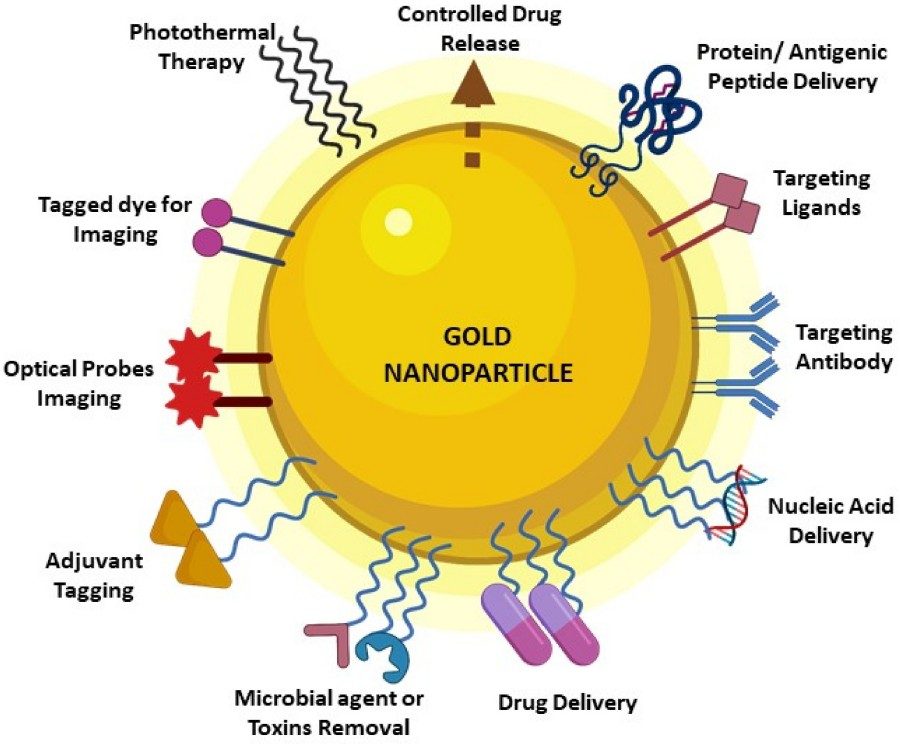 Figure 1. Schematic representation of the gold nanoparticle and its possible uses in the biomedical field.1
Advantages of Gold Nanoparticle Conjugated Antibody
✅These labels are highly stable even under harsh buffer conditions.
✅The stable and reproducible labels provide reliable analyte quantification.
✅The simple and consistent label preparation method saves time in antibody screening experiments.
✅The antibody-to-gold nanoparticle ratio can be precisely controlled, which is crucial for optimizing sensitivity when using antibodies with varying binding kinetics.
Characterization and Quality Control of Gold Nanoparticles to Antibodies Conjugates
Spectroscopic Analysis (UV-Vis Spectroscopy)
Measure SPR band peaks. Successful conjugation and stabilization typically result in a red-shift in the wavelength of maximum absorption, providing initial evidence of successful surface modification and coating.
Dynamic Light Scattering (DLS)
Used to determine the hydrodynamic diameter and polydispersity index (PDI). An increase in size and a low PDI after conjugation indicate a stable, monodisperse product.
Zeta Potential Measurement
Monitor surface charge. A significant change in zeta potential after binding confirms protein binding and assesses colloidal stability.
Transmission Electron Microscopy (TEM)
Provides visual confirmation of size, shape, and particle distribution, confirming the integrity of the nanoparticle core.
Functional Activity Assays (ELISA/Western Blot)
The ultimate measure of success, ensuring that the immobilized antibody retains its full antigen-binding affinity and specificity after conjugation.
Principles of Bioconjugation: Linking Gold Nanoparticles to Antibodies
The creation of high-performance gold nanoparticle-antibody conjugates relies on fundamental principles of bioconjugation chemistry, which dictate the orientation, stability, and ultimate functionality of the resulting complex. Conjugation can be achieved through two primary mechanisms: passive adsorption and covalent conjugation.
Table 1. Comparison of Gold Nanoparticle-Antibody Conjugation Methods
| Conjugation Method | Mechanism | Advantages | Limitations |
|---|---|---|---|
| Passive Adsorption | Non-specific physical adsorption to citrate-capped AuNPs | Simple procedure, no chemical modification required | Random antibody orientation, potential loss of activity, stability issues |
| Covalent Conjugation | Site-specific coupling through functional groups (e.g., carboxyl, amine) | Controlled orientation, enhanced stability, reproducible performance | Requires surface functionalization, more complex optimization |
| Bioorthogonal Click Chemistry | Strain-promoted azide-alkyne cycloaddition or other click reactions | High specificity, minimal interference with antibody function | Requires engineering of reactive groups into antibodies |
Core Services at Creative Biolabs
Custom Antibody Gold Conjugation: Customer-supplied antibodies (monoclonal, polyclonal, or fragments) are conjugated to gold nanoparticles of various sizes (5 nm to 100 nm) using passive and advanced covalent methods.
Site-Specific and Directed Conjugation: Utilizing proprietary chemistries to maximize functional activity and minimize batch-to-batch variability.
Custom Antibody Gold Conjugation
Customer-supplied antibodies (monoclonal, polyclonal, or fragments) are conjugated to gold nanoparticles of various sizes (5 nm to 100 nm) using passive and advanced covalent methods.
Site-Specific and Directed Conjugation
Utilizing proprietary chemistries to maximize functional activity and minimize batch-to-batch variability.
Labeling Functionality Test
The quality of gold nanoparticle-labeled antibodies can be initially assessed simply by observing the solution color after each step. Gold nanoparticles have a distinctive visible color that changes as the particles aggregate, so simply monitoring the solution color provides a good initial assessment of labeling success. Additionally, a functional test of the labeled antibody can be performed to determine labeling efficiency.
Optimization of Antibody Labeling
Many steps in the conjugation protocol can be adjusted and optimized based on the specific antibody and detection application. When starting any new conjugation or assay, it is important to examine various relevant parameters to optimize the performance of the antibody-gold nanoparticle conjugate.
Advanced Bioconjugation Strategies for Enhanced Performance
To overcome the limitations of passive adsorption and achieve superior control over orientation and loading, Creative Biolabs utilizes advanced site-specific conjugation technologies:
Site-specific Thiolation and Maleimide Conjugation
By genetically engineering or chemically modifying antibodies to introduce a single free thiol group in non-antigen-binding regions (such as the Fc fragment), we ensure uniform antibody orientation and fully active antigen-binding Fab domains. The thiol then reacts with the maleimide-activated polymer coating on the AuNPs to form a highly stable, oriented conjugate.
Polyethylene Glycol (PEG) Spacer
Introducing a PEGylation layer before or after conjugation is a key strategy. PEG acts as a steric stabilizer, minimizing nonspecific protein adsorption and aggregation, thereby significantly improving colloidal stability and the half-life of the conjugate in complex biological media. This is particularly important for in vivo applications.
Polymer-mediated Conjugation
Utilizing an intermediate polymer shell (e.g., poly(L-lysine) or poly(vinylpyrrolidone)) coated on the AuNPs can increase loading capacity, provide better control over surface chemistry, and protect the AuNP core. Antibodies are then attached to functional groups on the polymer.
Why Choose Us?
Creative Biolabs is a global leader in bioconjugation, distinguished by:
 Unparalleled Expertise
We have a team of PhD-level bioconjugation experts with extensive experience in nanoparticle surface chemistry and protein engineering.
Stringent Quality Control
Our multi-step quality control process ensures conjugates of high purity, optimal stoichiometry, and verifiable bioactivity, accelerating your R&D timelines.
Customization
We tailor our bioconjugation strategy (e.g., linker length, surface chemistry, stabilizers) to your specific application needs, whether it's a highly sensitive lateral flow assay or an in vivo imaging probe.
Application-Focused Solutions
We recognize that different applications have distinct requirements, and we tailor our conjugation strategies accordingly.
Customer Review

"To develop a rapid diagnostic test for clonorchiasis, we evaluated both homemade and commercially available gold nanoparticle-antibody conjugates. Creative Biolabs' covalently conjugated AuNP-TEG-NH-mAb complex significantly outperformed our standard conjugate, demonstrating a lower limit of detection (1.54 ng/mL) and reduced cross-reactivity. The conjugate demonstrated excellent stability under tropical field conditions, maintaining its performance throughout its shelf life."
— Dr. Samantha Chen, Diagnostic Development Division
Frequently Asked Questions
Q: How do we ensure that the antibody remains functional after conjugation?
A: We use site-specific conjugation methods (e.g., modification of the non-binding Fc region) to ensure that the antigen-binding Fab domain is not sterically hindered or chemically altered. Additionally, each batch undergoes mandatory functional activity testing (e.g., capture ELISA or Western blot) to confirm that the conjugated antibody retains its full binding affinity and specificity for the target antigen.
Q: What is the main difference between passive adsorption and covalent conjugation of gold nanoparticles?
A: Passive adsorption is simpler and faster, relying on non-covalent electrostatic forces, but can result in random antibody orientation and potential denaturation. Covalent conjugation forms a permanent, chemically stable bond with improved long-term stability. It allows for precise control of the antibody to gold nanoparticle ratio (stoichiometry) and the ability to control directional attachment, significantly improving functional sensitivity. Creative Biolabs recommends covalent methods for critical applications.
Q: What factors should be considered when selecting the gold nanoparticle size for antibody conjugation?
A: The nanoparticle size should be matched to your specific application requirements. Smaller nanoparticles (1.4-16 nm) offer better tissue penetration and higher labeling density, making them ideal for electron microscopy and immunohistochemistry. Intermediate-sized particles (20-40 nm) provide a balanced approach for many immunoassay applications, while larger particles (60-80 nm) deliver a stronger signal in lateral flow assays and other visual detection platforms. Our technical team can guide you in selecting the optimal size based on your assay, sensitivity requirements, and sample characteristics.
Q: Which applications would benefit most from gold nanoparticle-labeled antibodies?
A: These conjugates are particularly well-suited for: 1) diagnostic lateral flow assays, where their strong visual signal enables rapid, instrument-free detection; 2) electron microscopy, where their high electron density provides excellent contrast without the need for additional staining; 3) biosensing platforms, where their plasmonic properties enable sensitive detection; 4) multiplexed detection systems utilizing size-encoded nanoparticles; and 5) western blotting, where silver enhancement can significantly improve detection sensitivity.
Conclusion
Creative Biolabs has unparalleled expertise across the entire lifecycle of AuNP-Ab development, from custom AuNP synthesis with controlled aspect ratios to implementing advanced site-specific conjugation strategies (enzymatic and bioorthogonal) to maximize antibody activity retention. Please contact us to discuss your demands or to request a proposal.
Reference
- Sengupta A, Azharuddin M, Al-Otaibi N, et al. Efficacy and immune response elicited by gold nanoparticle-based nanovaccines against infectious diseases. Vaccines, 2022, 10(4): 505. https://doi.org/10.3390/vaccines10040505 (Distributed under Open Access license CC BY 4.0, without modification.)