
Custom Nanoparticle-Streptavidin Conjugation Service
At Creative Biolabs, we perfect the art and science of custom nanoparticle-streptavidin conjugation, providing researchers with a powerful and precise toolkit to accelerate diagnostics, therapeutics, and fundamental biological discoveries.
Nanoparticle-Streptavidin Conjugation Introduction
The fusion of inorganic or polymeric nanoparticles with biomolecules has given rise to a class of powerful hybrid materials called bioconjugates. Among them, streptavidin-nanoparticle conjugates stand out due to their role as a versatile and high-affinity adapter. Streptavidin is a 52.8 kDa tetrameric protein derived from Streptomyces avidinii, possessing four identical biotin (vitamin B7, vitamin H) binding sites. The biotin-streptavidin non-covalent bond is one of the strongest bonds in nature, characterized by an extremely low dissociation constant (Kd ~ 10⁻¹⁵ mol/L), rapid binding kinetics, and excellent stability under harsh conditions such as pH, temperature, and denaturants.
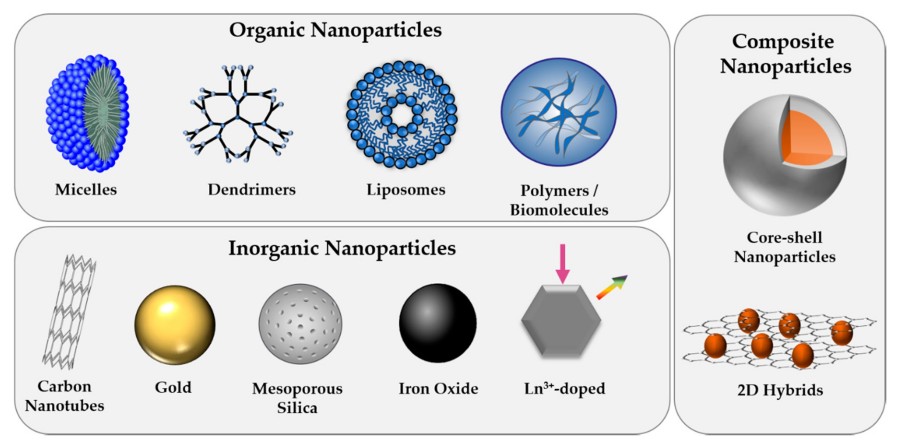 Figure 1. Overview of commonly used nanoparticle (NP) types, classified as organic, inorganic, or composite structures.1
Streptavidin Conjugated Gold Nanoparticles
Streptavidin-coated gold nanoparticles (AuNPs) can bind to biotinylated proteins or oligonucleotides. This is due to the interaction between streptavidin and biotin, an interaction characterized by extremely high sensitivity, specificity, stability, and versatility. A single streptavidin molecule can bind multiple biotin molecules; therefore, when streptavidin-modified gold nanoparticles are coupled with a biotinylated protein amplification system, trace amounts of proteins and oligonucleotides can be effectively detected.
Optical Properties
Gold nanoparticles (AuNPs) exhibit a phenomenon called localized surface plasmon resonance (LSPR). A strong absorption band is observed when the incident light frequency matches the collective oscillation frequency of the conducting electrons. For AuNPs with a size of approximately 20 nm, this absorption band appears as a bright ruby-red.
Surface Functionalization
The gold surface exhibits a high affinity for thiol groups through strong Au-S bonds (~44 kcal/mol). This makes it possible to construct stable self-assembled monolayers (SAMs) using alkathiol ligands.
Application of Streptavidin Conjugated Nanoparticles
Lateral Flow Immunoassay (LFIA)
Biotinylated capture antibodies and detection line antibodies are immobilized on a nitrocellulose membrane. As the sample flows, if the target antigen is present, a complex forms and is captured on the detection line, concentrating red SA-AuNPs for visualization.
Transmission Electron Microscopy (TEM) Immunolabeling
In ultrastructural analysis, biotinylated primary antibodies bind to specific cellular antigens. SA-AuNPs subsequently bind to these antibodies, providing high electron density labeling, allowing for precise location of the antigen with nanoscale accuracy under TEM.
Surface Plasmon Resonance (SPR) and LSPR Biosensing
Sensor chips coated with biotinylated capture molecules (e.g., antibodies or DNA probes) can efficiently capture SA-AuNPs after analyte binding.
Targeted Drug Delivery
Gold nanospheres or nanoshells can be conjugated to streptavidin and loaded with biotinylated chemotherapeutic drugs (e.g., doxorubicin) and biotinylated targeting ligands (e.g., anti-EGFR antibody fragments).
What Creative Biolabs Offers?
At Creative Biolabs, we offer more than just simple reagent supply. We are your strategic partner in the field of nanobioconjugation. Our services are fully customizable:
Nanoparticle Cores: Gold nanoparticles (various shapes: spherical, rod-shaped, shell-shaped), magnetic nanoparticles (Fe₃O₄), quantum dots (CdSe/ZnS), polymer nanoparticles (PLGA, polystyrene), and silica nanoparticles.
✅Streptavidin Variants: Recombinant streptavidin and mutant streptavidin with customized binding kinetics.
✅Surface Chemistry: Thiols, NHS esters, maleimides, click chemistry (DBCO, azides), and phospholipid-PEG modifications for liposome conjugation.
✅Co-conjugation: We can co-conjugate streptavidin with other functional molecules (such as fluorescent dyes, radioisotopes, or other targeted ligands) to create multifunctional nanoplatforms.
Design of Nanoparticle-Streptavidin Conjugates
In addition to streptavidin, Creative Biolabs offers other types of affinity conjugates, such as avidin or neutral avidin, with different properties and affinities, which can be selected according to experimental objectives and conditions. Furthermore, through proper sequence design and mutation, the sequence of the affinity conjugate can be optimized, thereby enhancing its binding affinity to the receptor and reducing non-specific binding.
Additionally, to facilitate detection and labeling, labeling sites, such as fusion tags (e.g., His tags or GST tags) or fluorescent tags (e.g., GFP or RFP), can be introduced into the sequence of the affinity conjugate.
Modification of Gold Nanoparticles
The surface of gold nanoparticles can be modified by introducing functional groups or modifying molecules. Common functional groups include thiol (-SH), amino (-NH₂), and carboxyl (-COOH). Modification methods include forming gold-sulfur bonds between thiol groups and gold atoms on the gold nanoparticle surface, or using cross-linking agents (such as EDC/NHS) to perform coupling reactions between amino and carboxyl groups. In addition, certain proteins or peptides can be adsorbed onto the surface of gold nanoparticles through electrostatic or hydrophobic interactions. We went beyond simple citrate stabilization to construct a robust functional interface.
Ligand Exchange
✅We replaced the citrate ions on the surface of the synthesized AuNPs with our chosen isobifunctional thiolation linker, most commonly HS-PEG-COOH.
Activation and Coupling
✅In the presence of NHS (N-hydroxysuccinimide), the carboxyl groups were activated using carbodiimide chemistry (e.g., EDC: 1-ethyl-3-(3-dimethylaminopropyl)carbodiimide) to form a stable NHS ester intermediate.
Synthesis of Gold Nanoparticles Labeled Streptavidin
Our synthesis protocol is a rigorously characterized multi-step process:
- Gold Nanoparticle Synthesis and Characterization: We synthesize gold nanoparticles of specific sizes (5-100 nm) using the citrate reduction method (Turkevich method) or larger gold nanoparticles using seed-mediated growth.
- Controlled PEGylation: Under optimized pH, ionic strength, and temperature conditions, gold nanoparticles undergo ligand exchange with HS-PEG-COOH to achieve maximum packing density without aggregation.
- Purification: Excess linker and byproducts are removed through repeated centrifugation and buffer exchange, combined with tangential flow filtration (TFF) or size exclusion chromatography.
- Streptavidin Coupling: Activated PEGylated gold nanoparticles are reacted with precisely stoichiometric high-purity recombinant streptavidin. The pH and buffer composition are strictly controlled to promote amine coupling and maintain protein activity.
- Quenching and Final Purification: After coupling, residual active esters are quenched with a small-molecule amine (e.g., ethanolamine). Finally, SA-AuNPs were purified to remove unreacted streptavidin.
Our Strengths
✅Proprietary Conjugation Solution: Optimizes streptavidin activity and nanoparticle stability.
✅Rigorous Quality Control: Guarantees performance for every batch, ensuring reproducibility of your most critical experiments.
✅Scalability: Meets your needs from milligram-level research doses to gram-level preclinical and diagnostic development doses.
✅Scientific Expertise: Direct access to a team of PhDs in bioconjugation chemistry and nanomaterials science.
Customer Review

"In developing a virus detection platform based on lateral flow immunoassay (LFA), we discovered significant batch-to-batch variations in commercially available standard streptavidin-gold nanoparticle conjugates, leading to unstable detection sensitivity. The Creative Biolabs team successfully prepared a 40nm AuNP-SA conjugate with extremely high functional activity using their custom EDC/NHS conjugation method and rigorous HABA activity testing. Their doctoral-level expertise solved the batch consistency problem that we couldn't overcome internally."
— Dr. Elara Chen, CEO
"Our project required a nanocarrier capable of precisely loading multiple biotinylated ligands, including targeting peptides and siRNA. Creative Biolabs not only successfully conjugated streptavidin to our custom polymer nanoparticles but also ensured the required number of streptavidin molecules per nanoparticle was achieved by precisely controlling the conjugation density—5 ± 1. This precise control over the conjugation stoichiometry allowed us to optimize the drug-ligand ratio and achieve unprecedented targeting efficiency in in vivo studies."
— Professor Ben Carter, Director
Frequently Asked Questions
Q: What is the typical shelf life of your custom-made streptavidin nanoparticles?
A: When stored correctly at 4°C in a preservative-containing buffer (azide-free buffer available upon request), our conjugates are stable for at least 12 months. We do not recommend freezing, as it can compromise colloidal stability.
Q: Can you conjugate streptavidin to my pre-synthesized proprietary nanoparticles?
A: Absolutely. We would love to work with you using your unique nanomaterials. We will first conduct a feasibility study to characterize your particles and develop the optimal conjugation strategy.
Q: How do you determine the number of streptavidin molecules on each nanoparticle?
A: We use a combination of methods, including spectrophotometric quantification of protein and nanoparticle concentrations, and functional titration using biotin derivatives to determine the number of active binding sites.
Q: How does your service differ from commercially available "off-the-shelf" streptavidin nanoparticles?
A: Off-the-shelf products are generic. Our customization service allows you to specify dimensions, surface chemistry, streptavidin density, and conjugates to obtain reagents tailored specifically for your application, which typically results in superior performance and reduces optimization hassles.
Conslusion
The strategic integration of streptavidin with functional nanoparticles is creating a powerful and versatile platform that is revolutionizing biomedical research and technology development. However, the full potential of these nanobioconjugates can only be realized through precise, reproducible, and scientifically sound preparation methods. At Creative Biolabs, we offer more than just products; we provide partnerships based on deep expertise in bioconjugation chemistry and nanotechnology. Don't hesitate to contact us!
Reference
- Gessner I, Neundorf I. Nanoparticles modified with cell-penetrating peptides: Conjugation mechanisms, physicochemical properties, and application in cancer diagnosis and therapy. International journal of molecular sciences, 2020, 21(7): 2536. https://doi.org/10.3390/ijms21072536 Distributed under Open Access license CC BY 4.0, without modification.